Righting the Ship, a short summary of the VA’s failures, and its attempts to fix its issues.

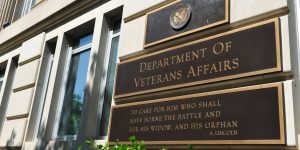
This May 19, 2014 photo shows a a sign in front of the Veterans Affairs building in Washington, DC. The VA and Secretary Eric Shinseki are under fire amid reports by former and current VA employees that up to 40 patients may have died because of delayed treatment at an agency hospital in Phoenix, Arizona. AFP PHOTO / Karen BLEIER (Photo credit should read KAREN BLEIER/AFP/Getty Images)

Written by M-VETS Student-Advisors Mike West and Fernando Cota-Wertz

“To care for him who shall have borne the battle and for his widow, and his orphan.” That is the official motto of the U.S. Department of Veteran’s Affairs.[1] The Department of Veterans Affairs, or the VA for short, is the Federal Department tasked with taking care of our Nation’s Veterans and their families. Yet, recent studies have found that “more than a half million veterans in the United States are homeless at some time, and on any given night more than 300,000 are living on the streets or in shelters.”[2]  “Although lack of education and limited transferable skills from military to civilian life are significant causes of these problems, physical and mental health problems (and lack of care for those problems) are also factors.”[3]  With physical and mental health problems weighing in as two major factors causing significant struggles for veterans and servicemembers to adapt to civilian life, the lack of care for these problems needs to be addressed.

The Military Times, in an article published on June 3, 2016, reported that in the past five months about 505,000 veterans were still waiting more than a month to see a doctor.[4] The problem is even worse for Veterans seeking mental health treatment. The American Physiological Association estimates that of the 1.7 million veterans that served in Iraq and Afghanistan, 300,000 suffer from Post Traumatic Stress Disorder or major depression.[5] It is also estimated that over twenty veterans commit suicide every day.[6]

In order to combat this epidemic, the VA has aggressively undertaken new measures to combat suicide among Veterans. VA facilities now have same-day access for veterans who suffer from mental health issues.[7] Additionally, the VA has hired 5,300 new mental health providers since 2010 and it is launching new community initiatives to try to get counseling to the Veterans in need.[8] The VA is also developing and utilizing preventive modeling systems so it can identify high-risk veterans in order to intervene as early as possible.[9] VA officials are hopeful that this new preventive research will give them a better idea of where to focus their efforts.[10]

In additions to its efforts to help Veterans in need of mental health treatment, the Federal Government has also put into place other programs to help combat the “backlog” at the VA. One of these programs is the Veterans Choice Program (VCP). The VCP tries to circumvent the long wait times by allowing veterans to see a private physician if they are not able to get an appointment at a VA in fewer than 30 days.[11] “For Veterans who have faced unacceptable waiting times for needed medical care, or for whom a regular VA medical facility is inaccessible, the Veteran Choice Program makes it possible for them to receive the needed care from a non-VA health care provider in their community.”[12]  In order to use the VCP, veterans must enroll in the program.[13]  After enrolling, veterans will receive a Veterans Choice Card and receive a letter detailing information about their eligibility.[14]

So far, it seems that the VCP has not done much to alleviate the problem of wait times. It has been reported that the VCP has had little impact on getting veterans to see a primary care physician within 30 days.[15]  Veterans are facing problems such as being referred to doctors that are too far away, not being placed on the list of patients eligible for the VCP, and being denied service due to the VCP not paying doctors on time.[16] A lot of the problems with the VCP may be due to the quick implementation time of the program.  The VCP, essentially a $10 billion program, was basically created in 90 days.  Usually a program of this size and complexity takes at least a year to create and have proper implementation.  The government needs to continuously updated and modify the procedures of the VCP to help decrease the wait time for veterans.  Due the fast implementation of the program, a lot of modification needs to continuously be implemented in the program until veteran wait time is drastically reduced.

The VCP needs to implement a directional plan to help decrease wait times in problem areas. Some hospitals’ clinics have no wait times.[17]  While at other facilities, veterans can wait months.  The VCP should reform to target theses problem areas first.  They should seek to enroll more local doctors in the problem areas by incentivizing local doctors to join.  For example, the government could offer some sort of tax credit for funds earned treating veterans based on participation in the VCP.  An incentive like this may help to get more doctors involved and result in decreased wait times in problem areas, and ultimately increase the effectiveness of the VCP in general.

“With the words, ‘To care for him who shall have borne the battle and for his widow, and his orphan,’ President Lincoln affirmed the government’s obligation to care for those injured during the war and to provide for the families of those who perished on the battlefield.”[18]  Though the federal government has put into place programs to help alleviate the various veteran health care problems, it still can do a better job at making sure veterans are able to receive proper health care in a timely manner. With physical and mental health problems weighing in as two major factors causing significant struggles for veterans and servicemembers to adopt to civilian life, timely medical services and care can help them to adopt more easily to civilian life.

[1] The Origin of the VA Motto: Lincoln’s Second Inaugural Address, United States Department of Veterans Affairs, https://www.va.gov/opa/publications/celebrate/vamotto.pdf

[2] Policy Statement, Am. Public Health Ass’n, Removing Barriers to Mental Health Services for Veterans (Jan. 2015).

[3] Policy Statement, Am. Public Health Ass’n, Removing Barriers to Mental Health Services for Veterans (Jan. 2015).

[4] Kime, Patricia, Some veterans still wait months for medical care, Military Times, June 3 2016, https://www.militarytimes.com/story/veterans/2016/06/03/some-veterans-still-wait-months-medical-care/85350810/

[5] American Physiological Association: The Critical Need for Mental Health Professionals Trained to Treat Post-Traumatic Stress Disorder and Traumatic Brain Injury, January 1, 2016: https://www.apa.org/about/gr/issues/military/critical-need.aspx (quoting RAND Center for Military Health Policy Research, Invisible Wounds of War, 2008.)

[6] Id.

[7] McLaughlin, Elizabeth, Va Releases Results of Largest Analysis of Veteran’s Suicide Rates, ABC News, July 7, 2016, https://abcnews.go.com/US/va-releases-results-largest-analysis-veteran-suicide-rates/story?id=40401007

[8] Kime, Some Veterans Still Wait Months For Medical Care, June 3, 2016.

[9] McLaughlin, Va Releases Results of Largest Analysis of Veteran’s Suicide Rates, July 7, 2016.

[10] Kime, Some Veterans Still Wait Months For Medical Care, June 3, 2016.

[11] Id.

[12]Veterans Affairs Program, Health Net Federal Services, LLC., October 27, 2016, https://www.hnfs.com/content/hnfs/home/va/home/veterans-choice/what-is-the-veterans-choice-program-.html

[13] Id.

[14] Id.

[15] Walsh, Steve, Lawrence, Quil, Pupovac, Jessica, How Congress and the VA left Many Veterans Without a ‘Choice,’ NPR, May 17, 2016, https://www.npr.org/2016/05/17/478215589/how-congress-and-the-va-left-many-veterans-without-a-choice

[16] Id.

[17] Kime, Some Veterans Still Wait Months For Medical Care, June 3, 2016.

[18] Celebrating America’s Freedoms: The Origin of the VA Motto Lincoln’s Second Inaugural Address, U.S. Department of Veterans Affairs, October 28, 2016, https://www.va.gov/opa/publications/celebrate/vamotto.pdf

How – and why – a law school veterans clinic works

cvopd_mwcaajs7a

The Antonin Scalia Law School Mason Veterans and Servicemembers Legal Clinic (“M-VETS”) recently contributed to the ABA Law Student Division Before the Bar blog.  The Before the Bar blog connects students to information on careers and topics within the legal field and spotlights projects that are going on at law schools.  One of these areas, legal services for Veterans, is the special focus for the ABA Pro Bono week taking place from 23-29 OCT 2016.  At the annual ABA meeting in August, ABA President Linda Klein launched a Veterans Legal Services Initiative focused on providing a major effort to mobilize lawyers on behalf of enhanced legal services for the nation’s veterans.

M-VETS Student-Advisors Rebecca Eubank and Michael West answered the call of President Klein through their enrollment in M-VETS and represented Scalia Law School and the M-VETS program by contributing an article to the Before the Bar blog detailing the M-VETS program, their experience as student-advisors in the M-VETS clinic and working directly with Veterans, Servicemembers and their dependents.  Ms. Eubank states “the best part of taking part in a clinic is the practical experience you gain and the opportunity to work directly with Veterans, Servicemembers and their dependents.  A clinic experience reflects life in a real law practice where you may or may not know much about a specific area of law before you’re assigned to a case. In a class, you might sit there for a semester pouring through property law and trying to commit as much of it as you can to memory. After assisting a veteran in one landlord tenant matter, you’ll probably remember the steps required for a landlord to evict a tenant much better when the bar exam rolls around.” Mr. West echoes this statement and adds “M-VETS gives us the opportunity to develop our law practice skills by providing us with a hands-on educational experience and the opportunity to gain real-world legal experience as if we worked in a real law firm.   The director and staff attorney give us leeway in how we want to operate our clinic.  The experience has been great thus far.   The learning curve was steep at first, but once we were over the hump, it has become an extremely satisfying experience.”

The article highlights the fact that M-VETS is dedicated to the mission of providing active-duty members of the armed forces, their families and Veterans with free legal representation in matters of clear injustice or in which they could not retain legal counsel without undue hardship.  As the first Veterans clinical program in the United States, M-VETS has served as the model for Veterans and military clinics in law schools across the country.  Managing Attorney Leigh M. Winstead praised the ABA’s decision to highlight Veterans clinics and other pro bono veterans initiatives in celebration of Pro Bono Week.  “Many of these clinics and initiatives began as a result of student-organized efforts to provide legal assistance to Veterans, Servicemembers and their families in a very nuanced and complex area of law unfamiliar to many practitioners and law students,” Winstead said.  “Their hard work and incredible results should be highlighted and praised.  It is important to spotlight the work being done in these clinics and organizations so we can educate the greater legal community about the continuing need for assistance in this area.”

The “How – and why – a law school veterans clinic works” written by Ms. Eubank and Mr. West can be read at https://abaforlawstudents.com/2016/10/25/how-and-why-a-law-school-veterans-clinic-works/


M-VETS Clinic Now Accepting Student-Advisor Applications for Spring 2017

M-VETS Clinic Now Accepting Applications for Spring 2017

The Mason Veterans and Servicemembers Legal Clinic (M-VETS) will begin accepting applications for the spring 2017 semester.  Applications will be accepted until 11 November 2016, however, student-advisors will be selected on a rolling basis until enrollment is met which may occur before the 11 November 2016 deadline.  All applicants are encouraged to apply as soon as possible as interviews are scheduled in the order M-VETS receives the application.      

Application and Permission of the Director are required for registration in M-VETS.  To apply, please email an updated resume to [email protected] and submit the Student-Advisor Online Application available at:  https://mvets.law.gmu.edu/students/.  Upon receipt and review, a brief interview will be scheduled with the Director and Managing Attorney.

M-VETS enables students to represent active-duty members of the armed forces, their families and veterans in a wide variety of civil and administrative, litigation and non-litigation matters, including consumer-protection, landlord-tenant, family law, contracts, and military and veterans law and entitlement matters.  Students are supervised by law school instructors or private practitioners with subject matter expertise, attend 2 hours of weekly classroom instruction and status meetings, and conduct an average of 6-10 hours per week (fall & spring) out-of-class casework.  Students registered for the fall or spring session of the clinic will receive three (3) total graded credits for this course, two (2) of which are “in-class” credit and one (1) of which is “out-of-class.”  M-VETS meets from 1600-1750 each Wednesday of the spring semester, student-advisors are required to complete office hours, attend director meetings and continue responsibility for the matters to which they have been assigned until the commencement of the summer 2017 semester. 

Selected student-advisors must be available for a 4 hour “boot-camp” which will take place prior to the first M-VETS class.  Although not required or dispositive, preference may be given to applicants that 1) possess or are able to obtain a Third Year Practice Certificate, and/or 2) those who have taken the course once previously or anticipate taking the course for both spring and summer semesters.  If accepted, students will be enrolled by the Records office in the course.

Please direct questions to the M-VETS Director: Timothy M. MacArthur, [email protected]

M-VETS Expands its Pro Bono Practice Areas to include Expungements

M-VETS Expands its Pro Bono Practice Areas to include Expungements

The mission of the Mason Veterans and Servicemembers Legal Clinic (“M-VETS”) is to provide active-duty members of the armed forces, their families and Veterans with free legal representation in matters of clear injustice or in which they could not retain counsel without undue hardship. M-VETS was founded in response to the legal needs of our deployed Servicemembers facing legal issues at home while protecting our country abroad.  In this sense, M-VETS’s services directly impact the readiness, quality of life, and morale of the members of our armed forces and their families.  The clinic later increased its footprint in the military community by expanding its practice area to include military law and VA matters, providing valuable representation to Veterans and their dependents which directly impacts their access to VA benefits and services.

Today, M-VETS represents clients from all five branches of the armed forces and provides the most comprehensive legal representation of any Veterans clinic in the Commonwealth of Virginia with services ranging from applications for discharge upgrades, Boards for Correction of Military Records, representation before Medical and Physical Evaluation Boards, appeals of the denial of VA disability compensation claims, requests for increased ratings decisions, and appeals to the Board of Veterans Appeals and the Court of Appeals for Veterans Claims, to representation in the negotiation and litigation of consumer protection, family law, landlord-tenant, and contract matters in Northern Virginia courts.

M-VETS will now further expand its practice areas to include requests for expungement in Northern Virginia courts.  Please apply for expungement services online at https://mvets.law.gmu.edu/apply/applicant-intake-form-for-civil-matters/

The following links provide initial information regarding expungements in the Northern Virginia courts M-VETS will operate:

https://www.fairfaxcounty.gov/courts/circuit/expungement_info.htm

https://courts.arlingtonva.us/circuit-court/expungements/

https://www.pwcgov.org/government/courts/circuit/pages/expungement.aspx

https://www.loudoun.gov/index.aspx?NID=961

M-VETS Community Outreach at a Celebration for Veterans at VFW Post 3103

pi

The Antonin Scalia Law School Mason Veterans and Servicemembers Legal Clinic (“M-VETS”) attended an outreach event at a “Celebration for Veterans” at the Veterans of Foreign Wars Post 3103 in Fredericksburg, Virginia, on 15 OCT 16.  Student-Advisors Anne Kidd and C.J. Nee represented Scalia Law School and the M-VETS program by providing information to the Veteran attendees and their family members in an effort to increase awareness of the pro bono legal services M-VETS is able to provide to these Veterans and their family members.   M-VETS Director, Timothy M. MacArthur, believes outreach to organizations like the VFW is “essential in providing visibility concerning our program, services and school to this population.  This type of outreach is also valuable to the M-VETS student-advisors as they are able to gain a greater understanding of Veteran and military culture through first-hand experience.”

The event was a “Celebration for Veterans” and was attended by local businesses and State and Federal organizations.  Local businesses provided access to on-site massage therapists, cosmetic services and a free lunch provided by Olive Garden.  M-VETS was joined by the Department of Veterans Affairs mobile Vet Center which provided health screenings to veterans in attendance and Virginia Department of Veterans Services who provided literature regarding benefits for Veterans and their family members.  M-VETS Managing Attorney, Leigh M. Winstead, was in attendance on Saturday and explains “we are very grateful to the organizers of the event and the Fredericksburg VFW for hosting a great day of appreciation for our Veterans.  It was a great opportunity to not only offer our assistance to local Veterans but simply be able to thank so many Veterans in-person for their service.”

M-VETS will continue to conduct outreach and provide information regarding the Scalia Law School to active-duty members of the armed forces, their families, and veterans.  Please keep visiting our webpage to keep updated on future events.

M-VETS files Amicus Curiae brief to the U.S. Supreme Court on behalf of veterans seeking redress in medical malpractice claims against the Department of Veterans Affairs.

The Antonin Scalia Law School Mason Veterans and Servicemembers Legal Clinic (“M-VETS”) filed an Amicus Curiae brief together with the Baylor Law School Veterans’ Assistance Clinic (“Baylor Clinic”) in an effort to increase available avenues of justice for veterans seeking redress in medical malpractice claims against the Department of Veterans Affairs’ (“VA”).

M-VETS and the Baylor Clinic filed the brief in support of the petitioner in Milbauer v. United States of America, which is on petition for writ of certiorari before the United States Supreme Court.  The case will resolve a split among the United States Circuit Courts as to whether the Veterans’ Judicial Review Act (“VJRA”) bars federal districts courts from hearing VA medical negligence suits arising under the Federal Tort Claims Act (“FTCA”).

The Petitioner, Richard Milbauer, brought suit against the VA after the failure of VA physicians to recommend and perform alternative diagnostic procedures rendered a treatable shoulder injury permanent.   The Eleventh Circuit held that the federal courts lacked jurisdiction over Milbauer’s claim based on a broad reading of the VJRA’s prohibition on judicial review of any VA decision affecting “the provision of benefits” to veterans.

“This issue is extremely important to our military veterans seeking redress in cases of medical negligence against the VA,” Leigh Winstead, M-VETS staff attorney said. “The split among the Circuits creates uncertainty for veterans who have been harmed by the decisions of VA medical staff and desire to pursue damages under the FTCA.”  Winstead said.  “It is imperative that the Supreme Court clarify the confines of the VJRA’s jurisdictional bar to ensure that appropriate legal remedies are available to our veterans.”

M-VETS and the Baylor Clinic were represented by the international law firm of Reed Smith LLP in filing the brief. Both clinics provide active-duty members of the armed forces, their families, and veterans with free legal representation in matters of clear injustice or where they cannot retain counsel without undue hardship.  See link below for the U.S. Supreme Court filing.

milbauer-v-united-states-of-america-m-vets

M-VETS Student Advisors Experience as a Legal Assistant with the Fairfax County Veterans Treatment Docket

M-VETS Student Advisor Mr. Jeremy Glenn recently completed independent study as a judicial extern for the Honorable Michael J. Lindner and acted as a legal assistant for the Fairfax County Veterans Treatment Docket.

In his independent study written submission to Professor Michael L. Davis, Mr. Glenn outlines his impressions of the valuable services provided by the Fairfax VTD, as well as, the dedication and commitment of the VTD team.  Further, Mr. Glenn provides a brief history of the background, purposes behind, and the unique constitutional issues pertaining to veterans treatment courts.   Bravo Zulu Jeremy!

Glenn_Veterans Courts paper_final

MVETS, DAV, and American Legion Host Veterans Benefit Fair

On Saturday March 14, 2015, the George Mason University School of Law Veterans and Servicemembers Legal Clinic, Disabled American Veterans Chapter 10, and American Legion Post 177, are joining forces to host an Information Seminar and Veterans Benefits Fair at Founder’s Hall on the George Mason University Arlington Campus, 3351 N. Fairfax Drive, Arlington, VA 22201.

At 10:00 am, Disabled American Veterans National Service Officers will provide a Benefits Information Seminar covering topics of Service Connection, Compensation, and other entitlements.  After the seminar, there will be representatives from many Veterans Service organizations, Community Groups, eBenefits, and the VA Medical Center available for networking and providing information on services and assistance. Local and regional organizations will also be present to provide information to Veterans, Servicemembers, and their families.

If you are a Veteran, Servicemember, or Military Family in need of assistance, please bring your pertinent VA information.  If you know of any Veterans, Servicemembers, or Military Families in need of help please send them to the event. The Point of Contact for Veterans is one of the DAV Chapters listed below. The Point of Contact for Organizations, sponsors, and interested parties is the Veterans and Servicemembers Legal Clinic.

For more information or to reserve presentation space, please email [email protected].

Contacts for Veterans:

Roanoke DAV NSO Office at 540-597-1731

Baltimore DAV NSO Office at 410-230-4440

Washington DC DAV NSO Office at 202-530-9260

Contacts for Service Organizations, Sponsors, or other Interested Parties:

Veterans and Servicemembers Legal Clinic at 703-993-8214

Sexual Assault, the Military, and Victim Resources

By: Allison Walsh, CLASV Student Advisor Spring 2014

Sexual assault is a serious crime that has recently pervaded the media, particularly in regard to the military services.  “The Pentagon estimates that 26,000 troops were assaulted or raped [in 2012].  But only a fraction of them, about 3,300, filed reports with military police or prosecutors in that time period.”[1]  The total number of active duty military personnel in December 2012 was 1,385,055.  Taking just the Active component alone, this would be approximately 1.88% of the military are victims of sexual assault or rape.[2]  While this may seem like a small percentage of victims, the crime of sexual assault affects their life, their participation in society, and their relationships, such that the people close to them become affected as well.  Within the military, these effects are particularly important because the organization is tight-knit and responsible to their fellow wingmen, soldiers, sailors, and marines.  The military has had difficulties in the laws and regulations regarding sexual assault.  Indeed, it still struggles in areas such as veterans benefits[3] and legal reform.[4]  However, the military social awareness and training on the topic of sexual assault and sexual harassment has changed dramatically, as demonstrated through the press, White House responses, and changing policies regarding sexual crimes within the Department of Defense itself.[5]

This blog will not only provide legal definitions of these crimes, but also several resources and recourses that victim, their coworkers, and their friends and families can utilize to empower the survivor of the unwanted sexual contact or harassment and help educate others to prevent sexual assault or harassment. If you are a victim or a concerned friend, family member, or coworker, please feel free to use the sections for information and access to resources.  The sections are as follows: (A) Definitions; (B) Reporting Sexual Offenses: Restricted vs. Unrestricted Reporting and Statutes of Limitations on Sexual Crimes; (C) The Department of Veterans Affairs: Free Counseling and Disability Compensation; (D) Giving Sexual Assault Survivors a Voice: Resources, Helplines, and Agencies.

A. Definitions

Under the Uniform Code of Military Justice (UCMJ), sexual assault is defined as “any person…who commits a sexual act upon another person by (A) threatening or placing that other person in fear; (B) causing bodily harm to that other person; (C) making a fraudulent representation that the sexual act serves a professional purpose; or (D) inducing a belief by any artifice, pretense, or concealment that the person is another person; or [who] commits a sexual act upon another person when the person knows or reasonably should know that the other person is asleep, unconscious, or otherwise unaware that the sexual act is occurring; or [who] commits a sexual act upon another person when the other person is incapable of consenting to the sexual act due to (A) impairment by any drug, intoxicant, or other similar substance, and that condition is known or reasonably should be known by the person; or (B) a mental disease or defect, or physical disability, and that condition is known or reasonably should be known by the person.”[6]  The UCMJ defines rape separately.

Sexual assault is connected to the consent that a person gives for sexual conduct.  The UCMJ defines consent as “a freely given agreement…by a competent person.”[7]  A lack of consenting words (saying yes) or conduct means there is no consent.[8]  A lack of verbal or physical resistance or a submission to the sexual conduct does not constitute consent.[9]  Sleeping, unconscious, or incompetent people cannot give consent; likewise, a previous or current relationship with that person does not constitute consent.[10]  Consent is never produced from fear, force, or bodily harm.[11]  Consent must be given for every sexual act.

The federal law pertaining to veterans benefits defines sexual harassment as “repeated, unsolicited verbal or physical contact of a sexual nature which is threatening in character.”[12]  The Department of Veterans Affairs (VA) further defines a result of sexual assault as “Military Sexual Trauma,” which is “psychological trauma…resulting from a physical assault of a sexual nature, battery of a sexual nature, or sexual harassment which occurred while the Veteran was serving on active duty or active duty for training.”[13]

These definitions are important to know because of the legal recourse and medical assistance that a survivor can access.  The legal rights that victims have access to are, notably, “the right to be reasonably protected from the offender, the right to be notified of and be present at court-martial proceedings, the right to confer with the Government attorney (prosecutor), and the right to available restitution.”[14]  Services for victims include “law enforcement personnel, criminal investigators, chaplains, family advocacy personnel, family service center personnel, equal opportunity personnel, judge advocates, and unit commanding officers.”[15]

B. Reporting Sexual Offenses: Restricted vs. Unrestricted Reporting and Statutes of Limitations on Sexual Crimes

The amount of resources and options can seem overwhelming to a victim of such a traumatic experience.  The military has implemented two different types of reporting to help ease the discomfort or nervousness a survivor may feel in this situation.  Restricted reporting “is recommended for victims of sexual assault who wish to confidentially disclose the crime to specifically identified individuals and receive medical treatment and counseling without triggering the official investigative process.”[16]  These specific individuals are a Sexual Assault Response Coordinator (SARC), Victim Advocate, or a healthcare provider.  Chaplains are not a part of this restricted reporting, but the communication “may [emphasis added] be protected under the Military Rules of Evidence or applicable statutes and regulations.”[17]  Unrestricted reporting “is recommended for victims of sexual assault who desire medical treatment, counseling, and an official investigation of the crime.”[18]  The victim should report the crime to the chain of command, law enforcement, the SARC (which would specifically request for unrestricted reporting), or healthcare providers that are requested to notify law enforcement.[19]  A Victim Advocate will routinely check on the survivor as needed to ensure continued victim support.[20]

For more detailed information on restricted and unrestricted reporting, the processes involved, and who is eligible for restricted and unrestricted reporting, please visit: https://www.preventsexualassault.army.mil/policy_restricted_unrestricted_reporting.cfm.

The National Defense Authorization Act for Fiscal Year 2014 (PL 113-66 (2013)) eliminated the statute of limitations on trial by court-martial for additional offenses involving sex crimes.  Sexual assault crimes currently do not have a statute of limitations, which would limit when a prosecutor could pursue a court-martial action against a perpetrator.

C.  The Department of Veterans Affairs: Free Counseling and Disability Compensation

The Department of Veterans Affairs recognizes that servicemembers, men and women alike, can experience sexual misconduct during their service that results military sexual trauma.[21]  Military sexual trauma, as explained previously, is the psychological result of sexual trauma.  Several indicators are strong emotions, depression, trouble sleeping, difficulty with attention, concentration, and memory, problems with alcohol or other drugs, difficulties in relationships, and physical health problems.[22]   In addition to seeking support from a doctor or counselor, there are some basic lifestyle changes for the individual seeking help for military sexual trauma, such as recognizing triggers, taking up a new hobby, and talking to others.[23]  A full list of suggestions can be found here: https://maketheconnection.net/conditions/military-sexual-trauma#3Anonymous health screenings can provide the initial step in assessing whether you are experiencing PTSD or military sexual trauma, and are available here: https://www.militarymentalhealth.org/PTSDScreen.

The VA provides free services for those who have military sexual trauma, which do not require any VA disability rating or a service connection to receive these services.  The victim did not have to report the incidents when they happened or have other documentation that they occurred.  There is also no time limit or salary cap for care eligibility.[24]

A veteran can receive disability compensation from the VA for post-traumatic stress disorder or other mental health diagnoses resulting from military sexual trauma.  The VA recognizes that many sexual assaults do not have immediate reporting or evidence; therefore, the VA assessment includes, but is not limited to, the following factors: “records from law enforcement authorities, rape crisis centers, mental health counseling centers, hospitals, or physicians; statements form family members, roommates, fellow Servicemembers, clergy members, or counselors; request for transfer to another military duty assignment; deterioration in work performance; episodes of depression, panic attacks, or anxiety without an identifiable cause…”[25]  More factors and access to a disability compensation application can be found here: https://www.benefits.va.gov/BENEFITS/factsheets/serviceconnected/MST.pdf.

D.  Giving Sexual Assault Survivors a Voice: Resources, Helplines, and Agencies

If you, a coworker, or a loved one has experienced sexual assault or harassment, the following resources for military and veterans are listed below.  Sexual assault does not just affect victims; it affects their relationships with others, including those closest to the survivors.  These resources are for veterans, their friends and families, and their coworkers.

  • DoD Safe Helpline allows for anonymous support for sexual assault survivors in the military.  It also provides information on what to do if you or someone you know has been sexually assaulted.  https://www.safehelpline.org/
  • Rape, Abuse & Incest National Network (RAINN) provides a National Sexual Assault Hotline, which connects you to the nearest rape crisis center, at 1-800-656-HOPE (4673).  It also provides information for victims and their friends and family at its interactive website: https://www.rainn.org/.
  • Military One Source compiled each service branch’s sexual assault prevention and response centers can be found here: https://www.militaryonesource.mil/sexual-assault.
  • The National Resource Directory is dedicated to connecting Wounded Warriors, Servicemembers, Veterans, their families, and caregivers with other supporting organizations.  Their compilation of service branch programs, and programs for National Guard and Reserve, and programs for women can be accessed here: https://www.nrd.gov/health/sexual_assault.
  • Make the Connection. For an overview of military sexual trauma, resources, and an explanation of treatment available and VA services, please visit: https://maketheconnection.net/conditions/military-sexual-trauma#3.
  • Department of Veterans Affairs. The VA website for military sexual trauma is: https://www.mentalhealth.va.gov/msthome.asp
  • Veterans Centers. Find the Veteran’s Center closest to you: https://www2.va.gov/directory/guide/home.asp?isflash=1
  • National Sexual Violence Resource Center. More national organizations have been compiled by the National Sexual Violence Resource Center for victims and survivor support organizations: https://www.nsvrc.org/organizations
  • Department of Justice. Sexual assault resources from the Department of Justice: https://www.ovw.usdoj.gov/sexassault.htm
  • Colleges and Universities. Many colleges and universities provide students with sexual assault hotlines and resources, usually free of charge.  An example of this would be Campus Advocates Respond and Educate (CARE) to Stop Violence at University of Maryland: https://www.health.umd.edu/care.


The views and opinions expressed in this article are those of the author’s only and do not necessarily reflect the official policy or position of CLASV, George Mason University School of Law, George Mason University or any agency of the Commonwealth of Virginia, and are not to be construed as legal advice.  The contents of this website are intended to convey general information only and not to provide legal advice or opinions. The contents of this website, and the posting and viewing of the information on this website, should not be construed as, and should not be relied upon for, legal or tax advice in any particular circumstance or fact situation. The information presented on this website may not reflect the most current legal developments. An attorney should be contacted for advice on specific legal issues.


[1] Ed O’Keefe, “Congress Approves Reforms to Address Sexual Assault, Rape in Military,” The Washington Post, Dec. 19, 2014, https://www.washingtonpost.com/politics/congress-poised-to-approve-reforms-to-address-sexual-assault-rape-in-military/2013/12/19/bbd34afa-68c9-11e3-a0b9-249bbb34602c_story.html.


[2] Given that the 26,000 number may include Guard and Reserve, the percentage may be less.  “Active Duty Military Personnel by Service by Rank/Grade: December 2012,”  Defense Manpower Data Center, available at https://www.dmdc.osd.mil/appj/dwp/reports.do?category=reports&subCat=milActDutReg.


[3] “New Report Finds VA Discriminates Against Military Sexual Assault Survivors,” American Civil Liberties Union, Nov. 7, 2013, available at https://www.aclu.org/womens-rights/new-report-finds-va-discriminates-against-military-sexual-assault-survivors (citing a study finding that women who petition for disability benefits for PTSD related to military sexual trauma receive significantly lower rates from the VA than claims for PTSD unrelated to military sexual trauma between the years 2008 to 2012).


[4] See generally, R. Chuck Mason, Sexual Assaults Under the Uniform Code of Military Justice (UCMJ): Selected Legislative Proposals, Congressional Research Service (2013), https://www.fas.org/sgp/crs/natsec/R43213.pdf.


[5]  For a list of these policies, directives, and initiatives, please visit: https://www.sapr.mil/; see also, https://www.sapr.mil/public/docs/news/SECDEF_Memo_SAPR_Initiatives_20130814.pdf.


[6] 10 U.S.C. § 920.


[7] 10 U.S.C. § 920(8)(A)-(C).


[8] Id.


[9] Id.


[10] Id.


[11] Id.


[12] 38 U.S.C. § 1720D.


[13]  “Disability Compensation for Personal Assault or Military Sexual Trauma,” Dep’t of Veterans Affairs (2012), available at https://www.benefits.va.gov/BENEFITS/factsheets/serviceconnected/MST.pdf.


[14] “DOD Victim and Witness Assistance Programs,” Dep’t of Defense, available at https://vwac.defense.gov/dodprograms.aspx.


[15] Id.


[16] “Reporting Options: Restricted/Unrestricted Reporting,” U.S. Army, available at  https://www.preventsexualassault.army.mil/policy_restricted_unrestricted_reporting.cfm.


[17] Id.

[18] Id.


[19] Id.


[20] Id.


[21] “Military Sexual Trauma,” Dep’t of Veterans Affairs (2012), https://www.mentalhealth.va.gov/docs/MST-BrochureforVeterans.pdf.


[22] Id.


[23] “Effects of Military Sexual Trauma,” Make the Connection (2014),  https://maketheconnection.net/conditions/military-sexual-trauma#3.


[24] “Military Sexual Trauma,” Dep’t of Veterans Affairs (2012), https://www.mentalhealth.va.gov/docs/MST-BrochureforVeterans.pdf.


[25] “Disability Compensation for Personal Assault or Military Sexual Trauma,” Dep’t of Veterans Affairs (2012), available at https://www.benefits.va.gov/BENEFITS/factsheets/serviceconnected/MST.pdf.