What Virginia Renters Need to Know About Failure to Pay Rent During the COVID-19 Pandemic

Written By Summer 2020 M-VETS Student Advisor Jonathan Moeller.

The coronavirus has disrupted virtually every area of life. With uncertainty about the economy and thousands of Commonwealth residents out of work, many Virginians have been left wondering how they will handle their most significant monthly expense: the rent. Here’s what you need to know if you are a Virginia renter struggling to make your rent payments during the COVID-19 crisis.

Eviction Moratoriums

Policymakers fear what might happen if thousands were suddenly homeless during the pandemic.[1] At the beginning of the lockdowns in March, the Virginia Supreme Court ordered a moratorium on eviction hearings, which it then extended through modifications to the order several times.[2] The court system suspended most of its operations for several months before resuming somewhat normal dockets, including eviction hearings, which started again on June 29.[3] That day, Governor Ralph Northam started the Virginia Rent and Mortgage Relief Program with $50 million dollars supplied by the federal CARES Act, aimed at forestalling evictions and foreclosures for certain qualifying Virginians.[4]

At the behest of Governor Northam, the Virginia Supreme Court once again amended the eviction moratorium, this time from August 10, 2020, through September 7, 2020.[5] Citing the risk of spreading the COVID-19 virus and the difficulty in hiring lawyers and accessing the courts remotely during the pandemic, the Court found in a 4-3 decision the virus may “‘substantially endanger[]’ or ‘impede[]’ the ‘ability of [tenants] to avail themselves of the court.’”[6]

The order places a temporary restriction on courts that effectively disallows landlords from initiating eviction proceedings for failure to pay rent. “Effective August 10, 2020, and through September 7, 2020, pursuant to Va. Code § 17.1-330, the issuance of writs of eviction pursuant to unlawful detainer actions is suspended and continued.”[7]

Eviction Moratoriums Are Not a Get-Out-of-Rent-Free Card.

While the order offers some relief to Virginians who are behind on their rent, the eviction moratorium does not excuse a renter from paying rent. Rent continues to accumulate, and skipped rent payments will be need to be repaid eventually.[8] For renters who cannot pay their rent, housing advocates and property owners alike recommend immediately alerting the landlord.[9] Replacing a current tenant is a costly prospect for landlords, so landlords may be inclined to accept requests for a grace period or to set up payment plans.[10]

Additionally, eviction hearings for issues other than rent payment are still in effect. The August 10 order states that “this suspension and continuation shall not apply to writs of eviction in unlawful detainer actions that are unrelated to failure to pay rent.” This means that a landlord may still initiate eviction proceedings for other causes, such as a tenant causing major damage to the rental unit, allowing too many guests to stay overnight, or failing to comply with other obligations under the lease. Under these circumstances, a landlord must still issue notice to the renter in the form of a Virginia Notice to Quit.[11] The tenant will have 21 days following this notice to remedy their noncompliance with the lease, or else the lease will terminate 30 days from the notice.[12]

What’s Next?

The eviction moratorium ends on September 7, 2020. More relief for renters struggling to make their rent payments may be on the way. The Virginia Supreme Court may extend the order again, as it has done several times since March, or Congress may reach a deal for a rent relief plan.

In any event, renters should proactively form a plan. Renters may seek financial assistance through the Virginia Rent and Mortgage Relief Program if they have experienced a loss of income due to COVID-19, have a rent or mortgage amount that is at or below 150% Fair Market Rent, and have a gross household income at or below 80% of their area’s median income.[13] Landlords may be inclined to create payment plans with troubled renters to avoid turnover in a volatile market. Renters should save whatever income they can to avoid falling behind on future rent payments.

If you do receive a notice from your landlord that you are being evicted, seek legal assistance. If you rent in Northern Virginia, M-VETS might be able to assist you or refer you to another pro-bono legal service that can.

[1] See, e.g. Press Release, Office of the Governor, Virginia Supreme Court Grants Temporary Statement Eviction Moratorium, (Aug. 7, 2020) https://www.governor.virginia.gov/newsroom/all-releases/2020/august/headline-859818-en.html (“As the ongoing Congressional stalemate leaves hundreds of thousands of Virginians without federal housing protection or unemployment relief, this is a critical step towards keeping families safely in their homes. I am grateful to the Virginia Supreme Court for granting this order, and I look forward to working with the General Assembly this month to develop more permanent legislative protections for Virginia homeowners and tenants.”).

[2] March 16, 2020, to April 6, 2020, https://www.courts.state.va.us/news/items/covid/2020_0317_supreme_court_of_virginia.pdf; April 6, 2020 through April 26, 2020, https://www.courts.state.va.us/news/items/2020_0327_scv_order_extending_declaration_of_judicial_emergency.pdf; June 8, 2020, to June 28, 2020, https://www.vacourts.gov/news/items/covid/2020_0608_scv_amendment_to_fifth_order.pdf

[3] Changes to Rent, Mortgage, Eviction, and Foreclosure Policies in Response to the Coronavirus (COVID-19) Pandemic, 2020, Ballotpedia, https://ballotpedia.org/Changes_to_rent,_mortgage,_eviction,_and_foreclosure_policies_in_response_to_the_coronavirus_(COVID-19)_pandemic,_2020 (last updated Aug. 20, 2020).

[4] 13NewsN Now Staff, Virginia Extends Rent, Mortgage Assistance Program as Pandemic Rent Freeze Ends, 13 News Now (June 26, 2020, 2:35 PM), https://www.13newsnow.com/article/life/virginia-extends-rent-mortgage-assistance-program-as-pandemic-rent-freeze-ends/291-57dd76ee-cae3-481b-a815-63df37f93833.

[5] Jessica Nolte, Virginia’s High Court Won’t Extend Ban on Evictions; Moratorium Still Set to Expire in Early September, The Virginian-Pilot (Aug. 20, 2020, 4:27 PM), https://www.pilotonline.com/government/virginia/vp-nw-judicial-emergency-extended-20200820-6rmvtuet3fecroprgkcqhqzn44-story.html.

[6] In Re: Amendment of Eighth Order Extending Declaration of Judicial Emergency in Response to COVID-19 Emergency, https://www.governor.virginia.gov/media/governorvirginiagov/governor-of-virginia/pdf/ORD-08-07-2020-Amendment-of-8th-DJE-order.pdf.

[7] Id.

[8] Resources for Renters, Stay Home Virginia, https://www.stayhomevirginia.com/renters.

[9] Renae Merle, A Federal Eviction Moratorium Has Ended. Here’s What Renters Should Know., Wash. Post (Aug. 4, 2020), https://www.washingtonpost.com/business/2020/07/24/faq-federal-eviction-moratorium/.

[10] See Resources for Renters, Stay Home Virginia, https://www.stayhomevirginia.com/renters.

[11] See Va. Code. Ann. § 55.1-1245.

[12] Id.

[13] Virginia Department of Housing and Community Development, Virginia Rent and Mortgage Relief Program (RMRP), https://www.dhcd.virginia.gov/rmrp.

Licensing and Easing the Burdens of Transition

Written By Summer 2020 M-VETS Student Advisor Patrick Francescon.

When a military recruiter speaks to a potential recruit one of the benefits the recruiter is likely to highlight is the job skills training that they will be given in the military. Though some Military Occupational Specialties (MOS), military jobs, are difficult to pair with a civilian counterpart skill set, many if not most do translate well. A challenge for transitioning service members, regardless of the years of experience they may have in their specialty, is the varying licensing requirements and processes among states.[1]

This problem is not new and both the federal and various state governments have tried to take steps to minimize the cost and time licensing takes veterans. The Chapter 33 Post 9/11 GI Bill does help with the cost of job training and testing, but it does not create a clear and consistent process across the states, nor does it mitigate the time lost to demonstrating mastery already shown in the military.[2] The federal government is, however, working to see which of the various states are most efficiently transitioning veterans into a profession.

In 2011 the federal government enacted section 237 of Veterans’ Opportunity to Work to Hire Heroes Act of 2011 (the VOW Act) which amended section 4114 title 38 of the United States Code.[3] The intent of section 237 was to find the most efficient process to transition veterans into civilian professions with high growth or high worker demand.[4] The study analyzed the licensing process for six states while focusing on three of six job fields in each state.[5] The study found that veterans typically faced three significant barriers attaining appropriate licensing when they transitioned to the barriers to the civilian world:

Veterans who have military training and experience that is equivalent to that of licensed civilians often find that civilian licensing boards are not accustomed to recognizing the military documentation of their training and experience.

Veterans that experience gaps between their military training and experience and civilian requirements may have to participate in duplicative training to attain relevant licensure or certification.

Administrative rules and processes within civilian licensing and credentialing systems may create hurdles for veterans to obtain licensure or certification unrelated to their ability to competently provide professional services to the public. [6]

The study recommended the following steps to reduce the three noted barriers:

To address equivalency challenges, states can assess the equivalency of military training courses and use official documentation to permit veterans with fully or partially equivalent training and experience to sit for civilian licensure examinations or license veterans by endorsement (officially recognize military training and experience to meet civilian requirements).

To address training gaps, states can work with education institutions to set up accelerated programs for veterans that bridge gaps, provide veterans advanced standing in existing programs, or offer bridge courses that prepare veterans to enter existing programs.

Finally, to address administrative or process challenges, states can assess any non-skill related requirements that might disadvantage veterans, such as fees or length of experience, or take steps to make civilian employment pathways friendlier to veterans through concerted outreach to both veterans and prospective employers.[7]

Finally, a key piece of the study generated several key takeaways for states from the implementation of the recommended changes. Most notably communication and coordination are the most vital elements. The governors need to orient several state agencies on the issue, state need to talk and coordinate with each other at multiple levels, national associations of state licensing boards need to create occupation specific curricula for accelerated courses, and as states in the study struggled with keeping up to date on the MOS’s of transitioning veterans the Departments of Defense and Veterans Affairs need to help coordinate with states so they can stay up to date on what training a veteran has received.[8]

The Department of Labor has followed the 2015 study with two additional studies in 2018 and 2019 that focused on academic credit and gap analysis in a particular job field.[9] While these efforts are helping to move the ball forward it is not sufficient, and it is not all that can be reasonably done. As a surge of veterans from the wars in Iraq and Afghanistan began transitioning out of the military, Congress developed and passed the Post 9-11 GI Bill, which President Bush signed.[10] The benefit has been adjusted as necessary and when that adjustment required changes by states, the federal government was willing to apply the necessary pressure. This is most clearly demonstrated with the Veterans Access, Choice, and Accountability Act of 2014, which forced states to treat veterans as in state students regardless of their actual status.[11] This level of focus and effort should be made in helping veterans transition into occupations not just in going to school.

I recommend the federal government, in coordination with the states, national associations of state licensing board develop a standard set processes for licensing qualified veterans and then motivate the states to adopt that standard. The leverage for change can be found in making various grants and funding for state veterans programs. The processes can be made sufficiently flexible that unique state requirements can be addressed but some form of regularity should exist so a veteran can generally know what to expect as early as when he gets his MOS. Each occupation’s process will vary and two different tracks for fully qualified and partially qualified service members can be developed. Though this is an aggressive solution, our current status is too wasteful and harmful for veterans.

The benefits of a clear process for the veterans are many. They save time and money proving they know a job they have done for the past several years or decade plus, are able to determine which state best fits their needs not which one makes it easiest for them to qualify for their job, and can better plan their time in the military to set them up for success after the military. The state and federal government will save money in minimizing costly benefits and will receive a qualified professional who can continue to be a contributing member of society.

[1] To simplify the article the term licensing is broadly meant to also cover certificates or any other formal state requirements for a person to work in a job field.

[2] https://www.va.gov/education/about-gi-bill-benefits/how-to-use-benefits/test-fees/;

[3] 38 U.S.C. section 4114 (a), as amended by the Veterans’ Opportunity to Work to Hire Heroes Act of 2011 (VOW Act), Section 237; Public Law 110-181; H.R. 674, 112th Congress.

[4] Veterans’ Licensing and Certification Demonstration -A Summary of State Experiences, Preliminary Findings, and Cost Estimates, 2, 2015 https://www.dol.gov/sites/dolgov/files/VETS/legacy/files/Veterans_Demonstration_Final%20Report_9_28_v2.pdf

[5] Id. at 2.

[6] Id. at 2-3

[7] Id. at 3.

[8] Id. at 4-5.

[9] U.S. Department of Labor Announces Funding for Cooperative Agreements to Assist Veterans and Transitioning Servicemembers Attain Occupational Licenses, Department of Labor, April 12, 2019, https://www.dol.gov/newsroom/releases/vets/vets20190412

[10] https://georgewbush-whitehouse.archives.gov/news/releases/2008/06/20080630.html

[11] https://www.benefits.va.gov/VOW/docs/GI_Bill_In_State_Tuition_Section_702_Choice_Act.pdf


Fifteen Years of Department of Defense Efforts to Prevent and Respond to Sexual Assault within the Military: The Accomplishments and Shortcomings

Written By Summer 2020 M-VETS Student-Advisor Ashley Close.

During the last couple of decades, numerous news stories shed light on the prevalence of sexual assault within the military. Following these scandals, in February of 2004, the former Secretary of Defense Donald Rumsfeld directed Dr. David Chu, the former Under Secretary of Defense for Personnel and Readiness, to review the Department of Defense (DoD) process for the treatment and care of victims of sexual assault in the military.[1] DoD then created a Care for Victims of Sexual Assault task force focused on making recommendations for preventing sexual assault within the military.[2] In January 2005, the taskforce presented recommendations for a comprehensive policy for preventing sexual assault within the military to Congress.[3] Based on these recommendations including the idea for a central point of accountability for sexual assault policy within the military, in October 2005, the taskforce transitioned to a permanent office, the Sexual Assault Prevention and Response Office (SAPRO).[4] SAPRO creates sexual assault prevention and response policy and provides oversight to ensure that each service branch complies with these policies.[5] SAPR offices were also created within each service branch.[6]

SAPRO crafted DoD Instruction 6495.02 which outlines Sexual Assault Prevention and Response Program Procedures.[7] These program procedures focus on five areas of effort: 1) prevention; 2) victim assistance and advocacy; 3) investigation; 4) accountability; and 5) assessment.[8] These efforts are executed through training and certifying SAPR coordinators at each service branch on sexual assault prevention and response procedures, crafting prevention-specific policies, providing resources and data collection systems, planning, and continuous evaluation.[9] SAPRO also created SAPR connect, an online platform for sexual assault prevention personnel to collaborate.[10] SAPR coordinators support service members by being available to active duty service members including through a 24/7 hotline number and offering numerous options for reporting sexual harassment or assault allegations. [11]

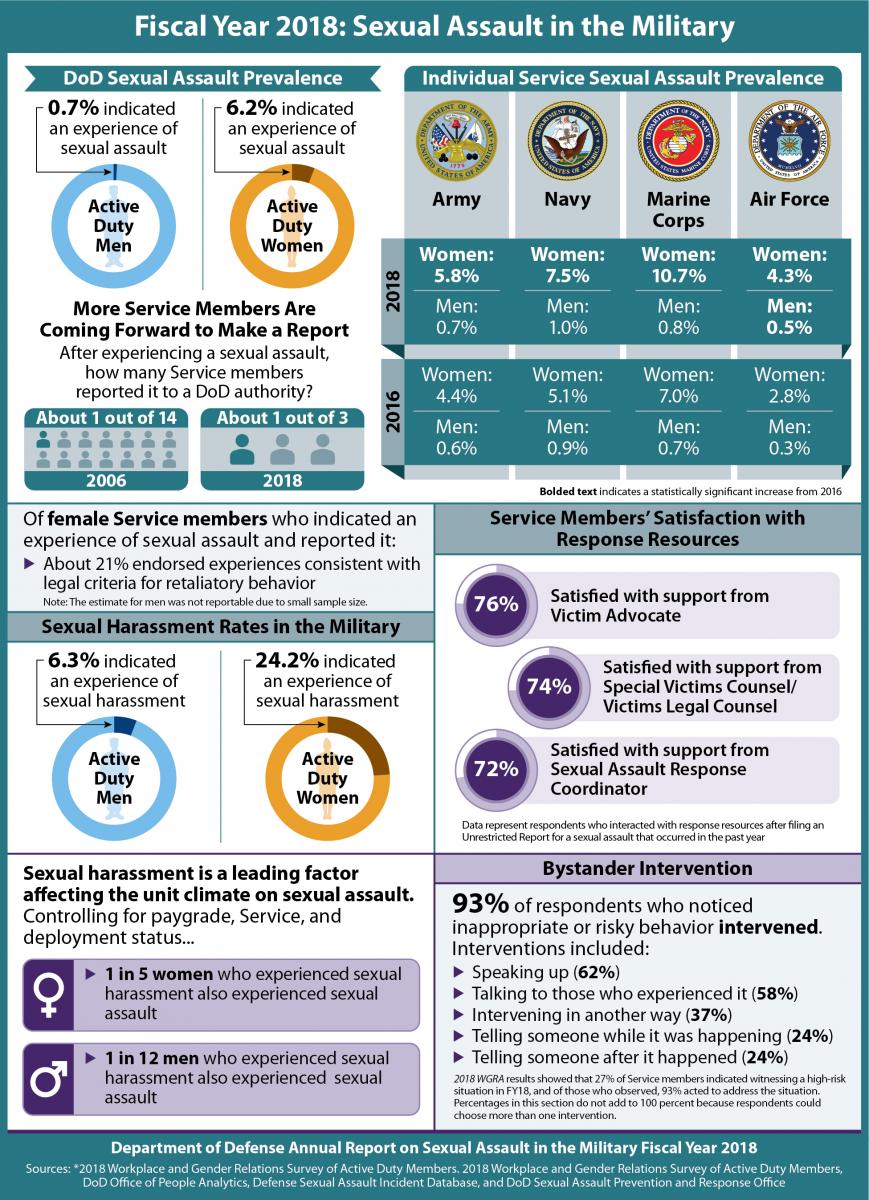
In April 2016, DoD published a new “Retaliation Prevention and Response Strategy” based on military data showing a high percentage of service member sexual assault victims admitted to underreporting sexual assault due to perceived fears about retaliation.[12] The strategy was employed to prevent any retaliation for reporting sexual assault.[13] Since then, according to the DoD statistical data on sexual assault from fiscal year 2019, the rate of reporting in each service branch has only increased.[14] Similarly, a report from fiscal year 2018 noted 1 out of 3 came forward to report sexual assault as compared to 2006 where 1 out of 14 reported sexual assault.[15] This report also indicated 76% were satisfied with support from Victim Advocate and “93% of respondents who noticed inappropriate or risky behavior intervened.”[16]

However, there is still plenty of room for improvement within the military. Despite fifteen years of sexual assault prevention efforts, sexual assault remains a problem within the military. The story of the April 2020 killing of Fort Hood Specialist Vanessa Guillen is a grave reminder of this shortcoming within the military. Guillen disappeared on April 22, 2020 from Fort Hood and her dismembered remains were discovered on June 30, 2020.[17] Prior to her disappearance, Guillen told her family she was being sexually harassed by a fellow solider at Fort Hood, but she was hesitant to report it to her superiors due to fears of retaliation.[18] Guillen’s family believes this sexual harassment was connected to her death. The story received so much media attention and public outcry that the United States Armed Services Subcommittee on Military Personnel held a hearing in July 2020 to examine Guillen’s killing.[19]

Following the discovery of Guillen’s remains the New York Times reported a rise in activism surrounding sexual assault in the military noting: “activists have expressed outrage at the lack of answers and action from the military when Specialist Guillen first disappeared and have called for changes in how the military handles reports of sexual harassment and assault and ramping up the military’s own #MeToo moment.”[20]

Despite efforts made by the military over the last fifteen years to prevent and respond to the sexual assault and harassment within it ranks, if the New York Times is correct, the military may be facing its own #MeToo movement. It may be time that SAPRO reviews its sexual harassment and assault prevention and response policies and procedures to address these shortcomings. Even though the military in 2016 implemented a strategy to prevent retaliation for reporting sexual harassment or assault, Guillen’s story shows the strategy has not fully reached its goals. The Secretary of the Army did order an independent review of Fort Hood’s command culture indicating signs that Guillen’s story may leave a lasting impact on the military’s response and prevention of sexual assault.[21]

[1] Rumsfled, Donald H., Memorandum on Department of Defense Care for Victims of Sexual Assault, Office of Secretary of Defense (05 February 2004).

[2] Chu, David S. C., Memorandum on Department of Defense Care for Victims of Sexual Assault, Office of Under Secretary of Defense (10 February 2004).

[3] United States Department of Defense Sexual Assault Prevention and Response Mission & History, https://www.sapr.mil/mission-history (last visited on Aug. 20, 2020).

[4] Id.

[5] Id.

[6] Id.

[7] U.S. Department of Defense, Sexual Assault Prevention and Response (SAPR) Program Procedures, Instruction 6495 (24 May 2017).

[8] United States Department of Defense Sexual Assault Prevention and Response DOD SAPR Strategic Plan, https://www.sapr.mil/dod-sapr-strategic-plan (last visited on Aug. 20, 2020).

[9] United States Department of Defense Sexual Assault Prevention and Response Prevention, https://www.sapr.mil/prevention (last visited on Aug. 20, 2020).

[10] Id.

[11] DoD Safe Helpline, https://safehelpline.org/telephone (last visited on Aug. 20, 2020).

[12] U.S. Department of Defense, DoD Retaliation Prevention and Response Strategy, April 2016.

[13] Id.

[14] Madeline Herzong, 15 Years of Support for Service Members, SAPR News, 12 June 2020, https://www.resilience.af.mil/News/Article-Display/Article/2220709/sapr-15-years-of-support-for-service-members/.

[15] Department of Defense Annual Report on Sexual Assault in Military Fiscal Year 2018, https://www.sapr.mil/sites/default/files/FY17_AR_Report_Statistical_Highlights_Info_Graphic_FINAL.jpg.

[16] Id.

[17] Kyle Rempfer, Missing Fort Hood was killed in armory, then hacked to pieces, family’s attorney says, ARMY TIMES (July 2, 2020), https://www.armytimes.com/news/your-army/2020/07/02/missing-fort-hood-soldier-was-killed-in-armory-then-hacked-to-pieces-familys-attorney-says/.

[18] Id.

[19] The Military’s #MeToo Moment: An Examination of Sexual Harassment and Perceived Retaliation in the Department of Defense and at Fort Hood Before the Subcommittee on Military Personnel Hearing: 116th Cong. (2020).

[20] Johnny Diaz, Maria Cramer, and Christina Morales, What We Know About the Death of Vanessa Guillen, (Aug. 14, 2020), https://www.nytimes.com/article/vanessa-guillen-fort-hood.html.

[21] Id.

M-VETS Wins $55,000.00 in Disability Compensation for Retired Air Force Veteran

The Antonin Scalia Law School Mason Veterans and Servicemembers Legal Clinic (“M-VETS”) secured Department of Veterans Affairs (DVA) disability compensation for a retired U.S. Air Force veteran. M-VETS argued in a brief before the Board of Veterans’ Appeals the veteran was entitled to service connection and disability payments for a condition caused by military service. While the DVA had previously denied disability compensation to the veteran for this condition, they agreed with the argument made by M-VETS and reversed their original denial for disability benefits for this condition. The initial disability payment for this condition was $55,000.00 with an additional monthly award of $3,200.00. The monthly disability payment will continue for the rest of the veteran’s lifetime.

“I can’t thank the student-advisors enough for all the work they did on my case, it is appreciated!” said the veteran. “I am glad the veteran reached out to M-VETS and that we were able to help out.” Timothy MacArthur, M-VETS Director said. “We have been working to resolve this issue since 2017 so many student-advisors were able to assist with this veteran’s matter and gain invaluable legal experience while in M-VETS. I am really pleased with the outcome and want to thank our student-advisors for the wonderful job they did on this matter as well as our client for working with us the last three years,” MacArthur said.

M-VETS mission is to provide free legal representation to active-duty members of the armed forces, veterans, and their families while offering law students the opportunity to receive supervised, practical legal experience by advocating for those who serve or have served in our United States armed forces. M-VETS provides representation in a variety of matters including Virginia civil litigation matters, uncontested divorces, consumer protection matters, wills and powers of attorney, as well as assisting with matters before the VA and various administrative boards, including discharge upgrades, record corrections, military pay and entitlement matters, and VA disability benefit appeals.

COVID-19 and Veterans Benefits: What Veterans Should Know

Written By Spring 2020 M-VETS Student-Advisor Corey Pray.

The COVID-19 pandemic has affected nearly every aspect of life in one way or another. The veterans community is included among those that have been significantly impacted. As of May 17, 2020, the Department of Veterans Affairs (VA) reports 12,208 cumulative confirmed cases of COVID-19 and 1,005 known deaths among patients who have been tested or treated at VA facilities.[1] Besides the direct effect of COVID-19 on veterans’ health, the virus has also brought about some changes at the VA. Many veterans may be wondering, “What does this mean for my benefits?”

Veterans already receiving benefits should expect to see little or no changes. The VA has confirmed this on its website, stating, “We’re currently processing all benefit payments as normal. This includes payments for disability, pension, education payments to your school, and more.”[2] Additionally, any money received as part of the COVID-19 stimulus package will not count as income for VA disability compensation, meaning veterans’ payments will stay the same.[3]

As for new claims, veterans still have several options for submitting claims and evidence to the VA. These include mail, fax, and uploading documents directly into the VA’s eBenefits system. The one option not currently available is in-person delivery to Regional Offices (ROs). The biggest obstacle for the VA right now is developing a claim and obtaining the sufficient medical evidence needed to issue a decision.[4] Typically, this is accomplished through a Compensation & Pension examination (C&P exam) conducted by a VA healthcare provider. Following a lawsuit in early April 2020 by the Veterans Legal Advocacy Group, the VA suspended all in-person C&P exams.[5] The VA is offering some alternatives to in-person C&P exams, including virtual (telehealth) C&P exams, but these are only available for some conditions, most notably certain mental health conditions.[6] Unless the VA comes up with another alternative, veterans who require in-person C&P exams will probably need to wait until the VA resumes this option. This is likely to be the biggest impact of COVID-19 on the veterans benefits system.

What about claim appeals? Veterans are able to continue submitting claim appeals via mail, fax, or the eBenefits system. The Board of Veterans Appeals (Board) continues to issue decisions as its staff attorneys and veterans law judges work from home.[7] Although the Board has suspended all in-person hearings until further notice, remote hearings continue to be available.[8] This is not a new practice for the Board, which historically has allowed veterans to request either an in-person hearing in Washington, D.C., or a hearing by video teleconference. Due to technology limitations, however, it is unlikely that the Board will be able to conduct the same number of hearings as usual, so some veterans may find themselves waiting for a hearing date until the Board restarts in-person operations.[9] Similarly, the Court of Appeals for Veterans Claims (CAVC) continues to issue decisions and is holding arguments by teleconference. According to Chisholm, Chisholm & Kilpatrick, CAVC was “prepared for this challenge” by previously equipping its judges and employees to work remotely.[10]

Overall, this is good news for veterans who may be concerned about their benefits. While the pandemic is far from over, and the VA must continue to adjust to remote operations, there is no indication that COVID-19 will affect current benefits or significantly increase the backlog for new claims and appeals. In the long term, if remote operations continue to be successful, options such as remote hearings and telehealth exams may become more common as a useful tool for veterans not able to appear in person.

[1] Department of Veterans Affairs COVID-19 National Summary, U.S. Dep’t of Vet. Aff., https://www.accesstocare.va.gov/Healthcare/COVID19NationalSummary (last visited May 17, 2020).

[2] Coronavirus FAQs: What Veterans Need to Know, U.S. Dep’t of Vet. Aff., https://www.va.gov/coronavirus-veteran-frequently-asked-questions/ (last visited May 17, 2020).

[3] Id.

[4] DBQ Changes and C&P Exams Among COVID-19, Chisholm, Chisholm & Kilpatrick (Apr. 16, 2020), https://cck-law.com/blog/dbq-changes-and-cp-exams-amid-covid-19.

[5] A.J. Lagoe & Steve Eckert, Kare11 Investigates: VA Continues High-Risk Exams During COVID-19 Crisis, Kare11 (Apr. 3, 2020), https://www.kare11.com/article/news/investigations/kare-11-investigates-va-continues-high-risk-exams-during-covid-19-crisis-according-to-lawsuit/89-f1a322e3-54b9-4bcf-bdaa-7d161419d39c.

[6] DBQ Changes and C&P Exams Among COVID-19, supra note 4.

[7] How Will COVID-19 Affect VA Disability Claims?, Chisholm, Chisholm & Kilpatrick (May 1, 2020), https://cck-law.com/blog/how-will-covid-19-coronavirus-affect-va-disability-claims.

[8] Id.

[9] Id.

[10] Id.

2019 Amendments to the Virginia Residential Landlord Tenant Act benefit Virginia Renters

Written By Spring 2020 M-VETS Student-Advisor Michelle Yearick.

The Virginia Residential Landlord Tenant Act (“VRLTA”), now codified in the Virginia Code at § 55.1-1200 through § 55.1-1262, has established the rights and obligations of landlords and tenants in Virginia since its enactment in 1974.[1] The VRLTA applies to all jurisdictions in the Commonwealth of Virginia and cannot be modified except by the General Assembly.[2] The VRLTA applies to “all single-family and multifamily dwelling units and multifamily dwelling units located in the Commonwealth”.[3] The General Assembly enacted several tenant-friendly provisions in 2019 that became effective on October 1, 2019. Some of these changes are detailed below.

Written Lease Required: Under § 55.1-1204(B), a landlord is required to offer a written rental agreement “containing the terms governing the rental of the dwelling unit and setting forth the terms and conditions of the landlord tenant relationship.” If a landlord does not provide a written rental agreement, several default provisions will apply to the lease.[4] The VRLTA will serve as the default law governing the lease, the lease will last 12 months, rent is an as-agreed amount or shall be fair market rent, rent is due on the first day of the month and not later than the fifth, any rent paid after the 5th may be subject to a late charge, and a security deposit cannot exceed two months of rent.[5]

Attorney’s Fees: A tenant who succeeds in an assertion claim is now entitled to reasonable costs and fees. Section 55.1-1244(G) now allows for a tenant to recover reasonable costs, court costs, and attorney’s fees for successful tenants in their assertion claim. Previously, a tenant could not recover any reasonable costs or attorney’s fees for an assertion claim.

Unlawful Detainer: There are new statutory protections for tenants who have been served an unlawful detainer (eviction notice). Section 8.01-126 regarding unlawful detainer (eviction) actions has been amended and now requires that the landlord admit a proper eviction notice into evidence before an order of possession can be entered.[6] Additionally, the law now requires the initial hearing to be held within 30 days.[7] The law allows a landlord to amend the amounts owed up to the final disposition of the pending unlawful detainer, but if a landlord fails to request an amendment, he or she is barred from filing an additional summons for the additional amounts if it could have been amended and was not.[8] If an order of eviction is issued, it is only valid for 180 days after which, the landlord will need to re-file.[9]

Right of Redemption: The right of redemption under the VRLTA allows a tenant to redeem tenancy by paying all amounts due. The VRLTA amendments extend the amount of time given to exercise the right of redemption. The previous version of the statute allowed a right of redemption up to the initial return hearing.[10] Under the new amendments, a tenant now has a right of redemption up to two days before the scheduled date of eviction.[11] So long as a tenant pays current rent, damages, late charges, costs of court, any civil recovery, attorney fees, and sheriff fees two business days prior to the eviction, the unlawful detainer action will be dismissed.[12]

This brief summary highlights some of the most tenant-friendly provisions in the new amendments to the VRLTA. These amendments reflect further protections for tenants by requiring written leases and disclosures prior to entering a rental agreement and extending protections for tenant’s who have been served with an unlawful detainer.

[1] The Virginia Residential Landlord and Tenant Act Handbook p. 3.

[2] Va. Code § 55.1-1201(A).

[3] Va. Code § 55.1-1201(B).

[4] Va. Code § 55.1-1204(C).

[5] Va. Code § 55.1-1204(C)(1)-(6).

[6] Va. Code § 8.01-126((D)(2)(a).

[7] Va. Code § 8.01-126(B).

[8] Va. Code § 8.01-126(D)(2)(b).

[9] Va. Code § 8.01-470.

[10] Va. Code §55-248.34.1(D).

[11] Va. Code § 55.1-1250(D).

[12] Id.

WORKERS’ COMPENSATION BENEFITS FOR PTSD – WHY LEGISLATIVE REFORM IS NEEDED TO PROTECT FRONTLINE HEALTH WORKERS

By Spring 2020 M-VETS Student-Advisor Joshua McKenney

In the wake of the global COVID-19 pandemic, frontline health workers around the world are receiving well-deserved social recognition for their efforts. But it is necessary that the law reflect equal recognition for these frontline health workers who place themselves at risk in service to their communities. Specifically, these workers are experiencing numerous psychological stressors during this pandemic that place them at high risk for developing mental health conditions such as posttraumatic stress disorder (“PTSD”). And unfortunately, the law in Virginia regarding compensation for workers struggling with job-related mental health conditions is inadequate to address this concern.

RECENT LEGISLATIVE REFORMS IN RECOGNITION OF MENTAL HEALTH CONDITIONS

A growing number of states including Colorado, Connecticut, Florida, Louisiana, Minnesota, Texas, and Vermont have passed legislation to provide workers’ compensation to first responders suffering from PTSD.[1] Virginia joined this trend in February of 2020.[2] The Virginia House and Senate passed two bills, House Bill 438 and Senate Bill 561, both aimed toward recognizing PTSD as an occupational disease. This would allow those affected to seek treatment and workers’ compensation. Those bills passed and became law on April 22, 2020.[3] However, these reform efforts are too narrow. The drafting of these bills was urged in part by the Director of Government Relations for Virginia Professional Firefighters. And the scope of the legislation reflects this. It specifically allows workers’ compensation to be awarded to qualifying law-enforcement officers and firefighters suffering from a mental health condition as the result of a traumatic event occurring in the line of duty on or after July 1, 2020.

Virginia has the same problem that many jurisdictions have. It has taken important steps in the right direction, but reform efforts are too restrictive. A second example can be found in Connecticut where a bill permitted workers’ compensation benefits related to mental health conditions for police officers but not paramedics. Some of these laws, as is the case in Virginia, also fail to consider the cumulative effect of traumatic events. Diagnoses are limited to PTSD resulting from a single qualifying event. While these legislative efforts show that progress can be made, it also reveals a tendency to underestimate and oversimplify the issue of job-related mental health conditions.

CONTEMPORARY PROBLEMS CAUSED BY COVID-19 AND THE NEED TO PROTECT MENTAL HEALTH

While the sense of normalcy has shifted across the world, this shift is especially apparent and dangerous in health systems. Dr. Shaili Jain, the Medical Director of the Primary Care-Behavioral Health Team at VA Palo Alto, described health workers as standing on the “frontline in the global war on COVID-19.”[4] The patient population has increased, more patients are seen in critical condition, and there is a shortage of necessary protective equipment. Breaks are sometimes not possible with critically ill patients, and health workers struggle to balance the need for social distancing against the need for self-care through traditional support networks. One DC nurse expressed concern that nurses may suffer from PTSD going forward.[5] Dr. Jain further stressed that the impact of this pandemic on large numbers of essential workers over a short period is concerning and stressors could lead to “mass traumatization.”

This concern highlights that the current COVID-19 pandemic is not only an unprecedented strain on health systems, but it also represents an unprecedented strain on the mental health of frontline workers. According to the National Center for PTSD, health workers treating COVID-19 patients are exposed to stressors including constant awareness and vigilance regarding control procedures, isolation, increased daily workload, and external stigma regarding health workers.[6] An article from The Independent cites the usual ratio of nurses to patients in the UK’s National Health System (“NHS”) as 1:1.[7] Now, it is 1:6. Health workers are doing whatever they can, sometimes at the expense of their own wellbeing. This is both laudable and concerning because health workers may continue to work despite experiencing symptoms of a mental health condition. Like many first responders and servicemembers, health workers tend to be service-oriented. With the fear of removal at such a critical time, many health workers may postpone or forgo seeking the psychological support they need. Such delay could lead to worsening mental health conditions in frontline health workers over time. Employers should therefore expect a “readjustment period” after treating COVID-19 patients, and the National Center for PTSD recommends that health workers consider formal treatment for stress lasting longer than two to three weeks.[8] Although most frontline health workers will recover naturally from the psychological toll of the pandemic, many will not.[9]

For those who do not recover naturally, it is necessary to seek medical treatment. Mental health conditions, particularly PTSD, can dramatically impact a person’s life. If left untreated, PTSD is often accompanied by addiction, depression, suicide, and an increased risk for heart disease. And unfortunately, PTSD is a well-established consequence for health workers in disease outbreaks. A case study from doctors working through the 2014 – 2016 Ebola outbreak described stressors including the death of colleagues, the high stakes that do not allow time for grieving and processing emotions, and isolation measures which cut off traditional support systems.[10] Frontline health workers in the current pandemic face these same stressors and share the heightened risk of developing a mental health condition. The first step is to ensure that immediate resources are available for personal safety. But a long-term, systematic response is necessary to identify vulnerable subgroups and offer psychological treatment if necessary. While effective psychological therapies exist, the burden of obtaining needed relief should not be shifted to frontline health workers. Sympathy for these health workers is not enough. Virginia must ensure a long-term, well-funded commitment to support these frontline health workers who put themselves at risk to protect their communities. The first step is allowing frontline health workers to seek workers’ compensation for PTSD under the existing framework.


LEGAL HURDLES – FILING FOR WORKERS’ COMPENSATION BASED ON PTSD

Filing for workers’ compensation in Virginia requires three basic steps. First, an employee must notify his or her employer of the injury within 30 days of its occurrence. That employee must then file a claim for benefits with the Virginia Workers’ Compensation Commission (“the Commission”) within two years of the accident causing injury. And third, the employee must seek medical treatment. This is simple enough, and these basic steps apply equally to both physical and mental injuries.

But beyond filing for compensation, receiving an award for job-related injury under the Virginia Workers’ Compensation Act[11] (“the Act”) is much more difficult for mental health conditions than for physical injuries. Under the Act, a physical “injury” only requires showing an injury by accident arising out of and in the course of the employment or an occupational disease. For a mental health condition to be compensable under the Act, the condition must qualify as an occupational disease or as a compensable ordinary disease of life. Occupational disease is defined as a disease arising out of and in the course of employment, but not an ordinary disease of life to which the general public is exposed outside of the employment.[12] Whether a condition or disease is an ordinary disease of life or an occupational disease is essentially a medical question decided by the trier of fact based on the evidence.[13] Virginia courts have had few occasions to further define whether and how PTSD may be compensable under the Act. And in the few cases addressing the issue, the courts tend to oversimplify and undercompensate mental health conditions.

One of the earliest Virginia cases discussing the award of worker’s compensation for mental health conditions was the 1941 case of Burlington Mills Corp. v. Hagood.[14] There, the claimant was exposed to an electric flash and a loud sound while working near an electric motor that short circuited. Although no signs of physical injury from the machine malfunction existed, the claimant was diagnosed with traumatic neurosis and awarded benefits. The Virginia Supreme Court affirmed, noting the claimant’s injury was “fairly traced to a risk which arose out of and during the course of her employment.” This case follows the traditional understanding of a compensable injury, which is an injury resulting from an occupational injury. The more complex issue of a mental health condition arising separately from a job-related injury was not addressed until much later.

In 2002, the Virginia Supreme Court in Fairfax County Fire and Rescue Dept. v. Mottram addressed the compensability of what is referred to as a mental-mental claim.[15] Such a claim refers to a mental health condition that developed from a psychological or emotional stimulus rather than a physical accident. These claims are often the most difficult to prove due to the lack of supporting evidence and the lack of development in this area of the law. In Mottram, repeated exposure to “traumatic stressors” caused reactions in the claimant’s neurobiological systems similar to an immune reaction which the court had previously characterized as a disease under the Act.[16] The court looked to scientific literature which described that a person undergoing conditions of acute and severe psychological trauma mobilizes neurobiological systems for the purpose of survival.[17] The mobilization of these systems can cause long-term negative consequences manifesting as symptoms of PTSD. And because PTSD symptoms may relate to chemical or physical abnormalities in the body, it is therefore properly considered a disease under the Act. But that alone does not render PTSD a compensable condition. Although Mottram’s PTSD was considered a compensable occupational disease under the circumstances, the circumstances of each case are unique. And to complicate matters, the Virginia Supreme Court noted that PTSD could be considered an ordinary disease of life or an injury by accident under other circumstances.

Several years later in 2015, the Virginia Supreme Court clarified that physical injury is not a prerequisite to recovery for psychological injury in Virginia.[18] Therefore, mental-mental claims may be compensable as a preliminary legal matter. But to be compensable, psychological injuries not accompanied by physical injury must be related to “a sudden shock or fright arising in the course of employment.” In practice, this requirement makes it nearly impossible for many claimants to demonstrate the causal connection between their mental health condition and job-related stressors. It further seems to require that mental health conditions originate from one single incident to be compensable. The Virginia Court of Appeal’s latest attempt to clarify this test resulted in a decision which made an already difficult hurdle perhaps insurmountable for those most at risk of developing mental health conditions as a result of their occupational duties.

In 2017, the Virginia Court of Appeals decided Hess v. Virginia State Police.[19] In Hess, a 10-year veteran of the Virginia State Police was denied compensation for PTSD which resulted from responding to a particularly gruesome auto accident. In Virginia, the court opined, the types of events giving rise to purely psychological but still compensable injuries are consistently described as shocking and unexpected. The court asserted that the claimant’s presence at a fatal auto accident as a state trooper was an “unfortunately frequent” occurrence which his training and experience should have prepared him for. Although the experience was subjectively traumatic, his condition was found not to be the result of an unexpected fright.

Therefore, the nature of a claimant’s profession and requisite training can disqualify PTSD as a compensable injury in Virginia by rendering certain traumatic events as objectively expected. This ruling is difficult to square both with contemporary understandings of PTSD and with the need to protect our most vulnerable and essential populations of workers. Certain professions train employees to encounter shocking and unexpected events. And this is desirable because such training could reduce the mental health impact of such incidents on essential workers. But under Hess, such training and experience makes it more costly for these individuals to receive necessary mental health treatment despite the expectation that they will be exposed to these stressors. Under the current state of Virginia law, it is difficult to see how a frontline health worker’s claim for PTSD could succeed. In a sense, properly trained and experienced health workers are far less likely to receive compensation than an ordinary employee with less training and less exposure to risk. This cannot be what the Virginia legislature intended, and the legislation adopted on April 22 in fact demonstrates the opposite. Those reform efforts indicate a shift toward greater workers’ compensation coverage for those most at risk.

CONCLUSION

We should all be appreciative of the essential work being done by frontline health workers during this pandemic. But those workers deserve more than our appreciation. They deserve access to the resources necessary to treat any mental health conditions which may result from their service during this extraordinary period. Legislative reform is needed to ensure that those sacrificing for the benefit of their communities receive the assistance they deserve to obtain the mental health resources they need.

[1] Rene Ebersole, First Responders Struggle with PTSD caused by the Emergencies, Deaths, Tragedies They Face Every Day, the Washington Post, https://www.washingtonpost.com/health/first-responders-struggle-with-ptsd-caused-by-the-emergencies-deaths-tragedies-they-face-every-day/2019/10/25/9c4c9a0e-d4b8-11e9-9610-fb56c5522e1c_story.html (Oct. 26, 2019).

[2] Adriana De Alba, Virginia House and Senate pass bills to help first responders with PTSD https://www.13newsnow.com/article/news/health/virginia-house-and-senate-pass-two-bills-that-would-help-first-responders-with-ptsd/291-dc52bd7e-643f-41da-afd8-373398b498b0 (Feb. 12, 2020 18:58).

[3] Openstates, Virginia House Bill 438 Workers’ compensation; post-traumatic stress disorder, law-enforcement officers and firefighters, https://openstates.org/va/bills/2020/HB438/; Openstates, Virginia Senate Bill 561 Workers’ compensation; post-traumatic stress disorder, law-enforcement officers and firefighters, https://openstates.org/va/bills/2020/SB561/.

[4] Shaili Jain, M.D., Bracing for an Epidemic of PTSD Among COVID-19 Workers, https://www.psychologytoday.com/intl/blog/the-aftermath-trauma/202004/bracing-epidemic-ptsd-among-covid-19-workers/ (Apr. 13, 2020).

[5] Mimi Montgomery, “They Fall Off a Cliff:” A DC-Area ICU Nurse on the Overflow of Covid-19 Patients She’s Seeing, https://www.washingtonian.com/2020/04/08/they-fall-off-a-cliff-a-dc-area-icu-nurse-on-the-overflow-of-covid-19-patients-shes-seeing/

[6] National Center for PTSD, Managing Healthcare Workers’ Stress Associated with the COVID-19 Virus Outbreak, https://www.ptsd.va.gov/covid/COVID_healthcare_workers.asp.

[7] Shaun Lintern, Coronavirus: Doctors and nurses will need PTSD treatment after Covid-19 virus peaks in hospitals, warn health leaders, https://www.independent.co.uk/news/health/coronavirus-uk-nhs-intensive-care-nurses-doctors-ptsd-a9450731.html/ (6 Apr. 2020 17:15).

[8] National Center for PTSD, supra note 5.

[9] Shaili Jain, supra note 4.

[10] Lorenzo Paladino et al., Reflections on the Ebola Public Health Emergency of International Concern, Part 2: The Unseen Epidemic of Posttraumatic Stress among Health-care Personnel and Survivors of the 2014—2016 Ebola outbreak, J. Global Infect. Dis. 45-50 (2017), https://www.ncbi.nlm.nih.gov/pmc/articles/PMC5452550/#ref16.

[11] Va. Code § 65.2-100 et seq.

[12] Va. Code § 65.2-400(A).

[13] Marcus v. Arlington County Bd. of Supervisors, 15 Va. App. 544, 550, 425 S.E.2d 525, 529 (1993).

[14] Burlington Mills Corp. v. Hagood, 177 Va. 204, 210-11, 13 S.E.2d 291, 293 (1941).

[15] Fairfax County Fire and Rescue Dept. v. Mottram, 263 Va. 365, 373, 559 S.E.2d 698, 702 (2002).

[16] A New Leaf, Inc. v. Webb, 257 Va. 190, 511 S.E.2d 102 (1999).

[17] Steven M. Southwick et al., Neurobiology of Post-Traumatic Stress Disorder in PSYCHOTRAUMATOLOGY, KEY PAPERS AND CORE CONCEPTS IN POST-TRAUMATIC STRESS 49, 53 (George S. Everly, Jr. & Jeffrey M. Lating eds., 1995).

[18] Jackson v. Ceres Marine Terminals, Inc., 64 Va. App. 459, 464, 769 S.E.2d 276, 279 (2015).

[19] Hess v. Virginia State Police, 68 Va. App. 190, 806 S.E.2d 413 (2017).
Scientific Developments in Detecting Traumatic Brain Injuries

By Spring 2020 M-VETS Student-Advisor Katherine Beard

Traumatic brain injuries (“TBIs”) impact thousands of military service members every year. With nearly 20,000 clinically diagnosed TBIs each year for the past five years, service members are at a higher risk of injury than members of the general public.[1] TBIs can have long-lasting, severe impacts that can become dangerous if not properly identified and treated. The problem with diagnosing TBIs is that there is no single test to concretely confirm the diagnosis of a TBI.[2] There are many symptoms that are associated with TBIs, but diagnosis of a TBI is a strictly clinical diagnosis.[3] Because of this, TBIs can be misdiagnosed and service members who may be suffering from a TBI may be not be given the immediate care they need to prevent long-lasting injury. Presently, while TBIs can be identified postmortem through changes of chronic traumatic encephalopathy, there is no concrete test for TBIs while the individual is alive.[4]

While there is presently no test to confirm the diagnosis of TBI, there has been significant progress in the scientific community towards developing a test to detect TBIs in an individual while that individual is alive.[5] Presently, there has clinical trials and research done towards developing a test to detect TBIs through the use of patient’s saliva.[6] This minimally intrusive test, once fully developed, could provide fast and accurate results to concretely detect whether an individual has a TBI.

Presently, scientists are developing a test to detect TBIs though saliva.[7] This type of test measures the levels of extracellular vesicles (“EVs”) preset in the individual’s saliva.[8] EVs travel from the brain to the oral cavity, and it is proposed that “the genetic profile of salivary EVs in patients who have suffered head trauma will differ from normal healthy controls, thus constituting a unique expression signature for” TBIs.[9] This means that an individual who may be suffering from a TBI would be able to receive a concrete diagnosis of a TBI simply through the testing of their saliva. Such a test would provide reliable ways to detect TBIs efficiently and through noninvasive means. A TBI saliva test would be groundbreaking for areas such as the military that have an increased rate of TBIs and many harmful effects that accompany this injury.

Once a saliva test for TBIs is perfected, the benefits will be many. By being able to detect TBIs early on through a noninvasive process, service members would be able to have a fast and reliable way to be diagnosed with a TBI and to have appropriate care taken. Rather than having a strictly clinical diagnosis, a concrete test will take the guesswork out of the equation. Although many of the less severe TBIs do not require medical intervention, more severe TBIs may require early treatment and monitoring to prevent lasting impacts. Testing for TBIs through saliva, at least through the initial research, appears to be a test easily performed in the wide variety of environments that our service members find themselves in. While some service members have stated that even if they were diagnosed with a TBI in the battlefield they would continue to fight due to wanting to protect the lives of their peers, a concrete test would help them know the risks they encounter through such a choice. They would have a more accurate picture of their own health and treatment necessary to accompany a TBI diagnosis.

Additionally, a concrete diagnosis of a TBI could be useful for service members collecting VA benefits upon retirement. Veterans often have a difficult time proving that a particular injury or disorder they have was directly caused by their time in service. TBIs can have long-lasting impacts that cause the veteran to need treatment and compensation to treat symptoms of the TBI years after service. With TBIs related to incidents such as blast injuries, symptoms such as headache, behavior changes, and memory loss can lead to long-term neuropsychiatric and cognitive consequences.[10] Having a TBI test available at the time the veteran was injured can provide the veteran with the concrete medical evidence they need to later file for VA benefits for lasting effects of that injury once they return home. The TBI test results would take some of the discretion out of a doctor’s clinical diagnosis and instead provide conclusive test results detailing the injury. This would make the VA’s job of service connecting related disorders more streamlined due to concrete evidence and help ensure the veteran gets the care and compensation he or she deserves.

Overall, while a TBI test is still in the developmental phase, it is exciting to see progress being made in this area. A concrete TBI test through just the use of an individual’s saliva could be potentially lifesaving and very useful for members of the armed forces who have a higher risk of injury than the average public. This type of test could help service members efficiently get the treatment they need and provide concrete medical evidence to help them receive VA benefits once retired. This test would give service members more peace of mind when it comes to evaluating their health and to minimize the harmful symptoms of TBIs going forward.

[1] https://dvbic.dcoe.mil/dod-worldwide-numbers-tbi.

[2] https://www.asnr.org/patientinfo/conditions/tbi.shtml

[3] See id.

[4] https://www.ncbi.nlm.nih.gov/pmc/articles/PMC4694720/

[5] https://www.ncbi.nlm.nih.gov/pmc/articles/PMC6478516/

[6] See id.

[7] https://www.ncbi.nlm.nih.gov/pmc/articles/PMC6478516/

[8] See id.

[9] Id.

[10] https://www.ncbi.nlm.nih.gov/pmc/articles/PMC4694720/

Small Businesses Supporting Veterans: A Practical Solution To Helping Veterans Within The Community

By Spring 2020 M-VETS Student-Advisor Josh Morrow

Veteran issues have been a prominent issue in society for many years, so much so that the federal government budgets over $240 billion to help our Veterans combat these issues. Moreover, in FY 2020, Virginia’s Office Of Veterans And Defense Affairs budgeted roughly $70.7 million towards helping Veterans in Virginia alone. Despite billions of dollars being budgeted by the federal and state governments, not all veterans receive the help they need. Although both the federal and state programs serve vital purposes, they do not necessarily account for lesser thought of necessities in a veteran’s life. Healthcare, homelessness, mental health, and reacclimating veterans back into society are critical issues that plague our veterans but, for those veterans who do not fall into one of those categories, the programs in place do not help combat their more “minor” struggles. I believe these minor struggles are a tremendous void left in a Veteran’s lives and that local businesses and community organizations are best equipped to provide these services.

In October of 2019, Legal Services of Northern Virginia (LSNV) and I volunteered to help a local dentist practice in Alexandria Virginia in administering free dental checkups to veterans in the community. The experience was great because I saw first-hand how a single small business and volunteers came together to provide a much-needed service to the local Veterans in the Alexandria area. In addition to the free dental checkups, the venue also provided a forum for myself and the volunteers from the LSNV to talk to veterans and answer their questions about lesser-known services available to them. The event was an absolute success. The dentists were busy throughout the day, and almost every Veteran stopped to talk to the volunteers from LSNV with questions on how to obtain other services they needed. As everyone knows, dental checkups are necessary to maintain good oral health but can also be expensive. Moreover, obtaining a dental checkup from a federal or state program can be cumbersome and hard to qualify for, making them less attractive options to Veterans. The experience got me to thinking about how other businesses within the community could bridge the gap between the major federal/state programs and lesser thought of services that Veterans need.

When people think about Veteran issues, most people immediately think about healthcare, homelessness, and struggles combating mental health. These stories are captivating headlines of the struggles that many Veterans face but, what gets lost or overlooked in these stories are Veterans struggling to afford the basic necessities they need on a day-to-day basis. For the most part, veterans leave active duty in only a handful of ways. They either retire with additional benefits, separate voluntarily to pursue other endeavors, or are involuntarily separated. For those veterans that retire or separate voluntarily, they often have a plan in place for life after the military, and the adjustment to leaving military service is not as dramatic of a change as someone who was separated from military service against their will. Veterans who voluntarily separate or retire from military service usually have a job in place for them post-separation and have a plan to how they will pay for necessities like healthcare, buying new work attire, moving to a new location, and so forth. However, for some veterans, separation from active duty was not a voluntary experience, and they do not have a plan in place for life after military service. For those Veterans that are involuntarily separated from service, the process can be completed within a few months, leaving them little time to find another job or find a mentor to help them plan for life after the military. These Veterans often struggle to afford necessities such as groceries, getting a haircut, or finding affordable housing because those services were provided to them while in service. These new challenges may seem like small obstacles, but these “smaller” issues are not the primary focus of federal/state Veteran programs. It is these very issues that I believe small businesses and communities can help these Veterans overcome such obstacles by providing these needed services. Like the Alexandria dental practice that opened its doors to Veterans and provided free examinations, other small businesses can also step up to fill the void of services not readily provided by the state/federal programs.

To illustrate my proposal, I hypothesize a situation where a barbershop offers its chairs for barber students to give veterans free or discounted haircuts. To obtain a Virginia Barber License, an applicant must complete 1100 hours of training that includes practical training that involves cutting hair. These students are generally unpaid or offer discounted prices for their cuts. To put this in perspective, my local barber charges me $26 to cut my hair and that does not include any shampoo or styling. For some veterans, they do not have the financial means to afford even a basic haircut like the one I pay for much less anything that would include any additional product. Allowing barber students to utilize the barbershop’s chairs for a weekend to cut Veteran’s hair offers a tremendous opportunity to all parties involved. Veterans would be able to get their needed haircuts, students would get hours towards obtaining a barber license, and the owner of the barbershop gets the positive publicity of helping both the Veterans and the student barbers. To further capitalize on the idea, the barbershop could partner or co-sponsor the event with a local restaurant to cater the event and invite Veteran groups like LSNV to support the event.

The mission to help our Veterans is never-ending, and it will take more than federal and state programs to help all of our Veterans. For some Veterans, they have no families, and their local community is the only support system they have. For a small dental clinic to open up its doors and offer free dental cleanings or a barbershop to open up its chairs to Veterans and students is a powerful gesture of kindness that can make a significant impact in a Veteran’s life. John Heywood coined the phrase “many hands make light work.” My hope is that communities and small businesses begin to come together to help our Veterans because it is the least we can do to show our support for their sacrifices.

“Outmoded and at Odds with Current Science:” Updating U.S. Military Policy on Servicemembers Living with HIV

By Spring 2020 M-VETS Student-Advisor Holly Kresge

Since the introduction of the human immunodeficiency virus (“HIV”) to the United States in the 1970s, the medical field has made significant advancements in the treatment of HIV. Prior to the 1990s, testing positive for HIV almost certainly led to death. However, people living with HIV today can live nearly as long as their HIV-negative counterparts.  Unfortunately, stigma and misinformation about HIV persist despite medical advances and educational campaigns. Such misinformation permeates current U.S. Department of Defense (“DoD”) policy and the individual polices of the branches of the U.S. Armed Forces, negatively impacting servicemembers living with HIV.

Current HIV Treatment

When infected with HIV, the virus attacks the individual body’s immune system and makes them more likely to contract infections and other serious illnesses or conditions.  If untreated over a period of time, HIV can weaken the immune so significantly that the cells in the body are unable to fight diseases and infections, leading to acquired immunodeficiency syndrome (“AIDS”).   Even without treatment, transmission of HIV is quite rare in comparison to other viruses, like influenza or coronavirus.  HIV can be transmitted to another person through certain types of bodily fluids and only when the fluids are in contact with the blood stream or through sexual activity.  In addition to the few avenues for transmission, the actual risk of transmission is relatively low in cases of sexual activity or needle sharing.  Blood transfusions pose a high risk for HIV transmission, but HIV-positive individuals are prohibited from donating blood, even in the military.

While no cure is available for HIV, the development of a combination of antiretrovirals in the mid-1990s created significant treatment measures to allow people living with HIV to have relatively healthy and normal lives.  Antiretroviral therapy (“ART”) acts to reduce the viral load, or the amount of HIV, in a person’s body.  When an HIV-positive individual adheres to ART treatment, their viral load “becomes ‘suppressed within several months and the virus reaches ‘undetectable’ levels shortly thereafter, meaning there are less than 50 virus copies per milliliter of blood.”  Upon reaching undetectable levels of viral load, HIV-positive individuals are effectively no longer able to transmit the virus to other individuals through any means other than blood transfusions.  Currently, ART is administered through one or two tablets taken daily by 75% to 80% of people living with HIV.  The ART pills “have no special handling or storage requirements[,]…tolerate extreme temperatures[,]…have minimal side effects and impose no dietary restrictions.”  As such, many people living with HIV are able to take a simple daily medication, which allows them to enjoy a healthy, long life.

DoD Policies on Servicemembers Living with HIV

Initially, anyone who tests positive for HIV is barred from entering the military through enlistment or commission, as the presence of HIV is a disqualifying medical condition under DoD Instruction (“DoDI”) 6130.03.  Once a member of the Armed Forces, a servicemember who tests positive for HIV cannot be involuntarily discharged solely for their HIV-positive status, unless they are unable to perform their military duties.

However, this policy can lead to involuntary discharge based on HIV status alone under the DoD’s “deploy or get out” policy. Under DoDI 1332.45, the DoD instituted policy begin administratively separating or referring servicemembers to the Disability Evaluation System who are “considered non-deployable for more than 12 consecutive months.”  Furthermore, the DoD specifically designated HIV as a “medical condition usually precluding contingency deployment.”  The DoD based this preclusion as “due to the potential lack of access to needed medical care or medication in austere environments, as well as the military risks inherent in the mission assigned that could lead to illness exacerbation and compromise unit readiness and mission completion.”  Those HIV-positive servicemembers must obtain a waiver in order to deploy, which may be granted upon a medical assessment of the “climate, altitude, rations, housing, duty assignment, and medical services available in theater.”  Therefore, if an HIV-positive servicemember is not granted a waiver for deployment, then that servicemember will likely be subject to an involuntary discharge under current DoD policy.

Litigation in the Fourth Circuit

Currently, two cases are pending trial in the U.S. District Courts within the Fourth Circuit concerning HIV-positive servicemembers negatively impacted by current DoD policy. In both cases, Lambda Legal and the Modern Military Association of America (“MMAA”) filed suit on behalf of current servicemembers.

In Harrison v. Esper, the U.S. Army denied Sergeant Nick Harrison a position in the Judge Advocate General (“JAG”) Corps after he tested positive for HIV upon return from his second deployment.  Despite adhering to ART treatment and maintaining an undetectable viral load, the U.S. Army denied commissioning Sergeant Harrison because (1) DoDI 6130.03 and 6485.01 prohibited the commissioning of HIV-positive individuals, and (2) he was classified as non-deployable solely on his HIV-positive status.  After an unsuccessful petition to the Army Board for Correction of Military Records, Harrison filed suit in the U.S. District Court for the Eastern District of Virginia with MMAA, arguing DoD and U.S. Army accession policies for people living with HIV “violate the equal protection component of the Fifth Amendment’s Due Process Clause, both on their face and as applied to Harrison.”  The suit is currently pending trial in the Eastern District of Virginia.

Most recently, the U.S. Court of Appeals for the Fourth Circuit weighed in on the issue of servicemembers living with HIV. In Roe v. Esper, the U.S. Air Force attempted to involuntarily discharge two servicemembers solely based on their HIV-positive status.  Both servicemembers adhered to proper ART treatment of one or two pills per day and maintained undetectable viral loads.  Despite the support of their commanding officers, colleagues, and military medical professionals, the Air Force referred both servicemembers to the Disability Evaluation System, where both the Informal and Formal Physical Evaluation Boards recommended them be discharged.  Upon review by the Air Force Personnel Council, the Council made nearly identical statements in both cases, asserting that the member’s HIV-positive status precludes him from deployment and because “deployability is a key factor in determining fitness for duty…and [the servicemember] belongs to a career field with a comparatively high deployment rate[,]…the Board determined he is unfit for continued military service.”

Consequently, the servicemembers brought suit for declaratory and injunctive relief in the Eastern District of Virginia to halt their discharges and challenge the military’s decisions and policies in court.  In particular, the servicemembers claim “the Air Force’s discharge decisions and the military’s deployment policies violate the Administrative Procedure Act (“APA”) and the equal protection component of the Fifth Amendment’s Due Process Clause.”  On February 15, 2019, the Eastern District of Virginia granted the preliminary injunction, which the Federal Government subsequently appealed to the Fourth Circuit.

Approximately a year later, the Fourth Circuit affirmed the lower court’s preliminary injunction, finding the Plaintiffs are likely to succeed on the merits of at least one claim.  First, the Fourth Circuit found the Plaintiffs showed they were likely to succeed on the merits on their claim that the Air Force violated the APA by acting arbitrarily or capriciously in their discharge of the servicemembers based only on their HIV-positive status and without any individualized evaluation of their fitness for military service.  DoD policy requires individualized assessments using objective evidence when determining a servicemember’s fitness for duty under the Disability Evaluation System.  In this case, however, the Air Force failed to make such individualized assessments and determinations for each of the affected servicemembers. Instead, the Air Force utilized identical language for each servicemember, stating their HIV-positive status precluded them from deployments, which rendered them unfit for duty.  The court found this decision inconsistent with DoD policy, which not only required individualized determinations, but also permitted medical waivers for servicemembers living with HIV to deploy.  Thus, the court determined the Air Force’s discharge orders here were arbitrary and capricious under the APA.

Second, the Fourth Circuit found the Plaintiffs showed they were likely to succeed on the merits of their claim that the DoD’s deployment policies violate APA requirements in creating policy “by failing to offer an explanation that is reconcilable with scientific and medical evidence available to it.”  Here, the court emphasized that the justifications for the DoD’s HIV-positive deployment policies and effective ban are “outmoded and at odds with current science.”  Countering the DoD’s argument that HIV requires ‘highly specialized’ treatment, the court highlighted that current ART treatments of single daily pills with no special storage requirements can be prescribed in the same manner the military does for other manageable chronic conditions.  Furthermore, medical evidence shows that disruption of ART treatment causes no immediate negative health impacts, and will take weeks for a person’s viral load to return to detectable levels. Lastly, the court dismissed the military’s concerns of battlefield blood exposure and blood transfusions, pointing to the low risk of any HIV transmission and the DoD’s own policy of not allowing HIV-positive servicemembers to donate blood for transfusions.  Therefore, the court found the government failed to follow APA requirements to articulate a satisfactory explanation for the HIV-positive deployment policy when it was adopted.

Based on these findings, the Fourth Circuit affirmed the district court’s preliminary injunction, barring the DoD and the Air Force from discharging these servicemembers, and those similarly situated, based solely on their HIV-positive status. As of April 2020, the DoD has not chosen at this time to appeal the Fourth Circuit’s decision. Currently, the case is pending trial in the Eastern District of Virginia with companion case, Harrison v. Esper.

The Need for Updated DoD Policy

As evidenced in the Fourth Circuit’s opinion in Roe v. Esper, current DoD policy regarding servicemembers living with HIV is significantly outdated. The original justification for prohibiting the enlistment and deployment of people living with HIV cannot be upheld with the advancement of ART treatment and low risk of HIV-positive servicemembers with suppressed viral loads to transmit the virus to their fellow soldiers. Discharging otherwise healthy and fit servicemembers solely based on their HIV-positive status is not only discriminatory and stigmatizing, but also counterintuitive to the core philosophy and purpose of military service. As such, the DoD needs to update its policies to better align with modern science and allow servicemembers living with HIV to continue their military service.