Changes are Coming and Have Come to Sexual Assault Prosecutions in the Military

Written by Spring 2022 M-VETS Student Advisor Doug Boyle.

  1. Introduction/Proposed Reforms

Sexual assault in the military has been a major public issue, particularly over the past decade. The issue was prominently highlighted by the tragic circumstances surrounding the death of Specialist (“SPC”) Vanessa Guillen. In April 2020, SPC Guillen was stationed at Fort Hood, Texas when she disappeared. Her remains were found in June 2020, and the suspect in her murder committed suicide after escaping the base during the investigation.[1] Then-Secretary of the Army Ryan McCarthy created an independent review panel to study the command climate at Fort Hood. The panel identified major flaws with the sexual harassment and assault response prevention (“SHARP”) program at Fort Hood, and a command climate that was permissive of sexual harassment and sexual assault.[2] And an Army investigation into the handling of SPC Guillen’s case found that she had been sexually harassed by a supervisor and leadership in her unit failed to take the proper actions. While the investigation did not connect the harassment to SPC Guillen’s murder, it did result in the firing of 21 Army personnel.[3]

During Fiscal Year 2020, the Department of Defense (“DoD”) identified a total of 6,290 reports of sexual assault by service members for incidents occurring during military service.[4] But of those 6,290 reports, only 50 led to sex-offense convictions under the Uniform Code of Military Justice (“UCMJ”). Women make up 16.5% of the armed services. But according to some studies almost one-quarter of female servicemembers have reported experiencing sexual assault while more than half have reported experiencing sexual harassment.[5] As it stands now, military commanders have the authority to decide whether a servicemember accused of sexual assault (and any other crime for that matter) is subject to a court martial[6]—regardless of the evidence against that servicemember. Advocates and some politicians saw this aspect of the UCMJ as a reason why “troops who are assaulted rarely see justice. . . .”[7]

As a result, the past decade has seen three major proposals aimed at reforming sexual assault prosecutions under the UCMJ. First, Senator Kirsten Gillibrand (D-NY) introduced the Military Justice Improvement Act (“MJIA”) in 2013. After several unsuccessful attempts to get the MJIA passed, Senator Gillibrand introduced a revised bill, the Military Justice Improvement and Increasing Prevention Act (“MJIIPA”) in 2021.[8] Under MJIIPA, the authority to convene a court martial after an alleged “covered offense” would be transferred from commanding officers to Judge Advocate General Corps’ (“JAG”) officers at an O-6 (Navy commanders and Army/Air Force/Marine Corps colonels) ranking or higher. Furthermore, that JAG must “have significant experience” with court martial trials and must be “outside the chain of command of the [servicemember] subject to such charges.”[9]

The UCMJ’s punitive articles (i.e., criminal offenses) are found in articles 77 through 134. These articles cover offenses ranging from breach of medical quarantine and “malingering,” to rape and murder.[10] Under MJIIPA, more than thirty of the UCMJ’s offenses would constitute “covered offenses,” meaning the court martial convening authority for these offenses would be divested from commanding officers and vested in qualified JAG officers.[11] Unsurprisingly, “covered offenses” include wrongful broadcast or distribution of intimate visual images (article 117a), rape (article 120), and other sexual misconduct (article 120c). But perhaps surprisingly, “covered offenses” also include larceny and wrongful appropriation (article 121) and fraudulent use of credit cards, debit cards, and other access devices (article 121a).[12] Finally, to constitute a “covered offense,” the maximum punishment authorized by the UCMJ must include “confinement for more than one year,” that is, the offense must be felonious.[13]

The second major proposal regarding sexual assault prosecutions in the military was the I Am Vanessa Guillén Act (the “Guillén Act”) which was introduced by a bipartisan group of more than 100 congressmen and congresswomen in 2020.[14] Under the Guillén Act, each military branch would be required to create a position of chief prosecutor, filled by “a commissioned officer in the grade of O-6 or above who has significant experience prosecuting sexual assault trials by court martial.”[15] If a servicemember were charged with a “sex-related offense,” the traditional court martial convening authority (i.e., the servicemember’s commanding officer) would have to present that charge to the chief prosecutor’s office.[16] At that point, the chief prosecutor’s office would decide whether to convene a court martial regarding the sex-related offense.[17]

The Guillén Act would cover far fewer offenses than MJIIPA. Under the Guillén Act, “sex-related offenses” include rape and sexual assault (article 120), mail: deposit of obscene matter (article 120a), rape and sexual assault of a child (article 120b), and other sexual misconduct (article 120c). As it stands, sexual harassment is not a standalone offense under the UCMJ. But servicemembers who engage in sexual harassment can be charged under other punitive articles. For example, a court recently upheld the Navy’s decision to charge a sailor accused of sexual harassment under UCMJ article 92 (failure to obey order or regulation).[18] And servicemembers have been properly charged with sexual harassment under UCMJ articles 117 (wrongful broadcast/distribution of intimate visual images)[19] and 93 (cruelty or maltreatment).[20]

The Guillén Act however would add article 120d to the UCMJ and make sexual harassment a standalone offense. The definition of sexual harassment under the Guillén Act is lengthy. But it includes “sexual advance[s],” “request[s] for sexual favors,” and “any other conduct of a sexual nature” in circumstances where “submission to the conduct involved is made either explicitly or implicitly a term or condition of employment,” “submission to or rejection of such conduct is used as the basis for an employment decision,” or “such conduct . . . create[s] an intimidating hostile, or offensive work environment. . . .”[21] Naturally then, the newly created article 120d would be a “sex-related offense” for which the court martial convening decision must be made by the office of the chief prosecutor.[22]

The third reform proposal was made by a DoD Independent Review Commission (“IRC”) that began its work in March 2021.[23] At President Biden’s direction, Secretary of Defense (“SECDEF”) Lloyd Austin established the 90-day IRC which was comprised of civilians, retired servicemembers, government officials, and federal prosecutors.[24] The IRC’s recommendations were primarily focused in four areas: Accountability, prevention, climate and culture, and victim support and care. At its conclusion, the IRC made 82 recommendations to SECDEF Austin.[25] It is SECDEF Austin’s intent to accept the IRC’s recommendations wherever possible,[26] but several are key here.

The first is the recommendation to create an “Office of the Special Victim Prosecutor in the Office of the Secretary of Defense . . . and shift legal decisions about prosecution of special victim cases out of the chain of command.”[27] The IRC also recommended ensuring independent personnel with specialized training investigate claims of sexual harassment, mandatory separation in the event of a substantiated claim, and “[p]rofessionalized career billets for military justice personnel handling special victim crimes.”[28] Finally, the IRC recommended that sexual harassment be delineated as a standalone offense and expedited processing of Executive Orders (“E.Os.”) regarding sexual assault in the military.[29]

2. What Actually Happened?

On 27 December 2021, President Biden signed into law the National Defense Authorization Act for Fiscal Year 2022 (the “2022 NDAA”).[30] The first change made in the context of military sexual assault is the insertion of a new section—824a (“Special trial counsel”)—into the UCMJ.[31] This addition to the UCMJ mandates the secretaries of each military branch to promulgate regulations for detailing JAG officers as special trial counsel (“STC”).[32] In turn, a STC has exclusive authority to determine whether reported offenses are “covered offenses,” over which a STC would have exclusive authority in determining whether to convene a court martial.[33] Plus, a STC could exercise authority over “any offense that the [STC] determines to be related to the covered offense.”[34] If a STC determines that something is a “covered offense”—but does not convene a court martial—the accused’s commander may nonetheless pursue administrative actions.[35] And each military service will have a lead STC who is a JAG officer with at least an O-7 (brigadier general or rear admiral (lower half)) rank.[36] These provisions of the 2022 NDAA will not take effect until late 2023.[37]

Next, the 2022 NDAA amends article 1 of the UCMJ (“Definitions”) in part by defining what constitutes a “covered offense.”[38] “Covered offenses” include UCMJ articles 117a (Wrongful broadcast/distribution of intimate visual images), 118 (Murder), 119 (Manslaughter), 120 (Rape and sexual assault generally), 120b (Rape and sexual assault of a child), 120c (Other sexual misconduct), 125 (Kidnapping), 128b (Domestic violence), 130 (Stalking), 132 (Retaliation).[39] In addition, “the standalone offense of child pornography,” which is punishable under UCMJ article 134 is a “covered offense.”[40]

The 2022 NDAA also directed President Biden to prescribe regulations establishing sexual harassment as an offense punishable under UCMJ article 134, and revise the Manual for Courts-Martial (“MCM”) to include the new offense.[41] On 26 January 2022, President Biden issued E.O. 14062 (“2022 Amendments to the Manual for Courts-Martial, United States”).[42] In that E.O., President Biden amended the MCM to reflect that the following elements constitute sexual harassment:

  • That the accused knowingly made sexual advances, demands or requests for sexual favors, or knowingly engaged in other conduct of a sexual nature;
  • That such conduct was unwelcome;
  • That, under the circumstances, such conduct:
  • Would cause a reasonable person to believe, and a certain person did believe, that submission to such conduct would be made, either explicitly or implicitly, a term or condition of a person’s job, pay, career, benefits, or entitlements;
  • Would cause a reasonable person to believe, and a certain person did believe, that submission to, or rejection of, such conduct would be used as a basis for decisions affecting that person’s job, pay, career, benefits, or entitlements; or
  • Was so severe, repetitive, or pervasive that a reasonable person would perceive, and a certain person did perceive, an intimidating, hostile, or offensive working environment; and
  • That, under the circumstances, the conduct of the accused was either: (i) to the prejudice of good order and discipline in the armed forces; (ii) of a nature to bring discredit upon the armed forces; or (iii) to the prejudice of good order and discipline in the armed forces and of a nature to bring discredit upon the armed forces.[43]

3. Will This Work?

As some commentators have noted, “except for diehard opponents of any transfer of disposition authority, everyone got something and no one got everything they sought.”[44] For example, Senator Gillibrand issued a statement after the 2022 NDAA’s passage complaining that “House and Senate Armed Services leadership have gutted our bipartisan military justice reforms behind closed doors. . . .”[45] Senator Gillibrand goes on to bemoan the fact that court martial convening authority writ large was not removed from commanding officers (recall the expansive list of crimes under MJIIPA for which commanders would not have convening authority).[46]

Conversely, Army Lieutenant General (Retired) Thomas Spoehr has argued that removing commanding officers’ convening authority “reduces them to mere observers in the justice system.”[47] To Mr. Spoehr, removing commanders’ convening authority in sexual assault cases will actually lead to fewer court martials. This is because as it stood prior to the 2022 NDAA, a commander could convene a court martial regardless of whether probable cause was established. In other words, a commander could convene a court martial even if there was no reasonable likelihood of success at trial—because the commander is not bound by the same rules of ethics that military lawyers are.[48]

Since the founding of the United States, its commanding officers have been tasked with maintaining “good order and discipline.”[49] Individuals like Mr. Spoehr argue that this mandate has led commanding officers to convene court martials even when probable cause did not exist. This is because the commanding officers “knew that sending the case to court martial sent a powerful message that such behavior would not be tolerated, even if the ultimate success of the case at trial was not certain.”[50]

Lieutenant Colonel Dan Maurer—an Assistant Professor of Law at the United States Military Academy—points out though that arguments like Mr. Spoehr’s are based solely on anecdotal and personal experience.[51] Furthermore, when senior military officers expressed concerns about the potential passage of MJIIPA, they offered “[n]o actual evidence” that reforms would erode commanders’ abilities to “fight and win wars.”[52] In fact, empirical evidence from other modern militaries with similar limitations on commanders’ convening authority suggested that just the opposite occurred.[53]

On the one hand, whether Mr. Spoehr’s and other senior officers’ fears are based on conjecture or not, it is difficult to dismiss them out of hand. It is not hard to hypothesize a case where a commanding officer convenes a court martial related to sexual assault, despite a lack of solid evidence. The commander may convene the court martial because of political pressures or because she wants to send a message regarding the tolerance of undisciplined behavior. If that same case is referred to a STC who has significant education and experience related to trial, would the STC really convene a court martial when there is not even enough evidence to find probable cause?

That said, the foregoing example is just that, a hypothesis. And there is evidence that removing the convening authority of commanding officers may actually improve commanders’ abilities to maintain good order and discipline.[54] All told, only time will tell whether the 2022 NDAA’s provisions strike the right balance between improving the military justice system’s handling of sexual assault and protecting commanding officers’ proper authority.

[1] Eline de Bruijn, Rebuilding Trust After Tragedy: How Vanessa Guillen’s Death Changed Fort Hood and the Army, WFAA News (15 JUL 2021), https://www.wfaa.com/article/news/local/texas/rebuilding-trust-tragedy-how-vanessa-guillens-death-change-fort-hood-army/287-f88df4ee-17aa-47a8-978b-49e3fbddbfac.

[2] Allie Yang, Denise Martinez-Ramundo, Natalie Cardenas, Chris Kilmer & Abby Cruz, Vanessa Guillen’s Fiance, Closest Friends Detail Upsetting Investigation, ABC News (11 JUN 2021), https://abcnews.go.com/US/vanessa-guillens-fiance-closest-friends-detail-upsetting-investigation/story?id=78174535.

[3] de Bruijn, supra note 1.

[4] Department of Defense Annual Report on Sexual Assault in the Military: Fiscal Year 2020, U.S. Dep’t Def. 5 (15 MAR 2021) (available at: https://www.sapr.mil/sites/default/files/DOD_Annual_Report_on_Sexual_Assault_in_the_Military_FY2020.pdf).

[5] See Melinda W. Moyer, ‘A Poison in the System’: The Epidemic of Military Sexual Assault, N.Y. Times (11 OCT 2021), https://www.nytimes.com/2021/08/03/magazine/military-sexual-assault.html.

[6] 10 U.S.C. § 822.

[7] Moyer, supra note 5.

[8] Press Release, Senator Kirsten Gillibrand, Gillibrand Statement on Inclusion of Military Justice Improvement and Increasing Prevention Act in NDAA, 22 JUL 2021 (available at: https://www.gillibrand.senate.gov/news/press/release/gillibrand-statement-on-inclusion-of-military-justice-improvement-and-increasing-prevention-act-in-ndaa).

[9] Military Justice Improvement and Increasing Prevention Act of 2021, S. 1520, 117th Cong. § 2(d)(1)(A)-(C) (2021) [hereinafter MJIIPA].

[10] See generally 10 U.S.C. §§ 877-934.

[11] See MJIIPA § 2(b)(1)(A)-(B).

[12] MJIIPA § 2(b)(1)(A).

[13] Id.

[14] Press Release, Representative Jamie Raskin, 100+ House Members Introduce Bipartisan I Am Vanessa Guillén Act to Transform Military’s Response to Sexual Violence and Missing Servicemembers, 16 SEPT 2020 (available at: https://raskin.house.gov/2020/9/100-house-members-introduce-bipartisan-i-am-vanessa-guill-n-act-transform#:~:text=The%20I%20Am%20Vanessa%20Guill%C3%A9n%20Act%20will%20fundamentally%20reform%20reporting,military%20service%2C%20to%20bring%20charges).

[15] I Am Vanessa Guillén Act of 2020, H.R. 8270, 116th Cong. § 2(a)(2) (2020) [hereinafter Guillén Act].

[16] Guillén Act § 2(a)(1).

[17] Guillén Act § 2(a)(1).

[18] See generally United States v. Olivares, No. 201800125, 2019 CCA LEXIS 97, at *2­–12 (N-M. Ct. Crim. App. 7 MAR 2019).

[19] United States v. Griffin, 81 M.J. 646 (N-M. Ct. Crim. App. 2021).

[20] United States v. Dear, 40 M.J. 196 (C.A.A.F. 1994).

[21] Guillén Act § 3(a)(1).

[22] Guillén Act § 2(a)(1).

[23] C. Todd Lopez, Commission Begins 90-Day Look into Sexual Assault in Military, U.S. Dep’t Def. (24 MAR 2021), https://www.defense.gov/News/News-Stories/Article/Article/2548632/commission-begins-90-day-look-into-sexual-assault-in-military/.

[24] Spotlight: Independent Review Commission on Sexual Assault in the Military, U.S. Dep’t Def., https://www.defense.gov/Spotlights/Independent-Review-Commission-on-Sexual-Assault-in-the-Military/.

[25] Greg Hadley, Pentagon’s Sexual Assault Commission Issues Recommendations, Austin Directs Reforms, Air Force Magazine (2 JUL 2021), https://www.airforcemag.com/pentagons-sexual-assault-commission-issues-recommendations-austin-directs-reforms/.

[26] Memorandum from Lloyd Austin to Senior Pentagon Leadership, Commanders of the Combatant Commands, & Defense Agency and DoD Field Activity Directors 1 (22 SEP 2021) (available at: https://media.defense.gov/2021/Sep/22/2002859809/-1/-1/0/DOD-ACTIONS-AND-IMPLEMENTATION-TO-ADDRESS-SEXUAL-ASSAULT-AND-SEXUAL-HARASSMENT-IN-THE-MILITARY.PDF).

[27] Independent Review Commission on Sexual Assault in the Military, Hard Truths and the Duty to Change: Recommendations from the Independent Review Commission on Sexual Assault in the Military 7 (2021) (available at: https://www.airforcemag.com/app/uploads/2021/07/IRC-FULL-REPORT-FINAL-1923-7-1-21.pdf).

[28] Id. at 32.

[29] Id. at 33; C. Todd Lopez, Sexual Assaults will no Longer be Prosecuted by Commanders, U.S. Dep’t Def. (2 JUL 2021), https://www.defense.gov/News/News-Stories/Article/Article/2681848/sexual-assaults-will-no-longer-be-prosecuted-by-commanders/.

[30] Statement, President Joe Biden, Statement by the President on S. 1605, the National Defense Authorization Act for Fiscal Year 2022, 27 DEC 2021 (available at: https://www.whitehouse.gov/briefing-room/statements-releases/2021/12/27/statement-by-the-president-on-s-1605-the-national-defense-authorization-act-for-fiscal-year-2022/).

[31] National Defense Authorization Act for Fiscal Year 2022, Pub. L. No. 117-81, § 531, 135 Stat. 1546 (2021) [hereinafter 2022 NDAA].

[32] 2022 NDAA § 531.

[33] Id.

[34] Id.

[35] Id.

[36] 2022 NDA § 532.

[37] Philip D. Cave, Don Christensen, Eugene R. Fidell, Brenner M. Fissell & Dan Maurer, The Division of Authority Between the Special Trial Counsel and Commanders Under the Uniform Code of Military Justice: Planning Now for the Next Phase of Reform, Lawfare Blog (28 FEB 2022), https://www.lawfareblog.com/division-authority-between-special-trial-counsel-and-commanders-under-uniform-code-military-justice.

[38] 2022 NDAA § 533.

[39] Id.

[40] Id.

[41] 2022 NDAA § 539D.

[42] Exec. Order No. 14062, 87 Fed. Reg. 4763 (26 JAN 2022).

[43] Id.

[44] Cave, et al., supra note 37.

[45] Statement, Senator Kirsten Gillibrand, Gillibrand Statement on the Gutting of Bipartisan Military Justice Reforms by House and Senate Armed Services Leadership, 7 DEC 2021 (available at: https://www.gillibrand.senate.gov/news/press/release/gillibrand-statement-on-the-gutting-of-bipartisan-military-justice-reforms-by-house-and-senate-armed-services-leadership).

[46] See id.

[47] Thomas Spoehr, Congress Should Avoid Changes That Would Erode the Military Justice System, The Heritage Foundation (11 MAY 2021), https://www.heritage.org/defense/report/congress-should-avoid-changes-would-erode-the-military-justice-system.

[48] Id.

[49] See Kevin B. Kennedy, Good Order and Discipline: A Commander’s Responsibility, Every Airman’s Duty, Ellsworth Air Force Base (25 FEB 2014), https://www.ellsworth.af.mil/News/Commentaries/Display/Article/807890/good-order-and-discipline-a-commanders-responsibility-every-airmans-duty/.

[50] Spoehr, supra note 47.

[51] Dan Maurer, What the FY 2022 NDAA Does, and Does Not Do, to Military Justice, Lawfare Blog (30 DEC 2021), https://www.lawfareblog.com/what-fy-2022-ndaa-does-and-does-not-do-military-justice.

[52] Id. (internal quotations omitted).

[53] Id.

[54] See id.

M-VETS Finalizes Adoption of Army Veteran’s Granddaughter

(Pictured: Student-Advisor Doug Boyle)

The Mason Veterans and Servicemembers Legal Clinic (“M-VETS”) assisted an Army Veteran and his wife in adopting their teenaged granddaughter who has lived with them for more than twelve years. In 2009, the Veteran’s wife was granted legal custody of their granddaughter. When the granddaughter’s biological mother moved out-of-state, the Veteran and his wife decided it was time to file for adoption. As a result, the Veteran and his wife sought the assistance of M-VETS in filing a Petition for Adoption with the Prince William County Circuit Court.

After obtaining consent from the granddaughter and both her biological mother and father, M-VETS was able to file the Petition for Adoption, including all affidavits, proposed orders and vital statistics forms. In March of 2022, the Prince William County Circuit Court entered the Final Order of Adoption, concluding the matter favorably for the Veteran and his family. M-VETS Student Advisor Doug Boyle worked with the Veteran and his wife beginning in the fall of 2021 and was able to resolve the entire matter before the 2021-2022 school year ended.

The Veteran was grateful for M-VETS’s assistance throughout the adoption process.  “My family and I would like to thank [M-VETS] from the bottom of our hearts for the service that you provided us in the adoption of our Granddaughter; we couldn’t have done it without you.”

“We greatly appreciate all of the hard work that [M-VETS] put into the process and we especially thank Doug Boyle for his knowledge and passion for our needs,” said the Veteran.

“We were honored to have the opportunity to finalize this adoption for a very deserving family,” said M-VETS Deputy Director, Leigh Winstead.  “I would like to thank M-VETS Student Advisor Doug Boyle who worked tirelessly on this matter from start to finish.  With Doug’s diligence, we were able to accomplish our client’s goals in a timely manner.”

M-VETS mission is to provide free legal representation to active-duty members of the armed forces, veterans, and their families while offering law students the opportunity to receive supervised, practical legal experience by advocating for those who serve or have served in our United States armed forces. M-VETS provides representation in a variety of matters including Virginia civil litigation matters, uncontested divorces, consumer protection matters, wills and powers of attorney, as well as assisting with matters before the VA and various administrative boards, including discharge upgrades, record corrections, military pay and entitlement matters, and VA disability benefit appeals.

M-VETS Secures Honorable Discharge for Navy Veteran

The Mason Veterans and Servicemembers Legal Clinic (M-VETS) successfully argued before the Navy Discharge Review Board for a Navy veteran to receive a fully Honorable conditions discharge, change in the narrative reason for separation, and an upgrade to his Reenlistment Code.  Filed in 2021, the M-VETS’s request was recently approved by the Navy Discharge Review Board and the veteran now has a fully Honorable conditions discharge and can rejoin the Navy if desired.

The veteran served in the active reserves in the Navy from 2007 through 2014 and, during this period of time, the veteran served honorably, which was reflected in his annual fitness reports.  After the veteran had served his initial period of enlistment, he applied to be transferred to the Inactive Ready Reserve (IRR), which was supported by the chain of command.  Unknown to the veteran at the time, the application was never submitted through the appropriate channels and was never approved or denied by the approval authority.  As a result of this administrative error and through no fault of his own, the veteran was determined to be a non-participant in the active reserves and was separated from the Navy with a General, Under Honorable conditions discharge certificate.

M-VETS Director, Timothy M. MacArthur, stated about the matter: “Thankfully, the veteran reached out to M-VETS for assistance with this matter and we are glad we were able to correct this issue.  There was a clear error in the processing of our client’s IRR application and how the veteran was ultimately discharged, resulting in an inequitable discharge.”

“I can’t thank M-VETS enough!” said the veteran.  “You all helped me when I started to lose hope. This will make a huge difference for my family and I. Thank you all again!”

MacArthur continued, “Our client served honorably in the Navy and to be able to correct this injustice before it potentially caused any more roadblocks was a great result.” MacArthur emphasized the contributions of the student-advisor that worked on this matter, Ms. Alana Nielson.  “Throughout the course of M-VETS representation, student-advisor Alana Nielson assisted with the client’s matter, and I am very appreciative of the time and effort she put into this case,” MacArthur said.  “Alana did a fantastic job and her hard work paid off.”

M-VETS assists veterans, Servicemembers, and their dependents in a variety of civil matters, including uncontested divorces, landlord/tenant matters, consumer protection and contract disputes, as well as in military/VA administrative matters, including MEB/PEBs, Discharge Upgrades, Boards for Correction of Military Records, and VA disability compensation appeals.


Veterans’ Benefits for Burn Pit Victims: Expanding the list of presumptive illnesses

Written by Fall 2021 M-VETS Student Advisor John Madigan.

“Infantry wins battles, logistics wins wars.”[1] Logistics management, therefore, has a preeminent place in the design of a campaign. In Iraq and Afghanistan, getting the necessary supplies to forward units was hard enough – it wasn’t uncommon for Forward Operating Bases to be supplied by airdrop because overground transport was too dangerous.[2] However, this meant that there was a reverse supply issue – a buildup of waste; human, electronic, and many others.[3] To solve this logistical traffic jam, the military determined the best answer was to install burn pits at many military bases throughout the Middle East.[4] The miscellaneous trash was doused in jet fuel or gasoline “and set ablaze, spewing toxic fumes and carcinogens into the air.”[5]

There has been widespread concern that servicemembers’ exposure to burn pits have caused a wide variety of illnesses,[6] and several illnesses (asthma, rhinitis, and sinusitis) have been classified by the Department of Veterans Affairs (VA) as being presumptively connected to those servicemembers service; provided that those illnesses manifested within 10 years of a servicemember or veteran’s overseas service.[7] The Department of Defense estimates that 3.5 million servicemembers have been exposed to burn pits;[8] an estimated 86% of post 9/11 veterans.[9]

However, many believe that many more illnesses – including cancer, other respiratory sicknesses, infertility, and others – should be service connected to burn pits as well.[10] The VA has responded to these concerns by opening a registry to “help uncover links between exposures and certain health conditions.[11] Support for this is likely forthcoming, but it may take a while.

The VA’s process for benefits distribution to veterans, servicemembers, and their families may be similar to how it handled Agent Orange – especially since the most hazardous chemical compound found in Agent Orange, dioxin, is also created from trash incineration.[12] In order to solve yet another logistical problem, the jungle, the U.S. military determined that the best solution would be to eradicate it with the potent herbicide Agent Orange.[13] In addition to removing the obstacle that the dense Vietnamese jungle posed, it would have the added benefit of interrupting enemy logistics.[14]

Just after the end of the Vietnam War, veterans began seeing adverse health conditions in both themselves and in their children.[15] Veterans began filing claims for these disabilities, citing their interaction with Agent Orange.[16] These Veterans were frequently denied as one of the requirements for receiving disability benefits for Agent Orange claims is that they manifested within one year of serving overseas.[17] In 1991, President George H.W. Bush signed the Agent Orange Act which mandated that non-Hodgkin’s lymphoma, soft tissue sarcomas, and chloracne (among others) be service connected for those veterans who were exposed to Agent Orange as part of their service, regardless of when it manifested.[18] Conditions have continued to be added since then; as recently as in 2021 with the passing of the National Defense Authorization Act.[19]  Today, 17 different illnesses have presumptive service connection for those veterans who worked in proximity to Agent Orange.[20]

The VA’s handling of the Agent Orange crisis can serve as a framework for veterans affected by burn pits. It is likely that the VA will continue to add additional illnesses that will be automatically service connected to servicemembers’ and veterans’ close contact with burn pits. However, this process may take many years. Timely and sufficient help for veterans will ensure that we have an American Military that can operate as required, and show our gratitude and appreciation for those who have served.

If you are a servicemember or veteran who was deployed to the Southwest Asia theater of operations any time after August 2, 1990 or Afghanistan or Djibouti on or after September 11, 2001, you are eligible to participate in the VA Airborne hazards and Open Burn Pit Registry (Registry). By joining the Registry, veterans and servicemembers will assist the VA in presumptively service connecting additional illnesses. To participate in the Registry, or to find out more, visit the Secure Registry Portal at https://veteran.mobilehealth.va.gov/AHBurnPitRegistry/#page/home.

[1] Gen. John J. Pershing.

[2] Brian W. Everstine, Need for Airdrops Skyrockets in Afghanistan, Air Force Magazine (Feb. 20, 2019), https://www.airforcemag.com/need-for-airdrops-skyrockets-in-afghanistan/.

[3] Justin Kase Conder, Veterans face uphill battle to receive treatment for ‘burn pit’ exposure, NBC News (April 12, 2021), https://www.nbcnews.com/news/military/veterans-face-uphill-battle-receive-treatment-burn-pit-exposure-n1263862.

[4] Id.

[5] Id.

[6] 10 Things to Know About Burn Pits, U.S. Dept. of Vet. Affairs, available at https://www.publichealth.va.gov/docs/exposures/ten-things-to-know-fact-sheet.pdf [hereinafter 10 Things].

[7] Leo Shane III, For the first time, some burn pit victims will get presumptive status for disability benefits, Military Times (Aug. 2, 2021), https://www.militarytimes.com/veterans/2021/08/02/for-first-time-some-burn-pit-victims-will-get-presumptive-status-for-disability-benefits/.

[8] Conder, supra note 3.

[9] Paul LeBlanc, Veterans exposed to burn pits will get expanded health care support, White House says, CNN Politics (Nov. 11, 2021), https://www.cnn.com/2021/11/11/politics/military-exposure-burn-pits-biden-administration/index.html.

[10] Kirsten Hirt, What are the Dangers of Burn Pit Exposure, Hill & Ponton (Dec. 29, 2021), https://www.hillandponton.com/what-are-the-dangers-of-burn-pits/.

[11] 10 Things, supra note 6.

[12] History.com Editors, Agent Orange, History.com (Aug. 2, 2011), https://www.history.com/topics/vietnam-war/agent-orange-1.

[13] 10 Things Every Veteran Should Know About Agent Orange, VAntage Point (Mar. 10, 2015), https://blogs.va.gov/VAntage/17744/10-things-every-veteran-know-agent-orange/.

[14] Id.

[15] Sadith Viranga Panangala & Daniel D. Shedd, Cong. Research Serv., R43790, Veterans Exposed to Agent Orange, Legislative History, Litigation, and Current Issues, 1 (2014).

[16] Id.

[17] Id.

[18] Agent Orange Act of 1991, 38 U.S.C. §1116 (1991).

[19] S.RES. 1605 117th Cong. (2021) (enacted).

[20] Veterans’ Diseases Associated with Agent Orange, U.S. Dept. of Vet. Affairs, https://www.publichealth.va.gov/exposures/agentorange/conditions/.

DOD’s Vaccine Mandate: What is it? And What are Your Options?

Written by Fall 2021 M-VETS Student Advisor Chapman Good.

The DOD’s Vaccine Mandate has caused quite a stir over the past several months. This writer would like to leave the politics up to the politicians and focus on what this means for our service members across the country.

The Secretary of Defense instituted the Mandate on August 24, 2021. It applies to “all members of the Armed Forces under DoD authority on active duty or in the Ready Reserve, including the National Guard…”[1] The Mandate requires that every member of the armed forces receive a Covid-19 vaccine by a certain deadline.[2] The allowed vaccines are only those that have been approved for use by the FDA. As of November 8, 2021, that includes the Pfizer-BioNTech, Moderna, and Johnson & Johnson vaccines.[3] And, in case you are thinking that this might not apply to the United States Coast Guard because they don’t fall under the DoD, you would be correct. However, the Coast Guard issued a similar mandate on August 26, 2021.[4]

For those service members that are concerned about getting the Covid-19 vaccine there are some exemptions available. First, a medical exemption. A service member can receive a temporary (less than 365 days) or a permanent medical exemption if they meet the right criteria and can get it approved by their branch of service.[5] For temporary exemptions, a service member can essentially get a doctor’s note from a DoD medical provider.[6] If a service member’s health conditions require a permanent exemption, they will need to get that approved by a member of their branch of service (unless they are a member of the Air Force), usually by a fairly senior doctor (no less than an O-5, and more often a General Officer).[7]

There are also two categories of administrative exemptions: those for service members pending separation or retirement, and those for service members with religious objections. The exemption for pending separation or retirement can be granted by the service member’s unit commander.[8],[9] The religious exemption has to go a bit higher. The Army requires the Army Surgeon General to sign off; the Air Force, a major commander; the Space Force, a major commander; the Marine Corps, the Deputy Commandant for Manpower & Reserve Affairs; the Navy, the Chief of Naval Personnel. If a service member is denied, the is also an appeals process in place to a higher authority. Needless to say, with a list like that, a religious exemption may be hard to come by.[10]

But, just because the odds are long, doesn’t mean you shouldn’t try. The Marine Corps just granted two religious exemptions, out of the 3,212 it has processed as of January 13, 2022.[11] The other services have yet to grant a religious exemption, but that doesn’t mean they won’t.[12] Additionally, there are federal court cases across the country dealing with this issue. As of this writing, at least two federal judges have made rulings on the Mandate. One ordered the Navy to remove the restrictions it placed on 35 Navy Seals that are suing to seek an exemption. The other judge threw out the case of an Army Sergeant and Marine Staff Sergeant because there exists an appeals process internal to the military.[13] All that is to say that the path forward for religious exemptions may be difficult, but not insurmountable.

What happens if a service member refuses? I’m glad you asked. According to the Congressional Research Service, that service member can be subject to administrative action, non-judicial punishment, and/or court-martial. As mentioned above, if a service member’s request for exemption is denied, they can appeal to a higher authority inside the military.

[1] See Mandatory Coronavirus Disease 2019 Vaccination of Department of Defense Service Members, August 24, 2021 at 1.

[2] The deadlines have been moved several times as the services attempt to adjust to changing circumstances.

[3] See The Military’s COVID-19 Vaccination Mandate, Congressional Research Service, November 8, 2021 at 1.

[4] Ibid at 2.

[5] Id.

[6] Ibid at 3.

[7] Id.

[8] Except for the Coast Guard, which requires an exemption granted by the Chief of Military Personnel Policy

[9] Id.

[10] Id.

[11] Marines Grant First Religious Exemptions in Military for Covid-19 vaccine mandate, Oren Libermann, January 13, 2022. Found at https://www.cnn.com/2022/01/13/politics/military-covid-vaccine-religious-exemption-marines/index.html.

[12] Several of the services have only processed a fraction of the requests they have received. Id.

[13] Judge Tosses Lawsuit Over Military Vaccination, Michael Karlik, January 16, 2022. Found at https://www.coloradopolitics.com/coronavirus/judge-tosses-lawsuit-over-military-vaccination-mandate/article_9bc73c12-7595-11ec-a3c9-df07fa828581.html.

From Hard Look To No Look Review

Written by Fall 2021 M-VETS Student Advisor Zach Kobokovich.

Introduction

Imagine you are suffering from severe anxiety while serving in the military.[1] You attempt to persevere and continue serving your country, but the mental struggle wears on you constantly and makes your day-to-day existence extremely challenging. As an ill-advised means of self-medicating, you turn to marijuana to calm your nerves and end up getting a minor citation for possession.[2] This one mistake causes a cascading chain of events leading to your immediate discharge from the military, increased difficulty in finding a job, and eventual homelessness.[3] But finally, the day has come for you to seek a discharge upgrade before a discharge review board (“DRB”). You can finally explain the extenuating circumstances which led to your misconduct, receive a characterization of service more commensurate with your otherwise strong record, and regain eligibility for certain benefits that might help you back on your feet. Yet, when the crucial day of decision arrives, you receive a two- or three-page ruling filled with boilerplate language denying your discharge upgrade with a dearth of genuine analysis.[4] And to make matters worse, due to the extreme deference that courts apply when reviewing the decisions of military administrative boards,[5] that rote analysis is all but final.

This scenario comes from a recent case before the Air Force DRB. Similar cases come before the various DRBs every day. Nearly every one receives the same minimalist treatment simply due to the volume of cases that the boards must handle. As a Student Advisor in M-VETS, I read countless decisions reciting the same barebones reasoning. For example, in the vast majority of cases dealing with drug misconduct in the Air Force, the decision will almost invariably recite that the Board “found no evidence to indicate the applicant was unaware of the Air Force policy of zero tolerance for illegal drug use” and that the “negative aspects of the applicant’s willful misconduct outweighed the positive aspects of his military service.”[6] With respect to any mental health issues bearing on the misconduct, the Board will usually state that there was “no conclusive indication that any mental health issues had a direct impact on the applicant’s misconduct or discharge”[7] without elaboration or any reference to the evidence consulted to reach that conclusion.

Perhaps this is all for the best. After all, the military review boards deal with a staggering number of cases each year.[8] If each case were to be dissected and analyzed in the level of detail presumably owed to those who have served our country, then the lengthy waiting times for a decision would be exacerbated even further.[9] On the whole, churning out perfunctory decisions in a reasonably timely manner may well be preferable in the long run. Another problem arises, however, when courts charged with reviewing the actions of military administrative boards treat these decisions as practically infallible. The United States Court of Appeals for the District of Columbia Circuit, for example, has announced a standard of review of military administrative action limited only to rectifying “perhaps only the most egregious decisions.”[10] That cannot be correct. Even if the analytically deficient decisions produced by the review boards must be accepted as a necessary evil to maintain a degree of efficiency, these decisions must be subject to a more searching level of judicial review due to their shortcomings. The balance that has been struck so far is well past due for reconsideration.

The Move to No Look Review of Military Administrative Actions

By design, judicial review of administrative action is naturally slanted in the government’s favor. As a general matter, courts may only set aside or remand for further consideration agency action which is arbitrary and capricious.[11] This is a narrow, deferential standard of review which seeks only to establish “a rational connection between the facts found and the choice made.”[12] That being said, the arbitrary and capricious standard is not toothless. In fact, as stressed by the Supreme Court in Motor Vehicle Mfrs. Ass’n v. State Farm, reviewing courts must examine whether the “agency has relied on factors which Congress has not intended it to consider, entirely failed to consider an important aspect of the problem, offered an explanation for its decision that runs counter to the evidence before the agency, or is so implausible that it could not be ascribed to a difference in view or the product of agency expertise.”[13]

Some courts have gone further. The D.C. Circuit, for example, pioneered the “hard look” doctrine of judicial review. Under this more stringent standard, the “function of the court is to assure that the agency has given reasoned consideration to all the material facts and issues.”[14] Even beyond that, the court must “intervene not merely in case of procedural inadequacies, or bypassing of the mandate in the legislative charter, but more broadly if the court becomes aware, especially from a combination of danger signals, that the agency has not really taken a ‘hard look’ at the salient problems, and has not genuinely engaged in reasoned decision-making.”[15] So long as the agency has taken a hard look at the material issues, however, its decision will be upheld even if it is of “less than ideal clarity.”[16]

In contrast, judicial review of military administrative decisions has become so deferential as to border on the non-existent. In Kreis v. Secretary of Air Force, the D.C. Circuit—the very same court that pioneered the hard look doctrine—found that reviewing courts may be limited to reaching only the most egregious abuses of discretion by the Boards for Correction of Military Records (“BCMRs”).[17] Kreis underpinned that conclusion by emphasizing the breadth of the statutory language, which authorizes the BCMRs to correct military records when they “consider[] it necessary to correct an error or remove an injustice.”[18] According to Kreis, this language suggests nearly unreviewable discretion because determining whether the BCMR improperly considered an action unnecessary to correct an error or injustice is very different from the BCMR being “required to act whenever a court determines that certain objective conditions are met, i.e., that there has been an error or injustice.”[19] Thus, Kreis imagined that there could well be situations where it would be unnecessary to act even in the face of “an undisputed error or to remove even a conceded injustice” such as where “an error upon which nothing turns by reason of mootness, lack of harm to the person in question, or inability by such correction to redress the harm claimed.”[20] With respect to these considerations, the BCMRs’ ad-hoc judgements would be essentially unassailable. And although this analysis is limited to the statutory mandate of the BCMRs, courts could certainly apply similar logic to the DRBs, which are instructed to “examine the propriety and equity of the applicant’s discharge and to effect changes, if necessary.”[21]

This state of affairs leaves veterans in an unenviable position when seeking a discharge upgrade. As previously mentioned, due to the massive volume of petitions they receive, the BCMRs and DRBs often issue rather cursory decisions that are filled with boilerplate language and devoid of in-depth analysis. Perhaps that is necessary for the sake of efficiency. Nonetheless, at least under the Kreis standard, the veteran is essentially bound to that decision unless he or she can demonstrate that it was egregiously arbitrary and capricious when seeking judicial review. That does not make a great deal of sense. To start, although Kreis imagines a few scenarios where action would not be necessary to correct an error or remove an injustice, it is difficult to conceive of such a situation in the discharge upgrade context. An unjust or incommensurate characterization of service cannot be moot or harmless because it perpetrates continuing harm on the veteran, who must deal with continuing stigma, increased difficulty in obtaining employment, and lack of access to certain benefits to which he or she may be entitled. That view also lines up with how the BCMRs and DRBs actually analyze these cases: by looking to whether an error or injustice (or impropriety or inequity in the case of the DRB) occurred, not whether the requested action is a necessary remedy.[22] Ultimately, the determination as to the existence of an error or injustice (or impropriety or inequity) is something that civilian courts can easily review without the need for extreme deference. A new way forward is likely needed.

Moving Forward: Save the Super Deference for When It is Needed

Although a poor fit with respect to discharge upgrades, Kreis super deference to the decisions of BCMRs may have a valid prudential basis when applied to basic personnel matters. After all, the BCMRs (though not the DRBs) handle a broad range of disputes including those relating to performance evaluations, pay and retirement benefits, discrimination, and promotions.[23] Kreis, in fact, centered on a negative Officer Effectiveness Report that had led to the claimant’s reprimand and reassignment.[24] That type of factual scenario raises a host of concerns, not because of the broad statutory grant of discretion discussed in Kreis, but because civilian courts would be entering dangerous waters by wading into the thicket of day-to-day oversight of military personnel management and discipline. As the Supreme Court discussed in Chappell v. Wallace, “[c]ivilian courts must, at the very least, hesitate long before entertaining a suit which asks the court to tamper with the established relationship between enlisted military personnel and their superior officers.”[25] If courts were to become a forum for internal grievances between active servicemembers and their superiors, the efficient functioning of the military could well be threatened. In this context, Kreis super deference is likely warranted and should limit review to only the most egregious decisions.

Discharge upgrades, however, are different and do not present the same risks of judicial micro-management. By definition, discharge upgrades, whether pursued before the BCMR or DRB, solely involve veterans who have already been separated from the military, usually years before they seek relief. In this way, they are no longer internal disputes. Nor do they involve the types of basic administrative, disciplinary, or pay-related disputes that are ill-suited to judicial review as in Kreis. Rather, discharge upgrades center around one crucial, final decision that has the potential to impact the veteran’s life for many years to come. In this context, extreme deference must give way and courts should engage in conventional arbitrary and capricious review. This standard, which is still quite deferential, best balances the need to respect military channels while also giving veterans a full opportunity to be heard considering the deficiencies of the BCMR and DRB review processes. At bottom, super deference is not needed with respect to discharge upgrades and should be applied only when truly necessary. It is time for veterans to have a fair shot when seeking judicial review of a poorly reasoned discharge upgrade decision.

Conclusion

Veterans are currently being shortchanged by the discharge upgrade system. Out of necessity, veterans face long wait times, inconsistent decisions, and cursory analysis before the DRBs and BCMRs. That is problematic enough and should not be compounded by a level of deference that is essentially impossible to overcome when seeking judicial review. Courts are perfectly capable of assessing the record, applying the relevant regulations, and holding the DRBs and BCMRs to the already-deferential arbitrary and capricious standard. For veterans to receive a fair shake, at least some bite must be restored to judicial review of discharge upgra

[1] Air Force Discharge Review Board, FD-2020-00749 (Mar. 17, 2021).

[2] Id.

[3] Id.

[4] Id.

[5] Kreis v. Sec’y of Air Force, 866 F.3d 1508, 1514-15 (D.C. Cir. 1989).

[6] Air Force Discharge Review Board, FD-2020-00749 (Mar. 17, 2021).

[7] Id.

[8] The Navy Board for Correction of Naval Records, for example, decided over 1000 cases in 2020. See CY2020, Navy Board for Correction of Naval Records, https://boards.law.af.mil/NAVY_BCNR_CY2020.htm (last visited Jan. 7, 2022).

[9] See Raymond J. Toney, Military Record Correction Boards and Their Judicial Review Program at 7, Texas State Bar Association, Jun. 11, 2010, https://www.texasbar.com/flashdrive/materials/military_law/militarylaw_toney_militaryrecord_finalarticle.pdf (estimating that the average wait time for a decision from the BCMR ranges from ten to eighteen months).

[10] Kreis, 866 F.3d at 1515.

[11] 5 U.S.C. § 706(2)(A).

[12] Motor Vehicles Mfrs. Ass’n of U.S., Inc. v. State Farm Mut. Auto Ins. Co., 463 U.S. 29, 43 (1983).

[13] Id.

[14] Greater Bos. Television Corp. v. F.C.C., 444 F.2d 841, 851 (D.C. Cir. 1970).

[15] Id.

[16] Id.

[17] Kreis, 866 F.3d at 1515.

[18] 10 U.S.C. § 1552(a).

[19] Kreis, 866 F.3d at 1514.

[20] Id.

[21] 32 C.F.R. § 865.120(a) (emphasis added).

[22] See, e.g., Air Force Discharge Review Board, FD-2020-00749 (Mar. 17, 2021).

[23] Toney, Military Record Correction Boards and Their Judicial Review Program at 3.

[24] Kreis, 866 F.3d at 1509.

[25] Chappell v. Wallace, 462 U.S. 296, 300 (1983).


Amazon Donates $25,000 to M-VETS Capital Campaign to Expand Pro Bono Legal Services

With its arrival in Arlington, Amazon has established itself as a significant community partner and continued to strengthen those ties this month by making a donation to the Mason Veterans and Servicemembers Legal Clinic (“M-VETS”) at the George Mason University Antonin Scalia Law School.  The funding will help support a third attorney position, greatly expanding M-VETS’ ability to provide legal support to the local veteran community.

In an effort to assist a greater number of veterans and to expand its scope of services, M-VETS has partnered with American Legion Post 139 to provide free legal services in the newly renovated Post headquarters housed in the Lucille and Bruce Terwilliger Place, an affordable housing complex spearheaded by the Arlington Partnership for Affordable Housing set to open in 2022.  Not only will Terwilliger Place be home to the new Post 139 headquarters, but, of the 160 units of affordable housing, 50% will have a veterans preference, providing critical housing and resources to local veterans.

In order to staff the new M-VETS outpost co-located in the American Legion’s new headquarters, M-VETS is leading a capital campaign to hire a third staff attorney dedicated to providing walk-in legal services, direct representation in new practice areas, and supervision of law students in these matters.  Amazon’s contribution will be earmarked to fund the third attorney position.  With the addition of a third attorney and expansion of practice areas, M-VETS anticipates that it will be able to increase its output of pro bono services by nearly 40 percent.

“With Amazon’s generosity, we have taken a significant step in continuing our mission to fund the third staff attorney position,” M-VETS Director, Timothy MacArthur said.  “We are extremely grateful to Amazon for its support of our clinic operations and look forward to continuing our partnership with our new Arlington neighbor.”

MacArthur emphasized the importance of being able to expand practice areas and provide walk-in legal services at the American Legion Post 139 Headquarters.  “Expanding into the areas of criminal law and employment matters will enable us to assist a greater number of veterans and service members in the community,” MacArthur said.  “In addition, our ability to offer walk-in legal counseling will provide an immediate impact the local military community.”

M-VETS provides free legal representation to veterans, active duty service members, and their families while allowing law students to gain practical legal experience under the supervision of practicing attorneys. M-VETS provides representation in a variety of matters including Virginia civil litigation matters, uncontested divorces, consumer protection matters, wills and powers of attorney, as well as assisting with matters before the VA and various administrative boards, including discharge upgrades, record corrections, military pay and entitlement matters, and VA disability benefit appeals.

“Can the Army really kick me out for this?” A look into the ACFT and its potential impacts on our Nation’s largest fighting force.

Written By Fall 2021 M-VETS Student Advisor Ty Delgado.

In June, 2019, the U.S Army introduced the Army Combat Fitness Test (ACFT), a replacement to the forty-year-old Army Physical Fitness Test (APFT). What has followed has been a slew of questions and controversies affecting current servicemembers and future veterans alike. Amid this tense transition, one of the most prominent questions asked by soldiers is “can I really be kicked out for this?” The short answer is “yes.”

The ACFT is a six-event, hour-long physical fitness test used to assess soldiers’ readiness for combat, suitability for advancement, and eligibility to remain in the Army. Under its newest version, a passing score on the ACFT requires deadlifting 140 pounds, throwing a ten-pound ball 4.5 meters, performing ten hand-release pushups in two minutes, performing a sprint-draft-carry routine in three minutes, bringing your knees to your chest while performing a pullup, and running two miles in twenty-one minutes.[1] This compares to the old APFT, which for an average age, male soldier required thirty-nine pushups in two minutes, forty-five sit ups in two minutes, and running two miles in seventeen-minutes.[2]

The ACFT began development in 2013 with the goal of better replicating basic tasks that a soldier should expect to perform under high-stress situations.[3] This largely means testing a wider array of muscle groups as compared to older standards.[4] The ACFT’s first, “1.0” version was announced in June, 2019, and was implemented in October of that year.[5] ACFT 1.0 was the product of sixty-three army units performing test runs as part of “Phase 1” of development.[6] The ACFT’s second version was introduced a year later and the ACFT 3.0, its current version, came out in April, 2021.[7] Compared to earlier versions, ACFT 3.0 adds planks as an alternative test of core strength and explores using gender-based standards to assess soldiers for purposes of advancement, such as promotions and professional education opportunities.[8]

The ACFT officially replaced the old APFT as the Army’s physical fitness test of record on October 1, 2020.[9] However, full implementation is on hold until April, 2022, due to COVID-19 and a Congressionally-mandated study.[10] Old APFT scores are therefore still valid until March 31, 2022, and “[n]o administrative actions . . . will be taken against a Soldier based on failing the ACFT until further guidance is published by the [Assistant Secretary of the Army].”[11] This for now means no ACFT-based separations and no impact on promotions or benefits.[12]

Despite its effort to improve Army fitness, the ACFT has sparked significant uproar since its inception. Many soldiers and observers argue that the old APFT, consisting of pushups, sit ups, and a two-mile run, was perfectly adequate for assessing soldier fitness.[13] Critics also argue that the ACFT, requiring more exercises most of which are more complex than those in the APFT, takes an excessive amount of time, equipment, and planning to conduct.[14] This in turn exhausts money and labor that could be better spent elsewhere.

Much of the controversy also centers around the ACFT’s goal of gender-neutrality. Unlike the APFT, the ACFT was designed from the outset to have both age-neutral and gender-neutral minimum requirements.[15] This means, for example, that male and female soldiers alike would have to deadlift the same number of pounds, and run the same two-mile time, to stay in the Army. In 2021, Congress partly responded to widespread concerns by barring implementation of the ACFT until the Army conducts an independent study on the test’s viability in harsh climates and the test’s potentially adverse impact on retaining critical support personnel.[16] Interested groups have argued for more though, with some urging for the study to also look at potentially adverse impacts on female soldiers.[17] This urging was in light of disproportionately high fail rates for female soldiers, as shown by one study that the Service Women’s Action Network argues used an intentionally biased methodology.[18] The Army has since partly addressed concerns over gender-neutral scoring in the ACFT’s newest, 3.0 iteration by ranking soldiers on a curve consisting only of same-gender soldiers.[19] This curve is used only for purposes of advancement and schooling however, not for determining whether a soldier can stay in the Army.[20] Whether a soldier is physically fit enough to be in the Army therefore remains gender-neutral.[21]

Despite the ACFT’s ongoing controversy, what is important for soldiers to know is that the Army will still hold them to the ACFT’s new standards come April 1, 2022. Congress gives each service branch’s Secretary broad discretion in how and whether to separate service members from the regular armed forces.[22] Administrative separations in the Army are governed by AR 635-200,[23] with Chapter 13 being the authority under which soldiers can be administratively separated from the Army due to unsatisfactory physical fitness.[24] Before determining that an administrative separation is appropriate however, unit commanders must make maximum use of counseling and rehabilitative measures.[25] This is especially true for soldiers in their first enlistment.[26] Before separation, a soldier’s leadership must conduct at least one written counseling then allow the soldier a reasonable opportunity to overcome and correct their deficiency.[27] This presumably means transferring the soldier to another unit for at least three months before initiating a separation proceeding.[28]

A separation proceeding begins when a soldier is notified by their commander in writing that the commander has recommended the soldier’s separation to a separation authority.[29] A separation authority is a person who can order a soldier’s administrative separation from the Army. These people are generally the soldier’s brigade-level command and higher.[30] A separation proceeding itself should normally take no more than fifteen to fifty working days, depending on whether the separation is by notice or reviewed by a separation board.[31] Soldiers who have served for at least six years are entitled to review by such a board.[32]

A separation from the Army due to ACFT-related changes can limit the soldier’s post-service benefits. Generally, “[a]n honorable discharge entitles a Soldier to full Federal rights and benefits provided by law.”[33] However, “[t]he service of Soldiers separated because of unsatisfactory performance will be characterized as honorable or under honorable conditions,” also known as a “general” discharge.[34] The Department of Veterans Affairs (VA) can usually afford disability benefits to soldiers subject to a general discharge.[35] Post-service education benefits, namely the post-9/11 G.I. Bill, requires an “honorable” characterization however.[36]

Overall, much has changed in the past few years with regard to the Army’s physical fitness standards, with more changes likely to follow.[37] What is important to know though is that regardless of what changes occur, every soldier can and will be expected to adapt to those changes, as service members across all branches have done throughout history.

[1] ACFT Scoring Standards, https://www.armycombatfitnesstest.com/scoringstandards; see also ACFT Overview, https://www.youtube.com/watch?v=vfTGBHYCtws (visual demonstration).

[2] See Army Regulation (AR) 350-1, para. F–5.j (10 Dec. 2017); APFT Male Standards, https://usarmybasic.com/army-physical-fitness/apft-standards; see also Army Field Manual (FM) 7-22 (Oct. 2012), https://www.atu.edu/rotc/docs/aprt_7-22.pdf.

[3] See FM 7-22, para. 4-3 (01 Oct. 2020); see also Miranda Lowe, The History of Army Physical Fitness (March 28, 2019), https://www.nytimes.com/2019/03/28/ma
gazine/army-physical-fitness-test.html.

[4] See FM 7-22, para. 4-4 (01 Oct. 2020) (“The Army Physical Fitness Test assessed only two of the five domains of combat physical fitness, aerobic endurance and muscular endurance”).

[5] Thomas Brading, New changes to ACFT being rolled out to impact all Soldiers (September 27, 2019), https://www.army.mil/article/227494?st.

[6] Id.

[7] Center for Initial Military Training, Stand-To! ACFT 3.0 (March 23, 2021), https://www.army.mil/standto/archive/2021/03/23/.

[8] Id.

[9] Army Directive 2020-06, para. 4.a (12 June 2020), https://www.army.mil/e2/download
s/rv7/acft/army_directive_2020_06_acft.pdf.

[10] See id. at para. 4.c; National Defense Authorization Act for Fiscal Year 2021, Pub. L. No. 116-283, § 598 (2021).

[11] Army Directive 2020-06, para. 4.c-d (12 June 2020).

[12] Id.

[13] E.g. David Brown, Army Combat Fitness Disaster: Units Refusing to Take Test, Medics Bailing (March 31, 2021), https://news.clearancejobs.com/2021/03/31/army-com
bat-fitness-disaster-units-refusing-to-take-test-medics-bailing/.

[14] Id.

[15] Associated Press, A look at the U.S. Army’s new physical fitness test (February 7, 2019), https://www.marketwatch.com/story/the-army-said-its-soldiers-werent-fit-enough
-so-it-designed-a-test-to-change-that-2019-02-07; Matthew Cox, Army Leaders Say ACFT 3.0 Remains Gender-Neutral, Despite Gender-Specific Evaluation Categories (March 22, 2021), https://www.military.com/daily-news/2021/03/22/army-leaders-say-ac
ft-30-remains-gender-neutral-despite-gender-specific-evaluation-categories.html.

[16] National Defense Authorization Act for Fiscal Year 2021, Pub. L. No. 116-283, § 598 (2021).

[17] SWAN Urges Congress to Halt Implementation of Army Combat Fitness Test (ACFT) (November 16, 2020), https://www.servicewomen.org/swan-updates/swan-urges-halt-of
-acft/.

[18] Id.

[19] Matthew Cox, Army Leaders Say ACFT 3.0 Remains Gender-Neutral, Despite Gender-Specific Evaluation Categories (March 22, 2021).

[20] Id.

[21] Id.

[22] 10 U.S.C. § 1169(1); AR 635-200, 1–6.f (28 Jun. 2021).

[23] See also Department of Defense, Instruction 1332.14 (27 Jan. 2014) (DoD-wide enlisted separation requirements); Department of Defense, Instruction 1332.30 (11 May 2018) (officer separation requirements).

[24] AR 635-200, para. 13–2.c (28 Jun. 2021) (“Commanders will initiate separation for unsatisfactory performance when the Soldier fails two consecutive record APFTs under AR 350–1 [para. 3–13]”). Note that both AR 635-200 and AR 350-1 have yet to be updated to reflect new ACFT requirements.

[25] Id. at paras. 1–16, 1–17, and 13–4.

[26] See id. at paras. 1–16.b (noting that “[a] substantial investment is made in training [enlisted] persons . . . .”) and para. 1–17.a (“Effective leadership is particularly important in the case of Soldiers serving their initial enlistments”).

[27] Id. at para. 1–17.b.

[28] Id. at para. 1–17.c(2).

[29] Id. at para. 2–2; see also para. 13–5.

[30] See id. at para. 1–20.a, c (granting separation authority to general and special court-martial convening authorities); Uniform Code of Military Justice (UCMJ), arts. 22-23 (10 U.S.C. §§ 822-23).

[31] AR 635-200, para. 1–8 (28 Jun. 2021).

[32] Id. at para. 2–2.c(4).

[33] Id. at para. 3–6.a.

[34] Id. at para. 13–8.

[35] See 38 C.F.R. §§ 3.4(a), 3.12 (interpreted as requiring a general discharge or above to receive disability benefits).

[36] See 38 U.S.C. § 3311(c); 38 C.F.R. § 21.9520(a).

[37] See Kyle Rempfer, ‘Too early to know’ how mandated studies will impact ACFT implementation (January 7, 2021), https://www.armytimes.com/news/your-army/2021/01
/07/too-early-to-know-how-mandated-studies-will-impact-acft-implementation/.

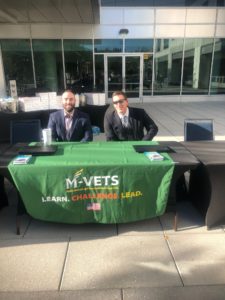
M-VETS Supports NSI/MINSLA Open House

(Pictured: Zach Kobokovich, Chapman Good)

The Antonin Scalia Law School Mason Veterans and Servicemembers Legal Clinic (“M-VETS”) supported the NSI/MINSLA Open House Event on 21 October 2021. Student-advisors Zach Kobokovich, Chapman Good, and John Madigan II represented the M-VETS clinic by proving information about the legal services offered by M-VETS and their experiences in the Clinic.

M-VETS Director, Timothy M. MacArthur, believes outreach to interested law students through school functions like the NSI/MINSLA Open House are instrumental in furthering the mission of the M-VETS legal clinic. “These outreach opportunities provide a valuable learning experience to potential student-advisors who want to apply and participate in the Clinic while at the law school,” MacArthur said. Student-Advisor Chapman Good commented: “A great example of NSI and M-VETS working together to recruit hard-working law students that will shape the future of our national security and continue to fight for our nation’s veterans. Thank you to all those students that showed interest in M-VETS, and for taking the time to talk with us.”

M-VETS will continue to conduct outreach and provide information regarding the Clinic to interested students, active-duty members of the armed forces, their families, and veterans. Please visit our webpage to keep updated on future events.

Military Retirement and Transition to the Blended Retirement System

Written By Summer 2021 M-VETS Student Advisor Mike Smiley

Summary

Military retirees and current Servicemembers ought to be aware of the military pension system that is applicable to their circumstance and the implications it can have on their financial wellbeing. The system of service member pensions is periodically revised, most recently and radically, as of January 1st, 2018, the Department of Defense has fully implemented the Blended Retirement System (BRS). This system modifies portions of the previous defined benefit plan and allows for matching contributions for the servicemember through matching contributions to the Servicemembers Thrift Savings Plan (TSP). Perhaps most impactful, it opens the doors to service members being able to develop a retirement nest egg even if they do not have the intention of serving a 20+ year military career. However, this added benefit also adds responsibility on the Servicemember who must take responsibility to participate in the program as they best see fit. Servicemembers participating in the BRS and any servicemember receiving retirement benefits should ensure that they are adequately educated on its impact on their retirement posture and planning.

Background

Throughout the history of the military, there has been some type of pension available for servicemembers meeting eligibility criteria. As far back as the Revolutionary War, a Servicemembers pension was implemented to encourage enlistment and prevent desertion amongst the ranks.[i] The concept of the 20 year military pension became standard around World War II and has remained a key component to military retirement eligibility to date.[ii] Currently, there are four different pension systems applicable to servicemembers based on their entry date of service: the Final Pay system; the High-3 system; the Career Status Bonus (CSB) or “Redux” system; and the current BRS.[iii]

1) Servicemembers who joined the military prior to September 8th, 1980, fall under the Final Pay system. Under this program a Servicemember that has accrued more than 20 years of applicable service is eligible for retirement pay equal to their final pay times a multiplier of 2.5 percent times their years of service. To protect the purchasing power of the retiree, the final pay system incorporates an adjustment annually by the percentage increase in the average Consumer Price Index (CPI).[iv]

2) Servicemembers who joined on or after September 8th, 1980 (but before implementation of the BRS) with 20 years of creditable military service have their final pay calculated by an average of their final three years of service, this is referred to as the High-3 System. This 36-month average still utilizes a 2.5 percent multiplier times the years accrued by the Servicemember and continues to use the CPI for an annual Cost of Living Adjustment (COLA).[v]

3) The CSB/Redux system was designed to provide incentive for service members on the fence about completing a 20-year military career to stay by providing an up-front payment with a reduction to their subsequent pension. A Servicemember who joined on or after August 1st, 1986, who also had 15 years of service before December 31st, 2017 (the start of the BRS) could opt for the CSB instead of the High-3 system. The system provided a $30,000 bonus at the Servicemembers 15th year of service but subject to a multiplier penalty if the servicemember retired with less than 30 years of service. This penalty (if enforced) is removed when the servicemember reaches age 62 and is then recomputed according to the high-3 system. Additionally, the COLA adjustment for those who elected the CSB is the CPI minus 1 percent except when CPI is less than a percent. Again, this CPI adjustment is converted back to the standard high-3 system when the Servicemember reaches the age of 62.[vi] This program ended on December 31, 2017.[vii]

4) Blended Retirement System (BRS): All Servicemembers who joined the military after December 31st, 2017, are automatically enrolled in the BRS.[viii] Additionally, Servicemembers with less than 12 years of service prior to December 31st, 2017, had the option to opt into the BRS if they did so by election in calendar year 2018 (without opting in Servicemembers remain on a High-3 system). The BRS combines components of the defined benefits programs with components more typical to a civilian employer-sponsored retirement program with matching contributions from the employer.[ix]

The Blended Retirement System

The Fiscal Year 2016 National Defense Authorization Act introduced the BRS and made it official beginning January 1st, 2018 and consists of three distinct components: a matching thrift savings plan (think traditional 401k), a career continuation bonus, and a pension.[x]

The Thrift Savings Plan or “TSP” is a defined contribution plan for federal employees to include Servicemembers. Servicemembers in the BRS will start with a default contribution of 3% of their base pay[xi] and after 60 days will automatically receive a 1% contribution from the Department of Defense. After two years, the service member will receive matching contributions up to 5% of their base pay as follows:

  • A 1 percent contribution from the Department of Defense automatically;
  • A 1 percent matching contribution for the first 3 percent of the Servicemembers base pay;
  • An additional .5 percent matching contribution for each additional 1 percent of the Servicemembers contribution.[xii]

This means that after two years a Servicemember can receive up to 5 percent matching contributions from the DoD in their TSP by investing 5 percent of their base pay into the program. All matching contributions become fully vested after completion of two years of service.[xiii]

The career continuation bonus looks and acts a lot like a reenlistment bonus but will occur between 8 and 12 years of service and is not actually affected by or limited by any reenlistment bonus that may exist.[xiv] Each service will implement different guidelines for the bonus but to be eligible the Servicemember must sign up for at least an additional 3 years (service dependent). The amount of the bonus will be determined based on the individual services needs and will range between 2.5 and 13 percent of the Servicemember’s base pay.

The first two benefits are at the expense of the defined benefit or pension program. The change is in the multiplier for years of service. The standard 20-year vesting period for the defined benefit remains, but the multiplier for years of service is reduced from 2.5 percent to 2 percent. In other words, the standard thought process of a 50 percent retirement at 20 years (2.5 x 20) is now replaced with a 40% defined benefit plus whatever value the servicemember has accumulated through the TSP and continuation of service bonus.[xv]

Why Change the Retirement System?

There are several reasons why the Government opted for an updated retirement system. First, as has been the case in most of corporate America, the traditional pension system had proved to be a high financial burden on the Government. Converting portions of the retirement system to a contribution system is likely a cost savings for the Government. Second, the “all or nothing” aspect of the previous military pension program meant that around 17 percent of military veterans received the benefit of a military retirement while the remaining 83 percent based solely on time in service were ineligible for any military retirement benefits.[xvi] Third, by introducing a retirement benefit available to all Servicemembers regardless of years of service, there is a potential to leverage retirement savings as a useful recruiting tool to Servicemembers not interested in committing to 20+ years of service. This combination of lower costs and an expansion of who may benefit from a military retirement incentive made the conversion largely amicable for Congress and the DoD.

Conclusion

When a Servicemember joined the service and how long they served will have a profound impact on what type of retirement program is relevant to that individual. As good as the BRS may be for the vast majority of Servicemembers (particularly those who likely would not have otherwise been eligible for any retirement compensation), it is also inherently more complex than its predecessors. Understanding this system and how to participate in it is vital to those currently joining or contemplating joining the service. There are several resources to help servicemembers understand this benefit and a great place to start is with the education program the Department of Defense has created to help encourage Servicemembers to both understand their employer funded contribution plan (TSP) and feel confident in the investment decisions they are making. For Servicemembers looking to start their education on managing their BRS, please reference the Department of Defense’s website: https://militarypay.defense.gov/blendedretirement/ and look at its litany of training options

[i] See Waite, Edward F., “Veteran’s Pensions: The Law and Its Administration From the Revolutionary War to the Civil War”, VCU Libraries Social Welfare Project presenting An Article from Harper’s new monthly magazine (Volume 86, Issue 512, January, 1893) found at: https://socialwelfare.library.vcu.edu/social-security/veterans-pensions-early-history/

[ii] Hudson, Rex, “A SUMMARY OF MAJOR MILITARY RETIREMENT REFORM PROPOSALS, 1976–2006” (page 1) Federal Research Division, Library of Congress, November 2007. Found at: Library of Congresshttps://www.loc.gov/rr/frd/pdf-files/CNGR_Summary-Military-Retirement.pdf

[iii] In addition to the retirement programs mentioned above, in certain circumstances, or when allowed by congress, Servicemembers may also qualify for retirement payments when either medically retired or when Temporary Early Retirement Authorization is enacted. These programs when applicable will provide retirement pay relative to the associated program based on date of service but have varying requirements for time in service. For additional information on TERA reference: https://www.dfas.mil/RetiredMilitary/plan/retirement-types/tera/. For additional information on medical retirement pay reference: https://www.dfas.mil/retiredmilitary/disability/disability/

[iv] DOD OFFICE OF THE ACTUARY, July 2018, “Statistical Report on the Military Retirement System” (pages 6-8). Found at: https://actuary.defense.gov/Portals/15/Documents/MRS_StatRpt_2017%20v4.pdf

[v] Id.

[vi] Id.

[vii] National Defense Authorization Act for FY 2016 (NDAA 2016, P.L. 114-92)

[viii] See Id.

[ix] DOD OFFICE OF THE ACTUARY, July 2018, “Statistical Report on the Military Retirement System” (pages 6-8). Found at: https://actuary.defense.gov/Portals/15/Documents/MRS_StatRpt_2017%20v4.pdf

[x] National Defense Authorization Act for FY 2016 (NDAA 2016, P.L. 114-92)

[xi] Military members will have multiple forms of compensation to include but not limited to Basic Allowance for Housing (BAH), Basic Allowance for Subsistence (BAS), and Cost of Living Adjustments (COLA) all of which are not subject to calculation for retirement benefits or defined contribution plans in the BRS.

[xii] Guina, Ryan, “Blended Retirement System (BRS) – Everything You Need to Know About the New Military Retirement Plan”. October 16, 2018. Found at: https://themilitarywallet.com/blended-retirement-system-brs/

[xiii] Id.

[xiv] Id.

[xv] Id.

[xvi]Military One Source, “Frequently Asked Questions Regarding the Blended Retirement System”. Found at: https://www.militaryonesource.mil/financial-legal/personal-finance/retirement-planning/frequently-asked-questions-regarding-the-new-blended-retirement-system/