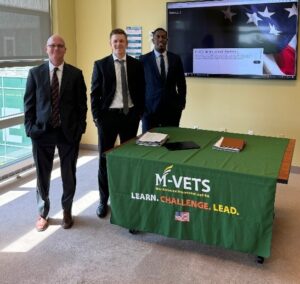
M-VETS Carries the Day and Secures Honorable Discharge for Navy Veteran

The Mason Veterans and Servicemembers Legal Clinic (M-VETS) successfully argued a claim before the Board for Correction of Naval Records (BCNR), a body responsible for correcting errors or injustices in Navy and Marine Corps records, seeking a fully Honorable conditions discharge for a Navy veteran. M-VETS filed a brief and argued on behalf of the veteran in 2024 and recently secured a fully Honorable conditions discharge.

The veteran served honorably in the active Navy from 2005 through 2006. The veteran was discharged for being a single parent who was unable to secure a family care plan due to serving thousands of miles away from her immediate family. Through no fault of her own, the veteran was separated from the Navy with a General, Under Honorable Conditions discharge characterization. This discharge characterization did not accurately reflect her honorable service.

In issuing their decision, the BCNR declared, “the Board noted that, under the authority and reason for which Petitioner was discharged, barring exceptional circumstances, she should have been issued a characterization consistent type warranted by service record. In that regard, the Board found that Petitioner’s record, to include her favorable performance evaluations and lack of documented misconduct, clearly reflected honorable service.”

M-VETS Director Timothy M. MacArthur stated: “Thankfully, the veteran reached out to M-VETS for assistance, and we are glad we could correct this injustice. Unfortunately, the separation authority made a clear error in judgment regarding the discharge characterization. Since 2006, due to the inaccurate discharge characterization, the veteran has carried the stigma of a discharge with less than fully honorable conditions. The stigma has been removed, and the veteran now has documented proof of her fully honorable service.”

“I appreciate all of your help and am super grateful!” said the veteran.

MacArthur continued: “Our client served honorably in the Navy, and to correct this injustice was a fantastic result.” MacArthur emphasized the contributions of the student advisors who worked on this matter, Mr. Alden Campo and Ms. Sarah Barker. “Throughout M-VETS’s representation, student advisors Alden Campo and Sarah Barker assisted with the client’s matter. Both student advisors truly believed in this veteran’s cause, and they were able to see this matter through to the end. I appreciate the time and effort they put into this case,” MacArthur said. “Alden and Sarah did an incredible job, and their hard work paid off!”

M-VETS assists veterans, Servicemembers, and their dependents in a variety of matters, including military and Department of Veterans Affairs benefits matters, including MEB/PEBs, Discharge Upgrades, Boards for Correction of Military Records, and DVA disability compensation and educational appeals.

Justice for Those Who Served: The Role of Veterans Treatment Courts in Recovery and Reintegration

Written By Fall 2024 M-VETS Student Advisor Curtis Power.

Each year, roughly 200,000 veterans transition from military to civilian life.1 While many veterans successfully reintegrate without significant challenges, a disproportionate number find themselves in the criminal justice system. According to 2021 census data, veterans make up 6.5% of the U.S. population, yet 31% have been arrested compared to just 18% of non-veterans. For many, breaking the law is often the first visible sign of deeper, unaddressed struggles.2
The root causes of these issues are well-documented. Veterans returning from combat frequently suffer from “invisible wounds”—injuries that are not physically apparent but profoundly impact their lives.3 Since 9/11, over four million Americans have served in the U.S. military during the extended conflicts in Afghanistan and Iraq.4 Veterans of these wars were twice as likely as those of earlier conflicts to have served in active combat zones.5 Many also completed multiple deployments, making them three times more likely to suffer from PTSD compared to non-deployed service members.6 According to Pew Research, seven out of ten post-9/11 veterans knew someone who was injured or killed in combat, and nearly 45% believe they experienced PTSD as a result of those exposures.7 Alarmingly, fewer than half of those suffering from PTSD seek treatment.8
The consequences of untreated trauma often manifest in substance abuse, which, in turn, leads to criminal behavior such as drunk driving, domestic violence, and other offenses.9 Recognizing the unique needs of these veterans, Veterans Treatment Courts (VTCs) were established to address the root causes of their criminal behavior and help them reintegrate into society.10
Origins of Veterans Treatment Courts
The first Veterans Treatment Court was launched in Buffalo, New York, on January 4, 2008, by Judge Robert Russell.11 Following its success, the model quickly spread across the country. By 2013, the Department of Justice began receiving dedicated funding for VTCs.12 In 2020, Congress passed the Veterans Treatment Court Coordination Act of 2019, mandating the creation of a grant program managed by the Bureau of Justice Assistance (BJA).13 Today, there are over 600 VTCs operating in jurisdictions across the United States.14
Why Do Veterans Treatment Courts Work?
Veterans Treatment Courts succeed because they are uniquely tailored to the military experience, leveraging the structure, camaraderie, and discipline that veterans are accustomed to.
  1. Structure and Discipline Military life is highly regimented, with clear expectations, rigorous training, and a unifying mission.15 VTCs replicate this structured environment, requiring regular court appearances (bi-weekly in the program’s early phases), mandatory attendance at treatment sessions, and frequent, random substance use testing.16 Veterans, accustomed to structure from their time in the armed forces, often respond positively to this approach.17
  2. Peer Mentorship Veteran mentors are considered the “secret sauce” of VTCs.18 These mentors, who are veterans themselves, provide guidance, encouragement, and accountability.19 They foster camaraderie and support while assisting participants with housing, employment, transportation, disability claims, discharge status appeals, and connecting them to local, state, and federal resources.20 This peer-to-peer interaction ensures veterans are not left behind.
  3. Incentives and Accountability VTCs employ a system of rewards and consequences to motivate participants. Positive behaviors—such as attending treatment sessions, court appearances, and maintaining sobriety—are recognized with incentives like praise, reduced court appearances, and small rewards such as gift cards.21 Conversely, non-compliance, such as failing a drug test or missing court, results in sanctions ranging from community service and fines to jail time or re-arrest.22
  4. Judicial Interaction The judge plays a pivotal role in the VTC model, maintaining regular interaction with each veteran throughout the program.23 This ongoing supervision fosters accountability and shows veterans that someone in authority genuinely cares about their progress.24 During a recent visit to a VTC, I observed a judge employing a compassionate yet firm approach with each participant. The judge opened every case by asking about the veteran’s family or interests. For one veteran, he lightheartedly inquired about how he was coping with the Georgia Bulldogs’ first college football loss of the season. These personal connections build trust and encourage veterans to stay engaged in the program.
Conclusion
Veterans Treatment Courts are a powerful tool in addressing the unique challenges faced by veterans involved in the criminal justice system. By combining structure, peer support, incentives, and compassionate judicial oversight, these courts help veterans break the cycle of criminal behavior and reintegrate into society. They not only address the root causes of criminal behavior but also restore dignity, hope, and purpose to those who have served our nation. Expanding access to these courts and ensuring their continued success is not just a matter of public safety—it is a moral imperative to honor the sacrifices of those who have worn the uniform.
 
Endnotes
3.  Rand Corp., Invisible Wounds of War: Psychological and Cognitive Injuries, Their Consequences, and Services to Assist Recovery (Terri Tanielian & Lisa H. Jaycox eds., 2008).
5.  Id.
6.  Id.
8.  Rand Corp., Invisible Wounds of War: Psychological and Cognitive Injuries, Their Consequences, and Services to Assist Recovery (Terri Tanielian & Lisa H. Jaycox eds., 2008).
10.  Id.
12.  Id.
13.  Id.
14.  Id.
16.  Id.
17.  Id.
19.  Id.
20.  Id.
22.  Id.
24.  Id.

How to Prepare for Your First Appearance Before the Board of Veterans’ Appeals (BVA)

Written By Fall 2024 M-VETS Student Advisor Danny Jenkins.

Appearing before the Board of Veterans’ Appeals (BVA) for the first time can feel daunting, but with the right preparation, you can effectively advocate for your client and make a strong impression. Here’s a step-by-step guide to help you navigate your first hearing successfully.

  1. Understand the Basics of BVA Hearings

The BVA reviews appeals related to decisions by the Department of Veterans Affairs (VA) on claims for benefits. Most hearings are informal and can be conducted virtually, in person, or via video conference. Your role is to present evidence and arguments to support your client’s case.

Key Tip: Familiarize yourself with the Veterans Appeals Improvement and Modernization Act of 2017 (AMA), as it governs appeals procedures and deadlines.

  1. Create a Trial Binder

The trial binder will be your saving grace. This should include medical records and service documents, applicable laws, regulations, and precedents relevant to the case, an outline of your argument and anticipated questions, and tabs for quick reference. This will keep you organized and able to answer questions quickly and effectively.

Key Tip: More is better. Clearly organize tabs and have everything ready that could come up at the hearing.

  1. Prepare Your Client

Ensure your client understands the process and their role during the hearing. If they will testify, conduct several mock interviews to prepare them for potential questions. Encourage honesty, clarity, and brevity in their responses.

Key Tip: Remind your client to stay calm and avoid overly emotional or argumentative statements.

  1. Master the Hearing Procedure

During the hearing:

– Arrive early (if in person) or test your equipment (if virtual).

– Introduce yourself and your client professionally.

– Listen carefully to questions from the Veterans Law Judge (VLJ) and respond clearly.

Key Tip: Be respectful, professional, and adaptable to the judge’s style of questioning.

Final Thoughts

Your first appearance before the BVA may feel like a learning experience, but preparation is key. By mastering the facts, developing a compelling argument, and presenting your case confidently, you’ll set yourself—and your client—up for success.

M-VETS Student Advisor and Assistant Director Advocate on Behalf of Two Clients at Board of Veterans’ Appeals Hearings

(Pictured L-R: M-VETS Director Timothy MacArthur, Student Advisor Danny Jenkins, and Assistant Director Raphael Johnson)

It has been a busy start to the fall 2024 academic semester for M-VETS. The Clinic advocated for two (2) clients before administrative judges at hearings before the Department of Veterans Affairs (DVA) Board of Veterans’ Appeals (BVA). The first hearing occurred on August 23, 2024, and the second was held on September 11, 2024.

Student Advisor (SA) Danny Jenkins conducted the August 23, 2024, hearing under the supervision of M-VETS Director Timothy MacArthur. The hearing involved a 2018 claim for a Certificate of Eligibility (COE) for a DVA home loan, which was finally heard after nearly six (6) years of litigation with the DVA.

M-VETS filed for the COE on behalf of a Virginia Army National Guard (VAANG) veteran who physically injured his right ankle while on active duty during initial training. Due to this injury, the veteran was discharged from active duty, and following his discharge, the veteran applied for the COE for a home loan. The DVA denied this request, and M-VETS filed a brief before the BVA and requested a personal appearance to argue the matter before a Judge.

M-VETS Director Timothy M. MacArthur stated, “I’m glad the veteran reached out to M-VETS and that we were able to advocate on his behalf at this hearing. The DVA initially denied the COE request because the veteran did not serve for the statutorily required six (6) years in the VAANG; however, there is an exception to this requirement if the veteran had been separated from service for a service-connected disability. While our veteran was service-connected for his injury, the discharge paperwork did not indicate that he was discharged from service for this injury, which created a challenge for our client and the Clinic.”

Due to the lengthy litigating of this issue, many M-VETS SAs worked diligently on it while in the clinic. When the matter was scheduled for hearing, current M-VETS SA Danny Jenkins argued the motion before the BVA.

“I was grateful for the opportunity to assist the veteran at the hearing. Six years’ worth of incredible Student Advisors helped the veteran get to this point through proper evidence collection, client preparation, and brief drafting that made my job at the hearing the easy part. To be able to represent a real client at a hearing, outside the classroom, is something I never thought possible while in school.” Jenkins said.

“Danny did a great job arguing the motion and presenting evidence during the hearing,” MacArthur commented. “Our client was able to attend the hearing virtually, and Danny conducted a pre-hearing conference with the Judge, delivered an opening statement, and a direct examination of our client, which effectively argued our position that the discharge documents did not accurately reflect the reason our veteran was discharged from the military,” MacArthur continued. “The DVA benefits process is paternalistic, which is invaluable for allowing our students to gain practical experience in a non-adversarial setting while providing valuable pro bono services to our clients.”

M-VETS continues working with the veteran to correct his discharge before the Board for Correction of Military Records to reflect a medical retirement.

M-VETS Assistant Director Raphael Johnson conducted the September 11, 2024, hearing. The hearing involved a 2019 claim for an increase in a disability rating from 10% to 50% for a service-connect injury, which the DVA initially denied.

“Raphael did a great job with this hearing,” MacArthur said. “The Clinic waited five (5) years for this hearing, and I am glad Raphael was the M-VETS representative who was able to represent our client at this hearing.  While a law student at Scalia Law, Raphael was an M-VETS SA for two (2) semesters and worked on this veteran’s matter while in the Clinic. This was a long process, and fortunately, our client could weather the storm to see this through,” MacArthur continued.

Johnson reflected, “It is an honor to assist and represent Veteran clients, both while serving as an M-VETS Student Advisor and now as the clinic’s Assistant Director. In this case, our client waited many years to make the case for much-deserved benefits and compensation. The DVA benefits system can confuse many clients, and I am proud to work for an organization committed to providing 100% pro bono services and representation to America’s Veterans.”

M-VETS assists veterans, service members, and their dependents with military/veteran/DVA administrative matters, including MEB/PEBs, discharge upgrades, Boards for Correction of Military Records, and DVA disability compensation and educational benefits appeals.

M-VETS and GMU Center for Community Mental Health Join Forces to Help USAF Veteran Receive Monthly Disability Payments!

(Pictured: M-VETS Student Advisor Danny Jenkins)

The Mason Veterans and Servicemembers Legal Clinic (M-VETS) successfully advocated for a United States Air Force (USAF) veteran to receive Department of Veterans Affairs (DVA) disability payments at the 50% compensation rate for the rest of the veteran’s life.

The veteran served on active duty in the USAF from 2016 through 2019. During her service, she could not serve openly in alignment with her gender identity and suffered invisible injuries due to the Department of Defense’s 2017 ban on transgender individuals serving in the military.

M-VETS student advisors worked with the veteran to collect and analyze her service treatment records and team up with the George Mason University Center for Community Health (GMU CCMH) to prepare a full-scope psychosocial and emotional evaluation.  The GMU CCMH report was then used by M-VETS to file a claim with the DVA on behalf of the veteran.  The claim was granted by the DVA, which resulted in the veteran receiving disability payments at the 50% compensation rate.

M-VETS Director Timothy M. MacArthur stated: “I’m glad the veteran reached out to M-VETS, and we were able to assist with this issue. GMU CCMH did a remarkable job assessing the situation and preparing a comprehensive evaluation that assisted our veteran in receiving the compensation she deserves. The completed report showed that during her military service, the veteran suffered from gender dysphoria and major depressive and anxiety disorders directly related to her military service.”

“I want to thank M-VETS and GMU CCMH for helping me obtain my benefits!” said the veteran.

MacArthur continued: “Our client served honorably in the USAF, and to have her invisible wounds recognized by the DVA as service-connected was a fantastic result.” MacArthur emphasized the contribution of the past student advisors who worked on this matter. “Throughout M-VETS’s representation, four (4) student advisors assisted with the client’s matter, and they did an incredible job,” MacArthur said. “I appreciate the time and effort they put into this case, and their hard work paid off.”

M-VETS Student Advisor Danny Jenkins stated, “The opportunity to step away from the classroom and learn by helping real clients with real problems has been invaluable. The past student advisors did incredible work, and I was honored to play a role in helping our client receive the compensation she deserves.”

M-VETS assists veterans, Servicemembers, and their dependents in a variety of civil matters, including uncontested divorces, landlord/tenant matters, consumer protection, and contract disputes, as well as in military/DVA administrative matters, including MEB/PEBs, Discharge Upgrades, Boards for Correction of Military Records, and DVA disability compensation and educational benefit appeals.

Understanding Your Rights: Active-Duty Service Members Must Know Their Rights to Claim Protection Under the Military Lending Act

Written by Summer 2024 M-VETS Student Advisor Brian Tarno.

“The MLA better protects our service men and women from predatory credit practices by expanding financial protections provided to service members, and helping ensure military families receive the consumer protections they deserve.”[1]

What is the Military Lending Act? 

The Military Lending Act[2] (“MLA”) protects active-duty service members from predatory lending practices that undermine military readiness and cause undue stress and harm to service members and their dependents.[3] The MLA limits the types, terms, and conditions of consumer credit products offered to active-duty service members and certain dependents.[4] The MLA is implemented through Department of Defense (“DoD”) regulations.[5]

What Does the MLA do? 

The MLA has two main functions. First, unlike many federal consumer protection laws in the United States, the MLA places substantive limitations on the terms and conditions of consumer credit products offered to service members.[6] Second, the MLA requires additional disclosures for service members who receive a consumer credit product.[7]

The MLA prohibits and limits the terms and conditions of consumer credit products.[8] First, the MLA caps the interest rate charged to service members at 36%.[9] This interest rate cap, known as the Military Annual Percentage Rate (“MAPR”), is calculated in a more expansive way than other interest rate regulations.[10] Subject to some exclusions, the MAPR includes:

  • Most finance charges;
  • Credit insurance premiums;
  • Fees for debt cancellation contracts;
  • Ancillary or add-on product fees;
  • Application fees, and
  • Participation fees.[11]

The annual interest rate cannot surpass 36% when all these fees and charges are calculated.[12]

Second, the MLA prohibits creditors from forcing service members to waive their rights.[13] The MLA is one of the few federal laws that expressly ban mandatory arbitration clauses in consumer financial contracts.[14] Additionally, the MLA makes it illegal for creditors to require a servicemember to waive protections under federal and state law, such as the Servicemembers Civil Relief Act.[15]

Third, the MLA prohibits creditors from charging prepayment fees to service members.[16] If a service member can pay the total amount of a loan or credit product before it is due, the creditor must accept this and not charge an early prepayment fee.[17] Fourth, the MLA makes it illegal for creditors to extend “roll-over” credit to service members, where the balance of an old loan rolls over to a new loan.[18] Finally, the MLA prohibits creditors from requiring service members to comply with “unreasonable notice” provisions.[19]

In addition to the substantive protections, the MLA requires creditors to make additional disclosures to service members. First, the MLA requires creditors to comply with the disclosure requirements found in Regulation Z.[20] Second, the MLA requires creditors to describe all fees and charges used in the calculation of the MAPR.[21] Finally, the MLA requires creditors to provide a “clear description of the payment obligations” to the servicemember.[22]

What is Covered? 

DoD regulations expressly defer to Regulation Z when defining consumer credit products, which provides a much broader scope of coverage than the initial statutory grant for the MLA. Therefore, the MLA covers any consumer credit product offered for personal, family, or household purposes that is either subject to a finance charge or payable in more than four installments. This includes credit cards, payday loans, nontraditional overdraft lines of credit, some types of student loans, and installment loans.[23]

However, there are important exceptions to MLA coverage. Any loan secured by the object of the loan is not subject to the MLA.[24] This exemption covers residential mortgages that are secured by the home being purchased, vehicle loans secured by the vehicle being purchased, and loans for personal property secured by the property being purchased.[25] For instance, a loan for a washing machine, secured by the washing machine as collateral, is not covered by the MLA protections.

Who Enforces the MLA?

In 2013, Congress amended the MLA to grant federal and state administrative bodies enforcement authority.[26] The same regulators that enforce the Truth-in-Lending Act can enforce the MLA.[27] This includes the Consumer Financial Protection Bureau, National Credit Union Administration, Federal Deposit Insurance Corporation, Federal Trade Commission, and state agencies entrusted with the supervision of state-chartered financial organizations.[28]

In addition to administrative enforcement, the MLA contains a private liability provision.[29] This means that creditors who violate the MLA may be sued by private individuals who suffer harm. Service members who sue under the MLA are entitled to recover actual damages, punitive damages, equitable relief, costs, and attorney’s fees.[30]

Recent Developments  

Federal courts have recently clarified two aspects of the MLA. First, the United States District Court for the Eastern District of Virginia applied a “broad reading” of the MLA’s statute of limitations.[31] Second, the United States Court of Appeals for the Eleventh Circuit — which covers Alabama, Georgia, and Florida — held that service members must be able to trace their harms to violations of the MLA in order to bring suit.[32] Taken together, these court cases showcase the need for service members to properly understand their rights to avail themselves of them under the MLA.

The MLA statute of limitations is two years from the date when the service member discovers the violation.[33] In Wood v. Omni Financial of Nevada, Inc.,[34] the district court held that the statute of limitations begins to run on the date the service member discovers the violation, not the date that the service member learns that the violation is against the law.[35] This means that a service member has two years from the date of discovery to bring suit, regardless of whether the service member knows they have the right to bring suit.[36] Therefore, service members need to know their rights under the MLA to redress their injuries adequately.

In the Eleventh Circuit, a service member does not have standing to sue under the MLA just because their contract contains illicit terms.[37] In Louis v. Bluegreen Vacations Unlimited, Inc., the court held that despite violations of the MLA, which could render a contract void, service members lack standing unless they can affirmatively trace an injury to the violations of the MLA.[38] Specifically, the court held that the plaintiffs failed to show that the alleged MLA violations caused them to sign the contract or make extra payments.[39] Therefore, service members in these states can be held to contracts that contain illicit terms if there is no directly traceable injury by the violation.

How can Service Members Protect Themselves? 

Knowledge is power, and service members can only protect themselves from harms they know about. When taking out a loan or accepting a provision of credit, service members should ensure they understand every aspect of the contract. Because the statute of limitations for an MLA claim is two years from the discovery of a potential violation, service members must be able to identify illicit terms early, as ignorance of the law is not a defense to the statute of limitations. Additionally, service members should contact their local Judge Advocate General’s office for counseling on their rights. Finally, based on a recent court case, service members can be bound by terms that violate the MLA and not have standing to sue. Thus, official complaints to the FTC and CFPB take on a more comprehensive role in helping service members assert their rights. Service members who believe they have encountered a violation of the MLA should report these companies to the FTC and CFPB to protect themselves and fellow service members.

[1] Press Release, Department of Defense, Department of Defense Issues Final Military Lending Act Rule (July 21, 2015), https://www.defense.gov/News/Releases/Release/Article/612795/department-of-defense-issues-final-military-lending-act-rule/ (hereinafter “DoD Press Release July 2015”).

[2] 10 U.S.C. § 987.

[3] DoD Press Release July 2015.

[4] Consumer Financial Protection Bureau, What is the Military Lending Act and what are my rights? https://www.consumerfinance.gov/consumer-tools/educator-tools/servicemembers/military-lending-act-mla/, (last visited Aug. 20, 2024) (hereinafter “CFPB MLA Blog”).

[5] Federal Reserve, Military Lending Act – Consumer Compliance Handbook, at 1.

[6] See CFPB MLA Blog.

[7] Id.

[8] Id.

[9] Id.

[10] Id.

[11] National Credit Union Administration, Complying with Recent Changes to the Military Lending Act, https://ncua.gov/regulation-supervision/letters-credit-unions-other-guidance/complying-recent-changes-military-lending-act-regulation, (last visited Aug. 20, 2024) (hereinafter “NCUA MLA Guidance”).

[12] Id.

[13] Id.

[14] See id.

[15] Id.

[16] CFPB MLA Blog.

[17] Id.

[18] Id.

[19] 10 U.S.C. 983(e)(3)-(4).

[20] 10 U.S.C. 983(c)(1)(b).

[21] 10 U.S.C. 983(c)(1)(a).

[22] 10 U.S.C. 983(c)(1)(c).

[23] CFPB MLA Blog.

[24] Id.

[25]  Id.

[26] Federal Reserve, supra n.5, at 1.

[27] Federal Reserve, supra n.5, at 1.

[28] 15 U.S.C. § 1607.

[29] 10 U.S.C. § 983(f)(5).

[30] 10 U.S.C. § 983(f)(5).

[31] Virginia Federal Court Applies Broad Reading of Military Lending Act’s Statute of Limitation in Dismissal of Borrower Class Action, (June 9, 2023) https://www.consumerfinancialserviceslawmonitor.com/2023/06/virginia-federal-court-applies-broad-reading-of-military-lending-acts-statute-of-limitation-in-dismissal-of-borrower-class-action.

[32] See Louis v. Bluegreen Vacations Unlimited, Inc., 2024 U.S. App. LEXIS 13925 at *8-*9 (11th Cir. June 7, 2024);

[33] About the Court, United States Court of Appeals for the Eleventh Circuit, https://www.ca11.uscourts.gov/about-court#:~:text=Established%20by%20Congress%20in%201981,Northern%2C%20Middle%20and%20Southern%20Districts (last visited Aug. 20, 2024).

[34] 2023 U.S. Dist. LEXIS 95656 (E.D. VA May 31, 2023).

[35] Id. at *41-*42.

[36] Id.

[37] Louis, 2024 U.S. App. LEXIS 13925 at *8-*9.

[38] Id.

[39] Id. at *6.

M-VETS Succeeds and Secures Honorable Discharge for USMC Combat Veteran

Liz Faris

(Pictured: Former Student Advisor Liz Faris)

The Mason Veterans and Servicemembers Legal Clinic (M-VETS) successfully argued a claim before the Naval Discharge Review Board (NDRB) seeking an Honorable conditions discharge for a United States Marine Corps (USMC) combat veteran. M-VETS filed the application with a supporting brief and exhibits on behalf of the veteran in 2022 and recently secured an Honorable conditions discharge. The successful application will allow the veteran to access long-overdue medical treatment and Department of Veterans Affairs (DVA) disability benefits.

The veteran served on active duty in the USMC from 2004 through 2007 as a Rifleman (0311). During his service, the veteran deployed twice to Iraq; the first deployment occurred in 2005, and the second was to Fallujah from 2006 to 2007, where the veteran earned a Combat Action Ribbon.  The veteran suffered from injuries due to combat, which led to self-medication to soothe the symptoms of Post-traumatic stress and Traumatic Brain injury. As a result, the veteran was discharged under Other than Honorable conditions despite both conditions being diagnosed during service. This discharge characterization prevented the veteran from accessing medical treatment and DVA disability benefits.

M-VETS Director Timothy M. MacArthur stated: “I’m glad the veteran reached out to M-VETS, and we were able to assist with this issue. Since 2007, the veteran has not been eligible for disability benefits due to the discharge characterization and has carried the stigma of a discharge with less-than-honorable conditions. The stigma has been removed, and the veteran can use those hard-earned benefits due to the honorable conditions discharge.”

“I am so happy!” said the veteran. “Thank you for everything.”

MacArthur continued: “Our client served honorably in the USMC, and to correct this injustice was a fantastic result.” MacArthur emphasized the contribution of the student advisors who worked on this matter, Ms. Liz Faris and Mr. Douglas Boyle. “Throughout M-VETS’s representation, student advisors Liz Faris and Doug Boyle assisted with the client’s matter. They truly believed in this veteran’s cause, and I appreciate the time and effort they put into this case,” MacArthur said. “Both student advisors did an incredible job, and their hard work paid off.”

Faris stated: “It was a great experience working with this client, and I learned a lot while working on his case. He fought and sacrificed for this country during his time in the USMC and deserved a discharge designation that reflected his service. I’m so glad that the NDRB agreed and that he can now access the resources he deserves!”

M-VETS assists veterans, Servicemembers, and their dependents in a variety of civil matters, including uncontested divorces, landlord/tenant matters, consumer protection, and contract disputes, as well as in military/DVA administrative matters, including MEB/PEBs, Discharge Upgrades, Boards for Correction of Military Records, and DVA disability compensation appeals.

The Lived Experience of Administrative Law

Written by Fall 2023 M-VETS Student Advisor J. Jordan Caruso.

“It is hard to imagine a more stupid or more dangerous way of making decisions than by putting those decisions in the hands of people who pay no price for being wrong.”[1]

It is uncontroversial that the ideal of expertise underlies the establishment and functioning of administrative agencies.[2]  One expects that such expertise includes a level of competence that minimizes the occurrence of administrative errors.  “Bureaucratic organizations are meant to be technical, rational, and consistent, which serves to maximize predictability in part through minimizing the risk of errors.”[3]  But the reality for too many individuals is that administrations are responsible for numerous avoidable mistakes. To prevent such errors and mitigate the burden of experiencing them, I propose two models for the DVA to consider: (1) a lawyer-administrator and (2) an Ombudsman.

During my two semesters as a Student Advisor (SA) for Mason’s Veterans and Servicemembers (M-VETS) pro bono legal clinic, I had the privilege of partnering with a fellow-SA, Amanda Nhek, to argue before the Board of Veterans Appeals (BVA) on behalf of one Veteran, a former Navy Sailor who served for 13 years.  The Department of Veterans Affairs (DVA) could not seem to get this particular Veteran’s disability claim right.  Over the course of many years, M-VETS successfully moved the DVA to correct several mistakes regarding the disability claim.  When my partner and I volunteered to work the case, M-VETS had its eyes on two remaining issues:  a jaw disorder and a chronic migraine condition.  In preparing for the hearing, my partner and I met at least twice a week, often with the Director of the clinic, Timothy MacArthur, to work through the issues, prepare evidence and filings, and rehearse the arguments we would eventually make before the BVA.  I primarily focused on the jaw disorder claim while my partner took point on the migraine claim.  Regarding the migraine condition, the DVA service-connected the condition but denied a compensable disability rating on multiple occasions despite the condition’s debilitating severity.  Regarding the jaw disorder, the DVA repeatedly denied service-connection, despite multiple diagnoses by different medical providers in the Veteran’s service record.

Mistake #1:  Failing to Read the Veteran’s Record

When a veteran claimant files a substantially complete disability claim, in theory, the DVA is supposed to review the veteran’s claim, including his or her entire service record, and service-connect those claimed disabilities that are linked to an event in service.[4]  Typically, a diagnosis from a military health provider is sufficient to show service-connection.[5]  Yet, despite our client’s record containing at least three separate diagnoses for the same condition from different military health providers, the DVA denied service-connecting the jaw disorder due to insufficient evidence.

Did the administrator read our client’s service record?  I didn’t think so.  But in good faith and zealous advocacy, M-VETS advised the Veteran to obtain current medical opinions from medical providers.  The Veteran received another diagnosis, confirming the diagnoses of previous military professionals in the Service Record.  We pressed the issue again, this time armed with the new medical evidence and a legal brief that left the DVA administrators with little work to do.

Mistake #2:  Failing to Read the Veteran’s Record, Again

Before appealing the issues to the BVA, M-VETS submitted extended briefs and additional evidence to help the DVA correct these issues.  For the jaw disorder, the DVA required the veteran to go through another DVA medical examination.  These examinations are par for the course of a disability claim.  When a veteran submits a substantially complete disability claim, the DVA has a statutory duty to provide the veteran with a medical examination or opinion if needed to substantiate the veteran’s claim.[6]  A DVA medical examiner is supposed to review a veteran’s entire service record, provide a summary of the veteran’s medical history, and reference pages in the record that the examiner relied upon to form his or her opinion.

When we got the rating decision back from the DVA, we noticed that the medical examiner believed that our client did not have the claimed jaw disorder but was actually just a teeth-grinder.  The medical examiner’s summary of our client’s medical history was vague and far too short, claiming that the veteran had no history of the jaw disorder.  Because we had reviewed the veteran’s entire service record, we knew this was false, and appealed the issue to the BVA.

The BVA Read the Veteran’s Record

This appeal was years in the making.  After preparing all semester, we presented the case before a Veterans Law Judge and his law clerk; both of which listened carefully and sympathetically to our arguments and our client’s testimony.  My partner argued the migraine issue and persuaded the Court to grant a 30% compensable disability rating for the condition, including back-pay to the Veteran’s date of filing.  As for the jaw disorder, I articulated the standard, showed that the condition met the standard, and directed the Court’s attention to the relevant evidence—hitherto ignored—in the Veteran’s DVA file.  The BVA acknowledged the merits and remanded the issue back to the DVA, instructing the administrators and medical examiners to thoroughly review the Veteran’s service record and provide a detailed opinion that references the relevant pages we brought to the Court’s attention.  This, too, we considered a win.

Sometimes it takes a judge and lawyer.  In our client’s case, it required an appeal to the BVA to tell the administration to do what it should have done in the first instance.  At this point, to get the benefits the Veteran was entitled to required several years of time and attention.  The Veteran was required to undergo unnecessary medical appointments just to amount cumulative evidence.  Over the years, M-VETS wrote nearly a dozen incredibly detailed legal briefs to clarify the claim for the sake of the DVA administrators, not to mention countless hours spent sifting through the Veteran’s 10,000+ page file to make the rater’s decision that much easier.  Luckily for our client, M-VETS is a pro-bono legal clinic with purpose-driven leaders; but I cannot help but think of the thousands of veterans who do not get help from a clinic or who cannot afford a lawyer.

Mistake #3:  Ignoring the BVA and Refusing to Read the Record

Upon remand from the BVA, the DVA reopened their review of the jaw disorder claim and ordered another medical examination.  When the BVA remands a veteran’s claim to the DVA, the new decision automatically goes back up to the BVA for review to ensure the DVA complied with the Court’s orders.  In our client’s case, the BVA remanded the jaw issue with detailed instructions that the DVA rater or medical examiner needed to view the previous diagnoses in the Veteran’s file and provide a clear rationale for each conclusion based on the record.  The DVA again denied service-connection for the jaw disorder.

After this denial, M-VETS had about forty-five days to file a response to be reviewed by the BVA with the DVA’s decision.  As I wrote the brief reiterating our points and pointing to the DVA’s errors, I noticed that the medical examination after remand was performed by the same medical examiner who seemed to ignore the veteran’s service record years earlier.  This medical examiner—even after remand and detailed instructions from a Veteran’s Law Judge—copied and pasted his summary of medical history from his first examination and wrote two sentences saying that he had examined the veteran a few years ago and concluded the veteran did not have the jaw disorder.  That was the only rationale provided.  I made sure to highlight this fact in the brief to the BVA.

Several weeks later, the BVA came back and granted the Veteran the relief we asked for.  The BVA decided that enough was enough; it service-connected the jaw disorder based on the diagnoses in the Veteran’s file and granted a 10% compensable disability rating based on the painful motion principle.[7]  Sometimes it takes a judge and a lawyer.

The Ordinary Experience of Administration

Administrative government is a constant topic of scholarly debate, and unsurprisingly so.  Although government administration has existed in the United States since its founding, the current “administrative state” has exploded since the 1940s and has reached into nearly every corner of American society.[8]  Administration is no longer something that occurs in a distant headquarters building at the nation’s capital, but is something every American experiences in ordinary life.  As one law professor puts it, “the renewed attention has been prompted by practices that are widely perceived as problematic, irregular, or even abusive. Examples include the imposition of civil fines by bureaucratic edict; ‘non-final’ enforcement actions that effectively thwart private citizens’ businesses or use of their land; the holdup of permits or licenses, and their conditioning on well-nigh extortionate demands; sudden changes of agency policy, accomplished by means of adjudication and without fair warning to the parties; the opportunistic shifting of enforcement proceedings from Article III courts into agency tribunals; and the administrative ‘death squadding’ of invention patents that cannot be canceled in any U.S. court.”[9]

Much of the legal and academic discourse around administrative law focuses on judicial deference, the separation of powers, or public policy decisions.  Yet, the lived experience of individuals petitioning administrative agencies is better characterized as constant battles to move the agencies to do their jobs correctly.

Our client’s experience with the DVA is hardly peculiar.  In 2019, a team of Stanford scholars authored a study that characterized “rampant errors and a backlog of appeals cases” as a “plague[] . . . of the nation’s administrative system.”[10]  Furthermore, the plague of administrative erring is not unique to the DVA.  The Office of the Inspector General of the Social Security Administration (SSA) released a report in November 2023 that found the SSA overpaid $11.1 billion and underpaid $3.5 billion to beneficiaries.[11]  Under the Department of Labor, the Employee and Training Administration (ETA) estimated that the national improper payment rate for Unemployment Insurance in 2023 was 16.47%, though a given state may vary significantly.[12]

My personal experience is of the same ilk.  When I petitioned the United States Citizenship and Immigration Service (USCIC) in 2020 for my spouse’s immigration, the agency misrouted my case to be processed as if my spouse already resided in the United States rather than going through the National Visa Center (NVC) to allow her to enter the border.  USCIS lost my casefile for nearly seven months.  In addition to sending letters and visiting field offices, I called USCIS nearly every day for six months to press them to fix the issue, waiting on hold for at least an hour each time.  Many repetitions taught me that I needed to say magic words to get a live representative on the phone, who usually knew nothing more than one could learn from the USCIS website.  It was possible to elevate an issue to an “immigration officer,” which required you to wait for a return call that rarely ever came.  If the phone lines were busy, the automated service would refuse to connect you to a representative and automatically end the call.  I finally—as a “Hail Mary”—wrote a detailed complaint to the White House.  About a month later, I received an email saying that the White House received my note and referred my issue to the proper authorities.  Three days later, USCIS located my casefile and routed it to the NVC.  About a day or two after that, NVC notified me that they received my immigration file and began processing my spouse for entry into the United States.[13]

Administrative Errors Cause Administrative Burden

Administrative errors create administrative burden.[14]  In their investigation of  how administrative burden “affects fair treatment and access to (social) rights,”[15] scholars explain that “[b]urdens can cause learning costs (finding out how procedures work and what services are available), psychological costs (social stigma associated with welfare services or stress caused by onerous procedures), and compliance costs (time and money spent on rules and requirements).”[16]  Administrative burden is not just about time and money, but justice.  Whether or not a person agrees with legislative welfare schemes, once an entitlement is granted to a class, then it becomes a matter of fairness and the rule of law in granting or denying benefits.[17]  Even aside from the merits of an entitlement, a person has a natural right to due process in our country, yet the burden of correction falls on the individual while facing an “escalation of consequences” because errors “spread automatically through the system, but corrections do not.”[18]  Although the due process aspects of administrative law at the level of Article III appellate courts are hotly debated, all theories seem to assume the administration is doing its job.  But if the administration refuses to read a petitioner’s casefile, then there was no due process from the start.

A Simple Solution for Administrative Competence.

While many scholars have offered high-level solutions of law and policy,[19] many of which are meritorious, the problem I am attempting to magnify is basic.  Whether we view it in terms of competence, accountability, or due care, the problem is one at the lower, foundational levels of administration.  My aim is to meet the basic problem with a simple solution based on experience:  that it takes a judge and lawyer.  Much of the discourse surrounding administrative law focuses on agency deference afforded by Article III courts or structures of oversight in the Legislative and Executive branches, but the reality is that the typical veteran is not equipped with the resources to appeal to the BVA, let alone to the Court of Appeals for Veteran’s Claims or higher.  It seems that it would not only save the DVA time and resources, but would also do justice for veterans if a lawyer reviewed rating decisions of the lower level administrators.  Simply position a lawyer at the administrative level.[20]

I use the word “simply,” but I am aware that some may object this too would cause inefficiency or unnecessary cost.  Lawyers are expensive and are surely fallible.  But one thing the legal profession inculcates is attention to detail, which seems to me the thing that administrators are severely lacking.  Lawyers are also trained to think like judges and anticipate appealable errors versus harmless ones.[21]  In theory, a simple legal review of work product in the first instance could help prevent countless administrative errors and mitigate burdens on both the government and beneficiaries.

Some might also object that resolving the problem of administrative error is simply impractical because administration requires administrators and administrators require training.  A healthy environment for any worker requires a certain degree of freedom to make mistakes and learn from them.  And there will always be a “new guy.”  But the basic oversight of a lawyer’s legal review is not that type of managerial supervision.  Of course, I do not want disability raters to lose their job for making a mistake now and then.  The legal review should be a skilled check independent of an administrator’s channel of supervision and accountability, allowing correction for the sake of the beneficiary without impeding on the leadership of supervisors.  Furthermore, an independent legal review would likely save time rather than extend it because the lawyer’s eyes are trained to see what the ordinary non-lawyer’s cannot.  A lawyer’s review of rating decisions can prevent administrative errors from causing the “escalation of consequences”[22] and a vicious cycle of appeals and denials.

The Ombudsman Solution

Taking the idea of a low-level legal review one step further, the experience of administration suggests the need for something like an Ombudsman.[23]  Potential beneficiaries need an expedient avenue to point an agency’s attention to its own errors, like a grievance or complaint department of a hardware store or an authoritative referee that is independent of the agency (not unlike the Board of Veteran’s Appeals, but at the operational level).  When an administrator errors or just fails to read the file, the disabled veteran—or any beneficiary for that matter—should not have the burden of repetitive filings or judicial appeal to move the government agency to correction.  Ombudsing has a rich tradition surrounded by a wealth of literature, in which one can find diverse models to fit agencies’ situations.[24]  Modern democratic regimes provide various Ombudsman models and many nations have effectively implemented the institution for the protection of human rights and correction of maladministration in government.[25]  An analogous institution in American governance is the Office of the Inspector General, which typically investigates or audits its respective government agency, provides it guidance, and reports to overseeing institutions.  What the Ombudsman offers that Offices of Inspectors General do not is two-fold:  legal authority and public accountability.  The Ombudsman’s duty is to individuals, not the government, yet the Ombudsman wields authority to move the government.  The underlying ideals are similar to those that found the independent judiciary, but it pinpoints that analogous power and duty at the operational level.  Whereas a lawyer providing legal review would help prevent administrative errors, an Ombudsman would help correct them expediently and relieve grieved beneficiaries from having to push through the current (and exhausting) administrative remedies.

[1] Thomas Sowell, Wake Up, Parents, Jewish World Review (Aug. 18, 2000), https://www.jewishworldreview.com/cols/sowell081800.asp.

[2] See Wendy E. Wagner, A Place for Agency Expertise: Reconciling Agency Expertise with Presidential Power, 115 Colum. L. Rev. 2019, 2023 (2015) (“Although the hypertechnicality of agency rules is a more recent phenomenon, the basic concept that the agencies should preside over specialized information is hard-wired into the design of the administrative state.”).  In one famous case, the U.S. Supreme Court held that judges should afford deference to the work product of agencies based on the assumption that agencies possessed greater expertise over their own statutes and policies.  See SEC v. Chenery Corp. (Chenery II), 332 U.S. 194, 209 (1947) (explaining that “administrative judgments are entitled to the greatest amount of weight [when they concern] . . . the product of administrative experience, appreciation of the complexities of the problem, realization of the statutory policies, and responsible treatment of the uncontested facts.  It is the type of judgment which administrative agencies are best equipped to make and which justifies the use of the administrative process.”).  See also Ronald J. Krotoszynski Jr., Why Deference: Implied Delegations, Agency Expertise, and the Misplaced Legacy of Skidmore Administrative Law Discussion Forum, 54 Admin L. Rev. 725, 736 (2002).

[3] Matthew M. Young et al., Complexity, Errors, and Administrative Burdens, Pub. Mgmt. Rev., 21 Dec 2023, at 1, https://doi.org/10.1080/14719037.2023.2288247.

[4] Every disability claim has two elements:  service-connection and disability rating.  The legal standard is to service-connect a veteran’s (1) current disability (2) that presents a continuity of symptoms and (3) is related to an event or diagnosis during the veteran’s military Service.  Disability ratings, on the other hand, generally follow the interpretive guidelines of Schedule for Rating Disabilities, 38 C.F.R. Part 4, which catalogs a multitude of conditions, each with a rating scheme.

[5] See Direct Service Connection (SC) and Service Incurrence of an Injury, M21-1, Part V, Subpart ii, 2.A., available at https://www.knowva.ebenefits.va.gov/system/templates/selfservice/va_ssnew/help/customer/locale/en-US/portal/554400000001018/content/554400000180481/M21-1-Part-V-Subpart-ii-Chapter-2-Section-A-Direct-Service-Connection-SC-and-Service-Incurrence-of-an-Injury?query=M21-1%20Service%20Connection; accord Principles Relating to Service Connection, 38 C.F.R. § 3.303.

[6] See Duty to Assist Claimants, 38 U.S.C. § 5103A(d); Providing Medical Examinations or Obtaining Medical Opinions, 38 CFR § 3.159(c)(4).  See also Evidentiary Standards for Finding an
Examination or Opinion Necessary, M21-1, Part IV, Subpart i, 1.B., available at https://www.knowva.ebenefits.va.gov/system/templates/selfservice/va_ssnew/help/customer/locale/en-US/portal/554400000001018/content/554400000180495/M21-1-Part-IV-Subpart-i-Chapter-1-Section-B-Evidentiary-Standards-for-Finding-an-Examination-or-Opinion-Necessary.

[7] See Painful Motion, 38 C.F.R. § 4.59 (2017).  See also Painful Motion and Functional Loss, M21-1, Part V, Subpart iii, 1.A., available at https://www.knowva.ebenefits.va.gov/system/templates/selfservice/va_ssnew/help/customer/locale/en-us/portal/554400000001018/content/554400000014407/M21-1-Part-V-Subpart-iii-Chapter-1-Section-A-Painful-Motion-and-Functional-Loss.

[8] See, e.g., Aaron L. Nielson, Three Wrong Turns in Agency Adjudication, 28 Geo. Mason L. Rev. 657, 658–59 (2021) (“Although it can be abused, agency adjudication . . . is a longstanding feature of administrative law . . . [and] is also controversial.”); Arjan Widlak & Rik Peeters, Administrative Errors and the Burden of Correction and Consequence: How Information Technology Exacerbates the Consequences of Bureaucratic Mistakes for Citizens, 12:1 Int’l J. Elec. Governance 40, 43 (2020) (citation omitted) (“As bureaucracies continue to survive and even thrive, . . . critics continue to point out their dysfunctional tendencies.”).

[9] Michael S. Greve, Why We Need Federal Administrative Courts, 28 Geo. Mason L. Rev. 765, 768 (2021) (internal citations omitted).

[10] May Wong, Stanford research finds flaws in veterans’ claims system, Stanford News (March 6, 2019), https://news.standofrd.edu/2019/03/06/new-research-finds-flaws-veterans-claims-system/; Daniel E. Ho et al., Quality Review of Mass Adjudication: A Randomized Natural Experiment at the Board of Veterans Appeals, 2003–16, 35:2 J. Law, Econ., and Org. 239–288 (2019), https://doi.org/10.1093/jleo/ewz001.

[11] Andy Markowitz, What if my Social Security benefit is the wrong amount? (March 25, 2024), American Association of Retired Persons (AARP), https://www.aarp.org/retirement/social-security/questions-answers/benefit-payment-wrong-amount.html; Off. of Inspector Gen., Soc. Sec. Admin., 022330, Management Advisory Report: The Social Security Administration’s Major Management and Performance Challenged During Fiscal Year 2023 (2023).

[12] Emp. and Training Admin., U.S. Dep’t of Lab., Unemployment Payment Accuracy by State, https://www.dol.gov/agencies/eta/unemployment-insurance-payment-accuracy (last visited May 13, 2024) (searchable database on unemployment overpayment data based on State Benefit Accuracy Measurement (BAM) reporting from July 1, 2020 to June 30, 2023).

[13] Obviously, I can only speculate as to what happened behind the scenes, but I like to think that all it took to move an agency to do its job was a single call from someone in a position of power.

[14] Matthew M. Young, et al., Complexity, Errors, and Administrative Burdens, Pub. Mgmt. Rev. (21 Dec. 2023), https://doi.org/10.1080/14719037.2023.2288247 (citing Burden, et al., The Effect of Administrative Burden on Bureaucratic Perception of Policies: Evidence from Election Administration, 72:5 Pub. Admin. Rev. 741–751 (2012), https://doi.org/10.111/j.1540-6210.2012.02600.x) (“Administrative burdens exist when citizens experience policy compliance requirements as onerous.”).

[15] Arjan Widlak & Rik Peeters, Administrative Errors and the Burden of Correction and Consequence: How Information Technology Exacerbates the Consequences of Bureaucratic Mistakes for Citizens, 12:1 Int’l J. Elec. Governance 40, 43 (2020).

[16] Arjan Widlak & Rik Peeters, Administrative Errors and the Burden of Correction and Consequence: How Information Technology Exacerbates the Consequences of Bureaucratic Mistakes for Citizens, 12:1 Int’l J. Elec. Governance 40, 43 (2020).

[17] An objector should note that “the first Congress provided compensation to disabled veterans.” Aaron L. Nielson, Three Wrong Turns in Agency Adjudication, 28 Geo. Mason L. Rev. 657, 658 (2021) (citing Harold J. Krent, Presidential Control of Adjudication Within the Executive Branch, 65 Case W. RSRV. L. Rev. 1083, 1089 (2015)).

[18] Arjan Widlak & Rik Peeters, Administrative Errors and the Burden of Correction and Consequence: How Information Technology Exacerbates the Consequences of Bureaucratic Mistakes for Citizens, 12:1 Int’l J. Elec. Governance 40, 50–51 (2020) (illustrating the heavy burden on citizens to successfully correct an administrative mistake).

[19] The U.S. Merit Systems Protection Board has suggested that administrators operate under the false assumption that procedural mistakes cannot be fixed in real time, recommending that agencies adopt the practice of simply cancelling what they have done and starting the process over. See Off. of Policy & Evaluation, U.S. Merit Sys. Prot. Bd., Adverse Actions: Agency Officials’ Substantive and Procedural Errors and How to Fix Them, in Adverse Actions: A Compilation of Articles, at 43–44 (December 2016), available at https://www.mspb.gov/studies/viewallstudies.htm.

[20] I am grateful to Timothy MacArthur, Director of M-VETS and Professor at Antonin Scalia Law School, George Mason University, for suggesting this idea.

[21] Nicholas Bagley, Professor of Law at University of Michigan Law School, argues that the rule of prejudicial or harmless error is an underutilized and largely forgotten by courts as a remedial mechanism for administrative law cases. See Nicholas Bagley, Remedial Restraint in Administrative Law, 117:2 Colum. L. Rev. 253, 258–60 (2017).

[22] Widlak & Peeters, Administrative Errors and the Burden of Correction and Consequence: How Information Technology Exacerbates the Consequences of Bureaucratic Mistakes for Citizens, supra note 18.

[23] I am grateful to Jeremy Rabkin, Professor of Law at Antonin Scalia Law School, George Mason University, for talking through these issues with me and suggesting the Ombudsman model.

[24] See C. McKenna Lang, A Western King and an Ancient Notion: Reflections on the Origins of Ombudsing, 2:2 J. Conflictology 56 (2011).

[25] See generally Benjamin S. Buckland & William McDermott, Ombuds Institutions for the Armed Forces: A Handbook (2012) (providing a comprehensive study of the Ombudsman institution and outlining various implementations across the globe).
Housing Our Homeless Veterans: The Conversation Surrounding America’s Heroes

Written By Spring 2024 M-VETS Student Advisor Mark Rasmussen.

Americans are feeling their belts tighten as their wallets get emptier due to rising inflation and cost of living. This has turned homelessness in America into a hot topic of conversation. As we see the surge of undocumented migrants coming over the southern border, it has started to create an amplified call to address the homelessness issue with many states wondering how they are going to house those migrants that are coming in.[1]

This focus on undocumented migrants coming through the southern border has led to a comparison on treatment for our Veterans. This comparison is ongoing, even as recently as May 02, 2024, when Senator John Kennedy introduced a bill that would block federal funding for undocumented migrants. The “Heros Over Aliens Act” or HOA, would prevent the current administration “from prioritizing illegal aliens over homeless heroes.”[2] The bill seeks to accomplish this goal by “prohibiting the use of Federal funds to provide or subsidize housing for aliens who are unlawfully present in the United States until the Secretary of Veterans determines that sufficient Federal resources exist to provide housing assistance to all homeless Veterans.”[3]

But how bad is the state of homelessness in America? How bad is it for Veterans?

The State of Homelessness in America

The Department of Housing and Urban Development (“HUD”) provided its Annual Homeless Assessment Report (“AHAR”) in December of 2023. This report provides estimates of homelessness in the U.S., on a single night. The 2023 report estimates that approximately 653,100 people who were experiencing homeless on a single night in 2023. This was a 12% increase from 2022. The number of homeless people is broken into two groups; those experiencing homelessness in sheltered locations and those experiencing homelessness in unsheltered locations. Those experiencing homelessness in sheltered locations were around 60% of the total number with the remaining 40% being unsheltered.

In previous years, AHAR saw single populations (such as minorities) that drove changes in the homelessness rates. However, this year, AHAR saw increases across all populations. This includes Veterans. HUD reported that on a single night in January 2023, over 35,574 Veterans were experiencing homelessness in the U.S., approximately a seven percent of all adults experiencing homelessness. Of these, 20,067 were sheltered while 15,507 were unsheltered.[4] These numbers represent a 7.4% increase over the previous year; of which unsheltered Veterans represent nearly 80% of the overall increase.[5] While this may not seem like a shocking amount in the face of a 653,100 total number, it is important to note that it is “more common for Veterans to experience homelessness than for all [other] people in the United States (20 people out of every 10,000).”[6]

How are we helping the problem?

Several bills have been drafted to help with the Veteran homelessness problem. One of the most significant bills has been Housing Our Military Veterans Effectively (“HOME”). This bill authorized the VA to collaborate with organizations to manage the use of VA land for homeless Veterans to live and sleep. The bill also extends certain loan fee rates through May 18, 2032, under the VA’s home loan program.[7] This means that millions of America’s heroes would be able to gain access to housing or find a loan and rates separate from the regular market.[8]

At the beginning of this month, the Veterans Healthcare and Benefits Improvement Act was agreed on by both the house and the senate.[9] This bill was stalled by negotiations but now the portions of the bill that caused the stall have been ironed out. This bill would increase the per diem rate the VA can pay to organizations providing short-term transitional housing from 115% of costs to 133%.[10] It would also allow the VA to go as high as 200% if the area is considered high-cost.[11] This will also allow the VA to provide homeless Veterans with free transportation to medical appointments, jobs, or support programs. This specific benefit is an extension of the benefits granted to the VA during the COVID-19 public health emergency.

The VA has also expanded its efforts to house Veterans that are experiencing homelessness. Last year, the VA announced that it had permanently housed 46,552 homeless Veterans.[12] Additionally, the VA helped more than 145,000 Veterans and their families retain their homes and avoid foreclosure.[13]

If you are a homeless Veteran or a Veteran at risk of homelessness

While the bills introduced will bring changes and added funds to the homeless Veterans issue, the changes won’t be immediate. Luckily, Veterans that are homeless or at risk of homelessness can find faster relief through programs provided by the VA and other government agencies. For example, the U.S. Department of Housing and Urban Development-VA Supportive Housing is a collaborative program between HUD and the VA which combines housing vouchers with VA supportive services to help Veterans who are homeless, and their families, find and sustain permanent housing.[14] Other programs for housing include: Supportive Services for Veteran Families (“SSVF”), Homeless Providers Grand and Per Diem Program (“GPD”), and Domiciliary Care for Homeless Veterans (“DCHV”).[15]

The SSVF provides case management and supportive services to prevent imminent loss of a Veteran’s home or help to identify new individual or family housing. The GPD awards capital grants and per diem payments for transitional housing where an afflicted Veteran can stay for up to 24 months. The DCHV provides residential care for sheltered and unsheltered Veterans with challenges such as illnesses or rehabilitative care needs. It focuses on getting Veterans the care they need at over 43 sites throughout the U.S.

Homeless Veterans deserve our help and our priority. Although there is improvement, Veteran homelessness remains a worrying issue. No one should be sleeping on the streets, citizen or undocumented migrant, but especially not our Veteran Heroes. If you or someone you know is a Veteran that is homeless or at imminent risk of homelessness, please seek help from the many resources that are available to you. You are strongly encouraged to contact the National Call Center for Homeless Veterans at (877) 4AID-VET (877-424-3838) for assistance.

[1] See Governor of New York, Immigration Reform (2024), https://www.governor.ny.gov/sites/default/files/2024-01/Immigration_Reform_FINAL.pdf (last visited May 12, 2024).

[2] See Senator Kennedy, Kennedy Introduces Bill to Stop Biden Admin from Funding Housing for Illegal Aliens Over Veterans, https://www.kennedy.senate.gov/public/2024/5/kennedy-introduces-bill-to-stop-biden-admin-from-funding-housing-for-illegal-aliens-over-veterans (last visited May 13, 2024).

[3] Heroes Over Aliens Act, S., 118th Cong. (2024).

[4] See U.S. Department of Housing and Urban Development, The 2023 Annual Homeless Assessment Report to Congress (2023), https://www.huduser.gov/portal/sites/default/files/pdf/2023-AHAR-Part-1.pdf (last visited May 13, 2024).

[5] See Veterans Affairs, Veteran Homelessness Increased by 7.4% in 2023, https://news.va.gov/126913/veteran-homelessness-increased-by-7-4-in-2023/# (Last visited May 14, 2024).

[6] U.S. Department of Housing and Urban Development, The 2023 Annual Homeless Assessment Report to Congress 66 (2023), https://www.huduser.gov/portal/sites/default/files/pdf/2023-AHAR-Part-1.pdf (last visited May 14, 2024).

[7] See H.R. 3848, 118th Cong. (2024).

[8] See House Committee on Veterans’ Affairs, House Committee on Veterans’ Affairs – Press Release (last visited May 14, 2024), https://veterans.house.gov/news/documentsingle.aspx?DocumentID=6327.

[9] See House Committee on Veterans’ Affairs, House Committee on Veterans’ Affairs – Press Release (last visited May 14, 2024), https://veterans.house.gov/news/documentsingle.aspx?DocumentID=6457#:~:text=%E2%80%9CThis%20legislation%20will%20improve%20access,addiction%20to%20get%20needed%20treatment.

[10] Id.

[11] Id.

[12] See Veterans Affairs, VA Housed More Than 46,000 Homeless Veterans in 2023 (last visited May 14, 2024), https://news.va.gov/press-room/va-housed-more-than-46000-homeless-veterans-in-2023/.

[13] Id.

[14] See Veterans Affairs, For Homeless Veterans (last visited May 14, 2024), https://www.va.gov/homeless/for_homeless_veterans.asp#one.

[15] See Veterans Affairs, VA Homeless Programs (last visited May 14, 2024), https://www.va.gov/homeless/for_homeless_veterans.asp.

COVID-19 and the Department of Defense: Response, Pushback, and New Policy

Written By Spring 2024 M-VETS Student Advisor Nicholas J. Bishop.

In response to the COVID-19 global pandemic, on 21 August 2021, the Secretary of Defense issued a memorandum directing senior Pentagon leadership, commanders of the combat commands, and defense agency and Department of Defense field activity directors to take necessary steps to ensure the immunization of all servicemembers against the COVID-19 virus.[1]

The Secretary’s memo directed that all servicemembers were to obtain the status of “fully vaccinated,” and defined “fully vaccinated” as starting “two weeks after…” injection with “the Pfizer-BioNTech vaccine, a COVID-19 vaccine subject to an FDA EUA (Moderna or Johnson), or a COVID-19 vaccine approved on the World Health Organization’s Emergency Use Listing.”[2] Medical, administrative, and religious exemptions were made available.[3] Part of the Secretary’s defense of the mandatory vaccination policy included a stipulation that “[m]andatory vaccinations are familiar to all of our Service members, and mission-critical inoculation is almost as old as the U.S. military itself.”[4]

The Secretary is not incorrect in his assertion: pursuant to DoD Instruction 6205, the Department of Defense has long enocuraged up to 90% inoculation for certain diseases, such as influenza.[5] Prior to any form of basic training, all Servicemembers must receive a bevy of different mandatory vaccinations: “The Department of Defense… requires 17 vaccines to protect members of the military from infectious diseases, including: influenza, measles, mumps, smallpox, and diphtheria.”[6]

However, unlike influenza or other vaccines, the COVID-19 vaccine received severe push-back from servicemembers over the mere 15 month period it remained effective.[7] Why did this vaccine caused uproar where other similar mandates go largely unnoticed as an issue?

The answer is simple: politics. For perhaps the first time in history, the questions surrounding an infectious disease became not issues of practical consideration and public health, but political talking points for both left and right to rally around.

Public trust in the government fell to near-historic levels in 2019, recovered only slightly between 2020 and 2021, and have fallen off a cliff again through to the present year.[8]

The perception of many uniformed men and women was that the mandate was the political invention of some other side in a vast political culture war: as Meghann Myers of Military Times succinctly summed up, “[m]ore than 17,000 service members balked at taking the shots, citing safety fears linked to the vaccine’s speedy development and spurred by misinformation about messenger ribonucleic acid technology, as well as concern over fetal lines used in formulation and testing. The more the controversy raged in the news, the more troops asked to skip the shots.”[9]  The most publicized pushback comes from a series of lawsuits alleging substantially the same thing: that the military’s failure to grant religious exemptions to the COVID-19 vaccine mandate violated their First Amendment Rights.[10]

In a memorandum last year, Secretary of Defense Lloyd Austin explained that “[s]ection 525 of the NDAA (National Defense Authorization Act) for FY (Fiscal Year) 2023 requires me to rescind the mandate that members of the armed forces be vaccinated against COVID-19 issued in my August 24, 2021 memorandum … I hereby rescind that memorandum.”[11]

Pursuant to the new guidance, “[n]o individuals currently serving… shall be separated on the basis of their refusal to receive the COVID-19 vaccination if they sought an accommodation on religious, administrative, or medical grounds.”[12]

“The Secretaries of the Military Departments will further cease any ongoing reviews of current Service member religious, administrative, or medical accommodation requests solely for exemption from the COVID-19 or appeals of denials of such requests.”[13]

If a Servicemember was already separated from their respective Service due to a refusal to take the COVID-19 vaccine, the Secretary’s guidance provides that such former Servicemembers “may petition their Military Department’s Discharge Review Boards and Boards for Correction of Military or Naval Records to individually request a correction to their personnel records, including records regarding the characterization of their discharge.”[14]

Politics and misinformation certainly played a role in the reaction to the DoD’s COVID-19 mandate, and it played a role in the mandate’s repeal. It seems likely then that politics will also mean very few take their former services up on the offer to either rejoin or update their records following separation: “… since the repeal, only 19 soldiers have rejoined the Army, while 12 have returned to the Marines, according to service spokespeople. The numbers are even smaller for the Air Force and Navy, where only one and two have rejoined, respectively, the services said.”[15]

At the end of the day, whether right or wrong, many Servicemembers feel that they were separated on behalf of a half-baked vaccine for which their Services did little to assuage mounting concerns, and it appears unlikely any of the Services will regain the numbers lost to the mandate. Only time will tell if future recruitment efforts can make up for the deficit.

[1] Austin, Lloyd Mandatory Coronavirus Disease 2019 Vaccination of Department of Defense Service Members, SECDEF (2021).

[2] Id. at 2.

[3] Id.

[4] Id. at 1.

[5]See DoD Instruction 6205.02, “DoD Immunization Program.”

[6] Newsweek, Full List of Vaccines Mandated by the U.S. Military, https://www.newsweek.com/list-vaccines-mandated-us-military-covid-1641228 (2021) (Quoting Representative Mike Rogers, Armed Services Committee).

[7] Lieberman, Orin, Only 43 of more than 8,000 discharged from U.S. military for refusing COVID 19 vaccine have rejoined, CNN, https://www.cnn.com/2023/10/02/politics/us-military-covid-vaccine/index.html

[8] Pew Research, Public Trust In Government, https://www.pewresearch.org/politics/2023/09/19/public-trust-in-government-1958-2023/ (Accessed 10 May 2024).

[9] Myers, Meghann, The Fallout of the Military’s COVID-19 Vaccine Mandate, Military Times, The fallout of the military’s COVID-19 vaccine mandate (militarytimes.com) (2023).

[10] Myers, Meghan, Could the Supreme Court strike down the military’s vaccination mandate?, Military Times, https://www.militarytimes.com/news/pentagon-congress/2022/02/18/could-the-supreme-court-strike-down-the-militarys-vaccination-mandate/

[11] Austin, Llyod, Recission of August 24, 2021 and November 30, 2021 Coronavirus Disease 2019 Vaccination Requirements for Members of the Armed Forces, SECDEF (2023).

[12] Id. at 1.

[13] Id.

[14] Id. at 1.

[15] Lieberman, Oren, Only 43 of More Than 8,000 Discharged From US Military for Refusing Covid Vaccine Have Rejoined, CNN, Only 43 of more than 8,000 discharged from US military for refusing Covid vaccine have rejoined | CNN Politics (2 October 2023).